[ad_1]
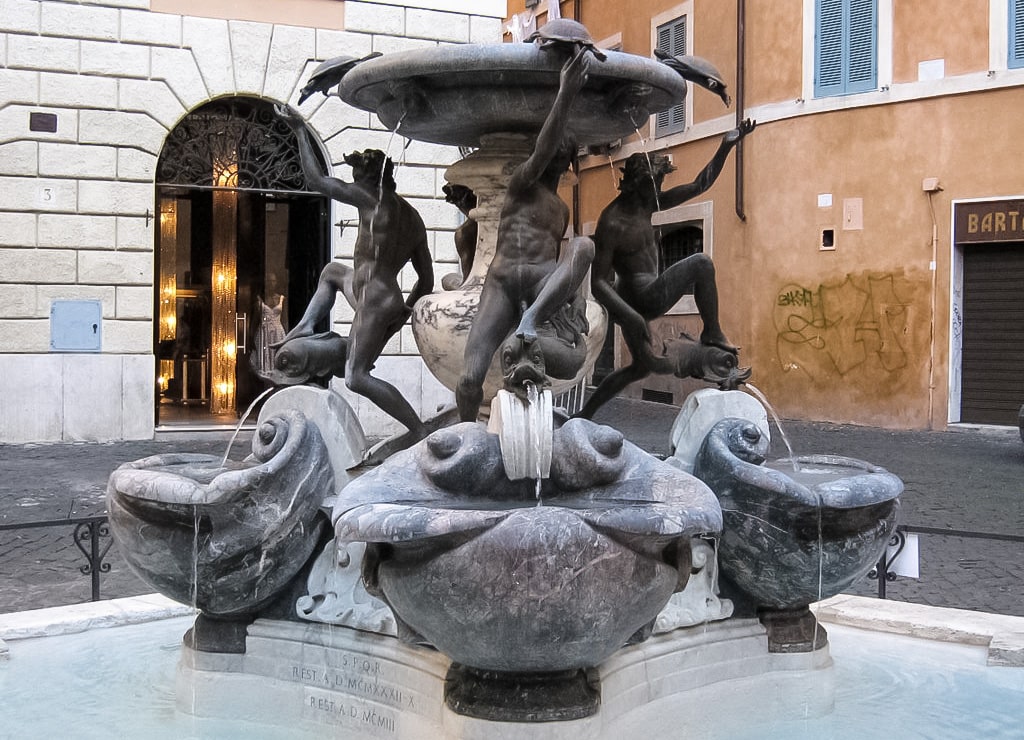
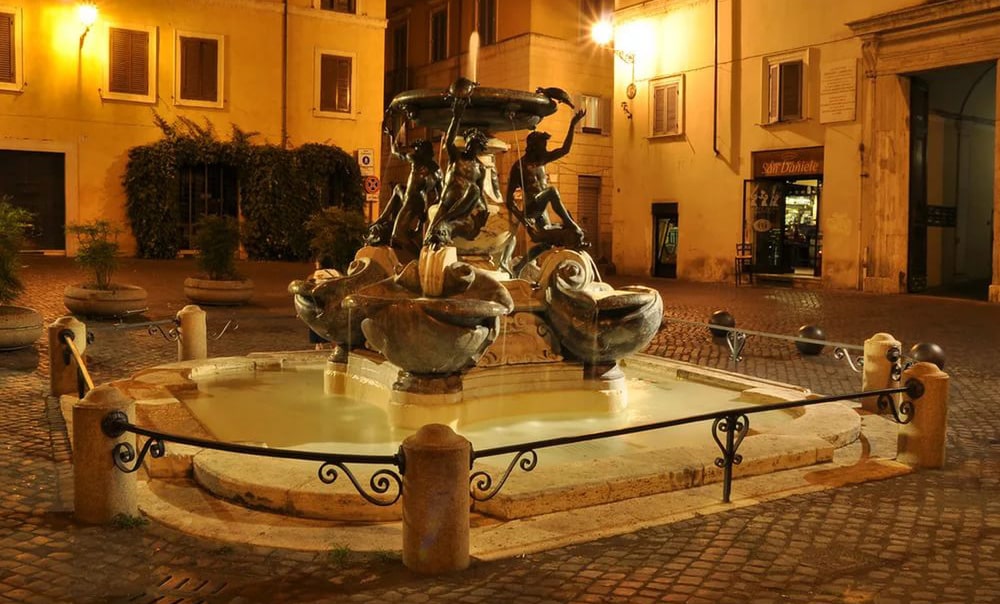
The Fontane delle Tartarughe (Turtle Fountain), a late Renaissance fountain located in the center of Rome in Piazza Mattei, is considered one of the most beautiful fountains in the city. The area was a Roman Jewish ghetto until 1870, and the fountain is located almost on the edge of the gates that separated the area from the rest of the city.
There is a legend connected with the appearance of the fountain. According to this legend, Prince Mattei once decided to marry a noble Roman woman. The prince was a great gambler and lost big at cards, which made his future father-in-law doubt the financial solvency of the prince. To prove the contrary, Mattei ordered overnight to build an exquisite fountain in the square in front of his palace, spending almost all the remaining money. The splendor of the fountain so impressed the bride’s father that he immediately agreed to marry his daughter to the prince. Mattei then walled up the palace window overlooking the square so as not to remind himself of the unpleasant incident. One of the palace windows is indeed bricked up, but the problem is that the palace was built several decades later than the fountain.
In 1570, the restoration of the ancient aqueduct dell’Aqua Virgo, built in 19 B.C., was completed and work began on its underground branches leading to the Champ de Mars (Campo Marzio), the most densely populated areas of Rome, to provide drinking water for the citizens.
Eighteen fountains were to be built as end points, of which the fountain of the turtles was not included. However, an Italian nobleman, Mucius Mattei, a member of the congress that decided on the water supply, insisted on providing the ghetto with a new fountain and pledged to contribute financially.
The Turtle Fountain was the only fountain of the period built under the patronage not of Pope Gregory XIII, but of the private Mattei family, wealthy merchants and patrons of the arts who owned an entire city block and the keys to the ghetto, partly located on their land. The design was entrusted to the architect Giacomo della Porto in 1580. He did not bother and repeated the already existing design of similar fountains with a ball on a pedestal, the water from which went to the top and flowed from there into a bowl.
However, the fountain, unlike others like it, was given a splendid design by the young, then unknown, sculptor Taddeo Landini, who completed the work by 1588. For the first time, the Roman fountain was decorated with the figures of four naked young men-ephebes, made in the style of Mannerism, and eight dolphins. The figures were cast in bronze, which was more expensive than the usual marble ones.
At the base of the fountain is a square bowl with a ball of African marble in the center. The ball is surrounded by four marble shells and topped by a bowl with four heads of cherubs, from whose mouths water flows into the pool. Above the basins, bronze young men rest their feet on the heads of bronze dolphins, holding their tails with their hands. Their free hands are raised to the upper bowl. Water from the dolphins’ mouths flows into the basins and from there into the lower bowl. In the 17th century, the fountain was mistaken for the work of Raphael or Michelangelo because of its perfect forms.

Originally there were no turtles on the fountain, and in the bowl there were four more dolphins, to which the hands of young men were raised.
However, the pressure of water coming from the aqueduct by gravity was not enough for the full work of all the figures, and after a while the dolphins from the upper bowl moved to the fountain Terrina, and then – to the church of Santa Maria in Valicella.
After that, the composition of the fountain began to seem unfinished – the young men were stretching their hands into the void. And so, in 1658, by order of Pope Alexander VII, who made a great contribution to the architectural appearance of Rome, four bronze turtles were added to the fountain.
The work on them is attributed to Lorenzo Bernini, but there is no documentary evidence of this. After that, the fountain, formerly called the Mattei Fountain, received its modern name, the Fountain of the Turtles.
To commemorate the restoration, a scroll with the inscription ALEXANDER VII can be seen between the shells at its base.

Even later, the fountain became purely decorative, and for domestic purposes, an ancient sarcophagus was installed nearby as a reservoir for the new drinking fountain. In the 19th century, in the era of total puritanism, the young ephebes acquired bronze leaves, three of which were removed only during the next restoration.

The bronze turtles have been stolen many times. In 1944, all four were stolen. They were nevertheless found and returned to their original location. In 1979, after another theft of one turtle, the remaining originals were placed in the Capitol Museums, and on the fountain installed their exact copies.
In the late 20th century, the fountain was equipped with a calcium water purification system, but it didn’t help much. In 2005 – 2006 the fountain was thoroughly cleaned, but the bronze sculptures were again covered with a white patina.
In the early 20th century, an exact replica of the Turtle Fountain was made in Rome and purchased by the couple William and Ethel Crocker for their villa. In 1954, it was donated to the city of San Francisco and installed in Huntington Park.
You can reach the fountain by descending from the Capitol to the Marcellus Theater and walking to the right along the narrow pedestrian street.
[ad_2]
Source link

