[ad_1]
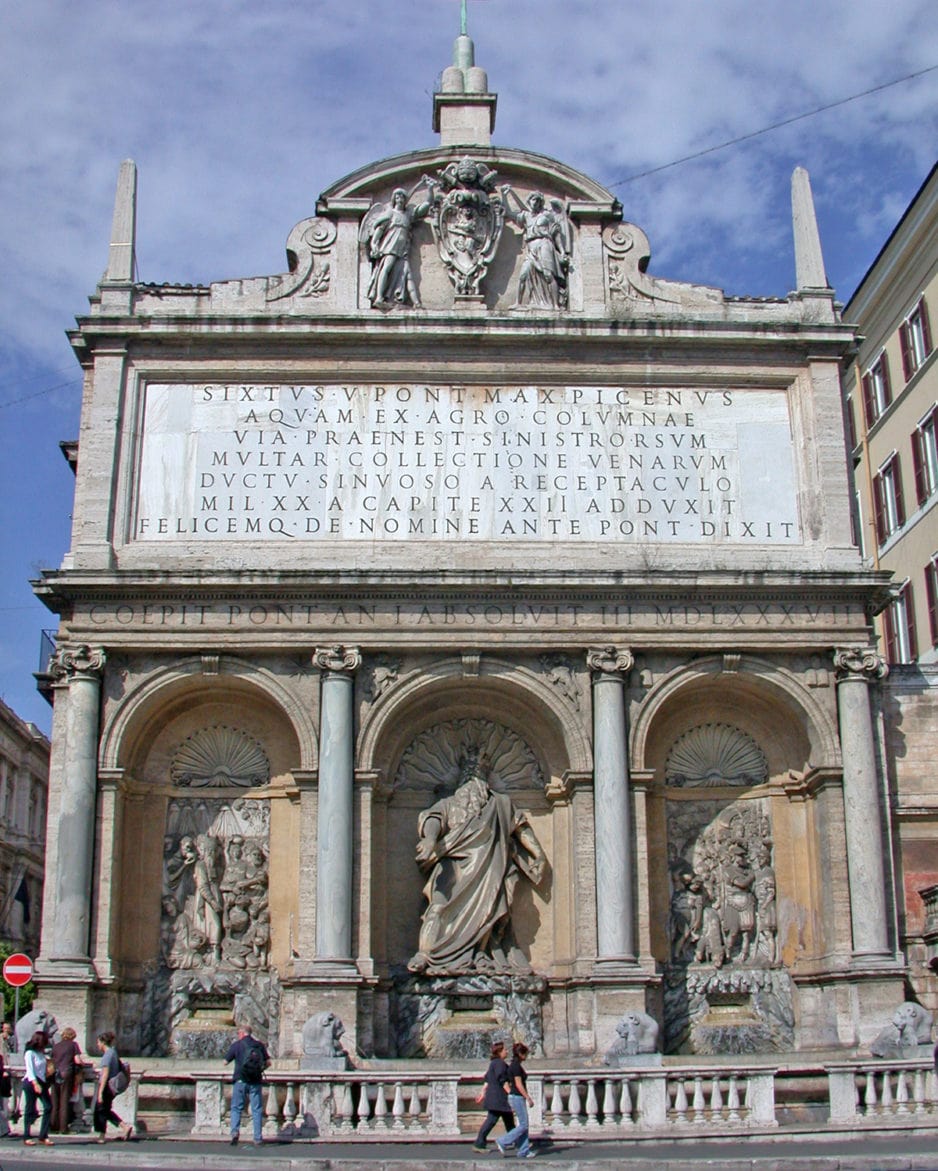
The Moses Fountain is actually called the Acqua Felice Fountain. It is located in Piazza San Bernardo and resembles a decorative triumphal arch with a large statue of Moses in the center.

In 1585, when Pope Sixtus V (Felice Peretti) came to power, only one of the ancient aqueducts that supplied the city with water, the Aqua Vergini Aqueduct, was still in operation. The citizens of Rome had to go to the only fountain fed by this aqueduct, located near the present Trevi Fountain, for clean drinking water.
Sixtus V took it upon himself to restore a number of old aqueducts. A month after his election, he bought the plot of land on which the Aquae Alessandrina aqueduct, built in 226, was located for 25,000 scudi. Initially the work of restoring the aqueduct was entrusted to the architect Matteo Bartolani, but due to his miscalculations the angle of inclination was insufficient to allow the water to rise to the Quirinal Hill.
Having lost the money invested, the pope delegated the work to Giovanni Fontana, who completed the construction in 1587. The aqueduct cost the pope an additional 300,000 scudi. The pope’s sister, Camilla Peretti, gave him a bottle of the first water to be delivered by the new aqueduct. Analysis showed that this water was the best drinking water in Rome.
The water was taken to the Villa Montalto (the pope’s residence), where a fountain was built, and a little later to the top of the Quirinal. Here from the aqueduct began to feed the fountain of Dioscuri (at that time – the fountain of Monte Cavallo) and the fountain of Santa Susanna in Piazza San Bernardo.
Where the aqueduct ended, the architect Domenico Fontana, Giovanni’s brother, built the first monumental fountain since antiquity in the form of a majestic three-span triumphal arch in white marble, inaugurated on June 15, 1587. Most of the material for the construction of the fountain was taken from the Thermae of Diocletian. Both the aqueduct and the new fountain were renamed by the pope in his honor, receiving the name Aqua Felice. A little later, the fountain would acquire another name, the Moses Fountain.

The façade of the fountain contains three vertical zones. In the lower zone there are four Ionic columns, between which there are three niches with sculptures installed in them. Two of the columns are carved from marble and the other two from breccia. In the central niche is a large statue of Moses, created in 1588 by sculptors Leonardo Sormani and Prospero da Brescia. The model was Michelangelo’s sculpture in the church of San Pietro in Vincoli.
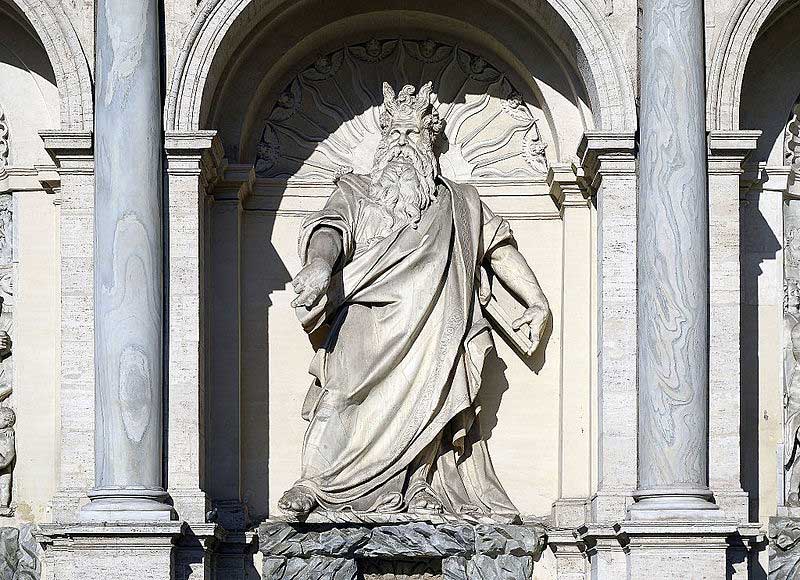
The statue of Moses has been much criticized both for its size, which is much larger than that of other figures, and for the broken proportions of the prophet. Perhaps these faults were due to the rush in the construction of the fountain.
In the side niches there are bas-reliefs depicting Old Testament subjects connected with water. In the left is Aaron leading the Jews to an oasis in the desert, by Giovanni Battista della Porta, and in the right is Joshua choosing soldiers by how they drink water, by Flaminio Vacca and Pietro Paolo Olivierti.
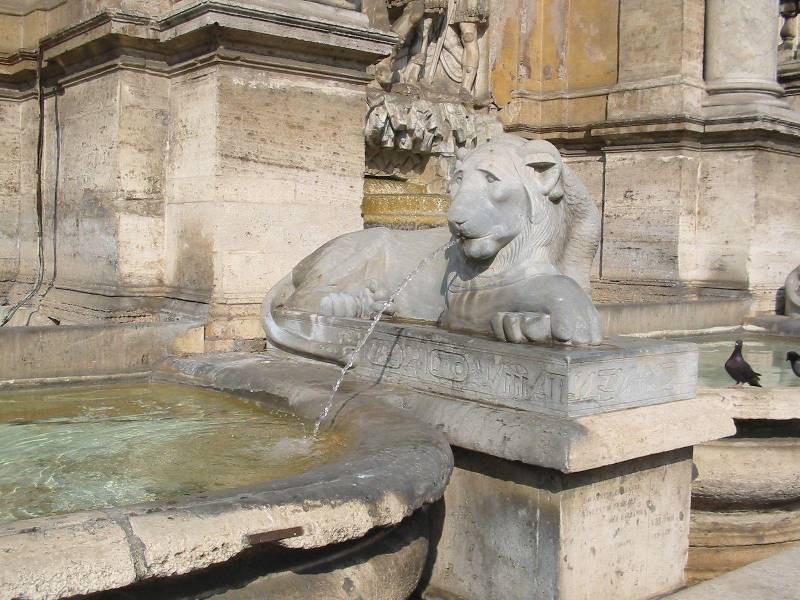
Water pours into six reservoirs – three at the foot of the statue and bas-reliefs, which imitates a spring that miraculously gushed from Mount Horeb, and the other three from the mouths of four Egyptian lions resting on small pedestals.
Two marble and two porphyry lions with the inscription “Nectaneb I” (Egyptian pharaoh 380 – 362 B.C.) were found on the site of the Temple of Isis near the Pantheon. Under Pope Gregory XVI (1831-1846), the original lions were moved to the Vatican Museums and replaced by copies by Adamo Tadolini.
The entablature above the niches bears the inscription COEPIT PONT AN I ABSOLVIT III MDLXXXVII (Begun in the first and completed in the third year of the pontificate 1587).

The middle zone of the façade is a flat panel fully occupied by a large inscription:
SISTVS V PONT MAX PICENVS
AQVAM EX AGRO COLVMNAE
VIA PRAENST SINISTRORSVM
MVLTAR COLLECTIONE VENARVM
DVCTV SINVOSO A RECEPTACVLO
MIL XX A CAPITE XXI ADDVXIT
FELICEMQ DE NOMINE ANTE PONT DIXIT

(Sixtus V the great pontiff from Piceno having collected many streams brought water by a winding canal from the former land of the Colonna to the left of the Prenestine road, 20 miles from the reservoir, 22 miles from its source, and called it Felice after his name before assuming the ministry).
The third, upper, area contains a pediment with sculptures of two angels holding the heraldic shield of Sixtus V, by Flaminio Vacchi and Pietro Paolo Olivierti. The sides are flanked by two obelisks.

The arrival of the new fountain revitalized the Quirinal district, which began to transform from a quiet rural suburb into a thriving urban area. And for four centuries, the Moses Fountain has been filled with clean drinking water.
[ad_2]
Source link

