Nationally, construction starts across almost all commercial real estate sectors were down from years prior, numerous reports show. Locally, several high-profile projects that had planned to break ground last year did not, including, in the city of Milwaukee, Bear Development’s soccer stadium complex in Westown, multiple apartment projects planned by New Land Enterprises and Neutral’s downtown high-rise apartment tower The Edison.
Now, with capital markets thawing, interest rates coming down and construction costs stabilizing, some industry leaders are reporting a greater sense of optimism that could mean more projects breaking ground in the year to come.
However, as population growth remains stagnant in metro Milwaukee and with public policy to support housing development not yet implemented, others aren’t convinced Milwaukee’s skyline will see new cranes added soon.
Based on their involvement in the front end of any given project, several local architects said multifamily projects that had been delayed were moving through the design process again. Assuming a multifamily project doesn’t encounter financing or municipal delays, it usually takes about a year to move through the design process, according to architects.
That has not been the case recently for a lot of local projects, many of which saw their timelines extended by a year or more as a result of unfriendly development conditions including high interest rates, higher construction costs and limited access to capital. Often, conceptual plans were drawn in order to pursue municipal approvals but did not advance to detailed construction documents due to budgetary issues.
“You’ll get the budgets back, and, of course, the project is over budget,” said Joe Galbraith, partner at Wauwatosa-based design firm Galbraith Carnahan Architects. “So that sometimes requires maybe changes to the design or maybe looking at more financing options or just a pause on the plans altogether, all of which delays an actual construction start.”
Recently, however, projects that were stuck at the concept plan stage have been moving toward construction documents.
“We were doing a good amount of concept plans for multifamily-type projects last year and several of those seem to be moving forward to detailed plans,” Galbraith said. “So that means the conditions are right to do this project and things are moving toward a groundbreaking.”
Following a year of delayed starts, some of the firm’s clients are looking toward a late 2025 or early 2026 groundbreaking, Galbraith said.
That’s the case for The Edison at 1005 N. Edison St. in downtown Milwaukee. Originally proposed in 2021, Madison-based developer Neutral closed on its $133 million construction financing package in early January and – after a couple of false starts – is planning a second-quarter groundbreaking.
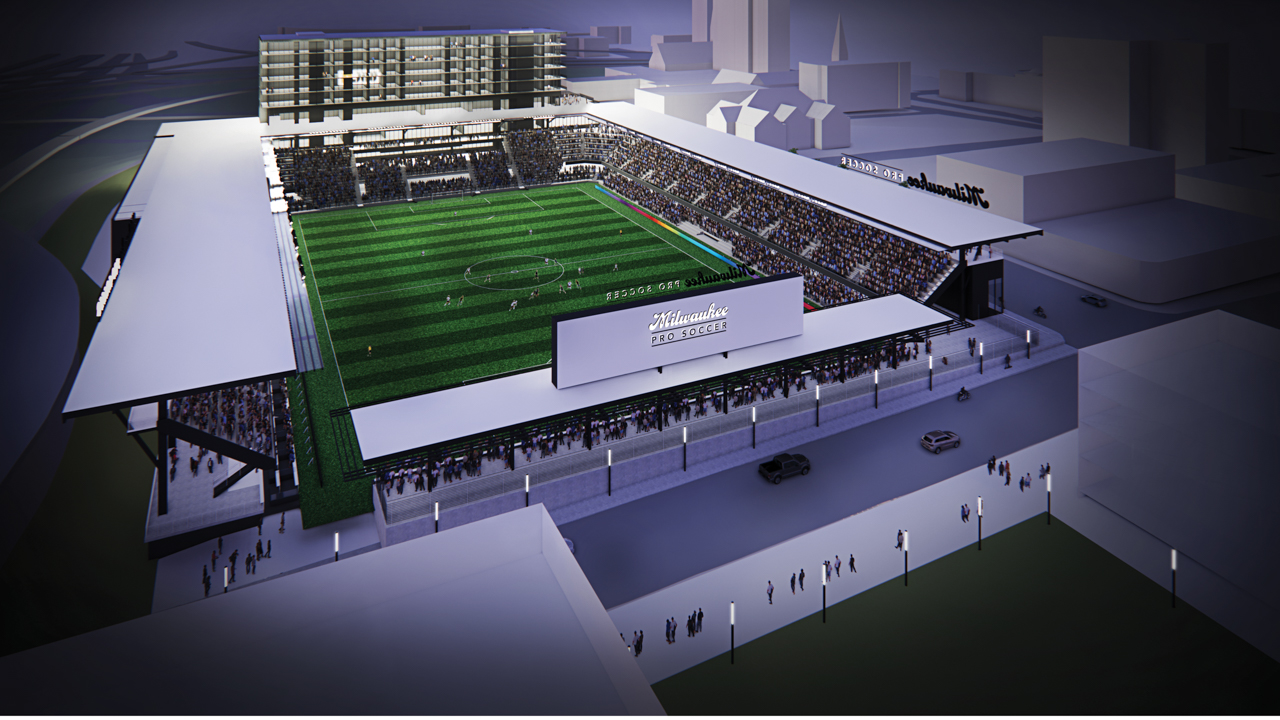
Further, Kenosha-based Bear Development CEO S.R. Mills said his firm is anticipating a 2025 construction start for its 8,000-seat soccer stadium as part of the 11-acre mixed-use Iron District, which will also include a connected hotel and events venue. First proposed in 2022, the stadium’s construction start was also delayed from previous years. Meanwhile, a 99-unit affordable housing building was completed last year at the site, located northeast of the Marquette Interchange.
“The capital markets are still a little squirrely and interest rates are higher than what they’ve been, but we’re starting to see some of that normalized, so we’re cautiously optimistic that things will get moving again this year,” Mills said.
While some projects still were able to get off the ground last year, Matt Rinka, founder and partner at Milwaukee-based RINKA, said architecture firms industrywide are seeing projects begin to make progress again after pauses last year.
“These days it really can’t just be a developer’s issue; it needs to be the architects understanding how the work that we do can really help a project either be financeable or not,” Rinka said. “Sometimes that means finding creative ways to adjust the scale of the project, other times it means finding ways to create more unique experiences or an otherwise better product.”
A 2022 rendering of the 8,000-seat soccer stadium planned to anchor Bear Development’s Iron District in downtown Milwaukee.
Others say 2025 might not be different than 2024
Milwaukee-based New Land Enterprises has multiple apartment projects planned on the East Side and in Walker’s Point that the firm at one point had contemplated breaking ground on in 2024, none of which did. There are no construction starts planned this year either in the city of Milwaukee, according to New Land managing director Tim Gokhman.
Gokhman has been warning that the “current development environment” is actually “a new normal.”
“As we see it, this is a relatively permanent shift with higher construction costs, higher interest rates, and I think our thesis has been proven right, because a lot of people said, ‘Well, let’s just make it through 2024 and interest rates will go down,’” Gokhman said. “Sure enough, we’re in a worse real estate development environment in many respects.”
Although the federal funds rate has been cut a few times in recent months, very few real estate developers borrow money at that rate, or something tied to it. Most construction loans are tied to the Secured Overnight Financing Rate and most long-term financing for real estate is tied to the treasury rate, neither of which have decreased.
In a low-growth market like Milwaukee, in order to make projects pencil out, rents in the completed product would need to be at the luxury price point, which has limited demand. As a result, Gokhman says that leaves many projects stuck until new public policy to support workforce housing projects is enacted.
Rinka said his firm is working on thousands of workforce housing units nationally, but “Wisconsin just hasn’t figured it out yet.”
City of Milwaukee officials are currently working to implement a tax incremental financing policy that would support workforce housing projects, which is generally defined as housing with rents affordable for those making between 60% and 120% of the area median income. A city spokesperson said the Department of City Development is planning to roll out the policy in 2025, but did not provide additional details.
Elizabeth Morin is a writer based in Virginia Beach. She is passionate about local sports, politics and everything in between.
Have any Virginia Beach-related news published on our website? Email us at admin at thevirginiabeachobserver.com.