Janesville-based SHINE Technologies announced today a conditional commitment from the U.S. Department of Energy (DOE) to provide a $263 million loan to support the completion of its Chrysalis facility, which is slated to become the largest isotope production facility in the world.
Once approved, the loan, allotted by the DOE’s Office of Energy Dominance Financing, will support the completion of its Chrysalis facility and later, the first domestic commercial supply of medical isotope molybdenum-99 (Mo-99) to be made at Chrysalis, according to a press release.
The project is currently 75%-80% complete, said Greg Piefer, founder and CEO of SHINE, at a Thursday morning press conference. The loan will primarily be used for equipment installation, as most of the equipment is already onsite in Janesville.
SHINE is still one-and-a-half to two years out from manufacturing its first radio isotopes at Chrysalis, and three to four years out from manufacturing at full capacity.
Mo-99, a medical isotope created using nuclear fusion, is used in over 40,000 procedures daily to diagnose heart disease, cancer and other serious medical conditions. SHINE’s reshoring of Mo-99 production from Europe, South Africa and Australia is part of an effort to address national security vulnerability and bring advanced nuclear technologies stateside, the release said.
Chrysalis is part of SHINE’s Janesville headquarters campus, located at 3400 Innovation Ct. Its construction will create roughly 200 temporary jobs and 150 permanent jobs.
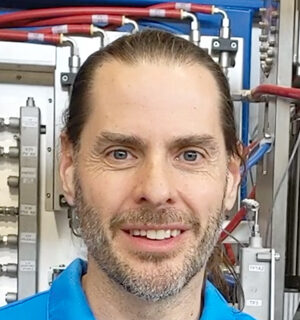
Greg Piefer
“Chrysalis proves that fusion doesn’t need to wait for future breakthroughs to create value for millions of people today,” said Piefer. “This conditional commitment is a critical catalyst that accelerates our scale-up of the world’s largest medical isotope facility and ensures a secure, domestic source of critical medical isotopes. We are incredibly grateful to the Department of Energy’s rigorous due diligence process and look forward to working to meet the conditions to move forward on the loan.”
Once operational, Chrysalis will have capacity to produce up to 20 million doses of medicine per year, and up to 1 billion in the facility’s lifetime. The facility will complement the existing supply chain ensuring a sustainable and reliable source of isotopes, including Mo-99 and lutetium-177 (Lu-177), the most widely-used cancer fighting isotope.
In February this year, SHINE announced it had closed a $240 million equity funding round, aimed at advancing its fusion technology across new products and services and developing new technology to recycle used nuclear fuel.
The $240 million is a portion of its more than $1 billion raised in funding to help commercialize fusion energy.
In 2024, SHINE opened one of the largest facilities in the western hemisphere dedicated to producing Lu-177. The facility has a production capacity of up to 100,000 doses of Lu-177 per year, with the ability to further expand to 200,000 doses per year.