Badger Ham
3521 W. Lincoln Ave., Milwaukee
INDUSTRY: Food manufacturing
EMPLOYEES: 26 badgerhams.com
For 87 years, Milwaukee-based Badger Ham has made one product: ham. Though the protein comes in different flavors, cures, shapes and sizes, Badger Ham has maintained its single-meat portfolio, capitalizing on its 10 proprietary recipes which contribute to its nearly 200-SKU catalog.
That legacy may soon change, however.
The company, now in its fourth generation of family leadership, is eyeing growth with expansion planned for both its local footprint and product portfolio. For the first time in company history, Badger Ham is planning to add another Milwaukee area facility, to be completed by 2029. The facility will bolster more manufacturing capacity and streamline operations, which could allow the company to add more proteins to its catalog, said Quinn Schwellinger, vice president of Badger Ham.
While a site for the new facility has not yet been selected, architectural design is underway to improve processing and avoid double handling, something Badger Ham has improved upon in the past five years at its Milwaukee location on West Lincoln Avenue.
Quinn and his father, Brian Schwellinger, took over for Brian’s brother, Mark Schwellinger, in 2020 shortly before the COVID-19 pandemic began. Prior to Mark’s leadership, the company was owned and operated by Jerry Schewllinger, father of Brian and Mark, and before that Jacob Schwellinger, father of Jerry and founder of the business.
In the early 1900s, Jacob immigrated to the United States from Canada and worked at Patrick Cudahy as a meat cutter and later in management before venturing off to start Badger Boiled Ham Co. Inc.
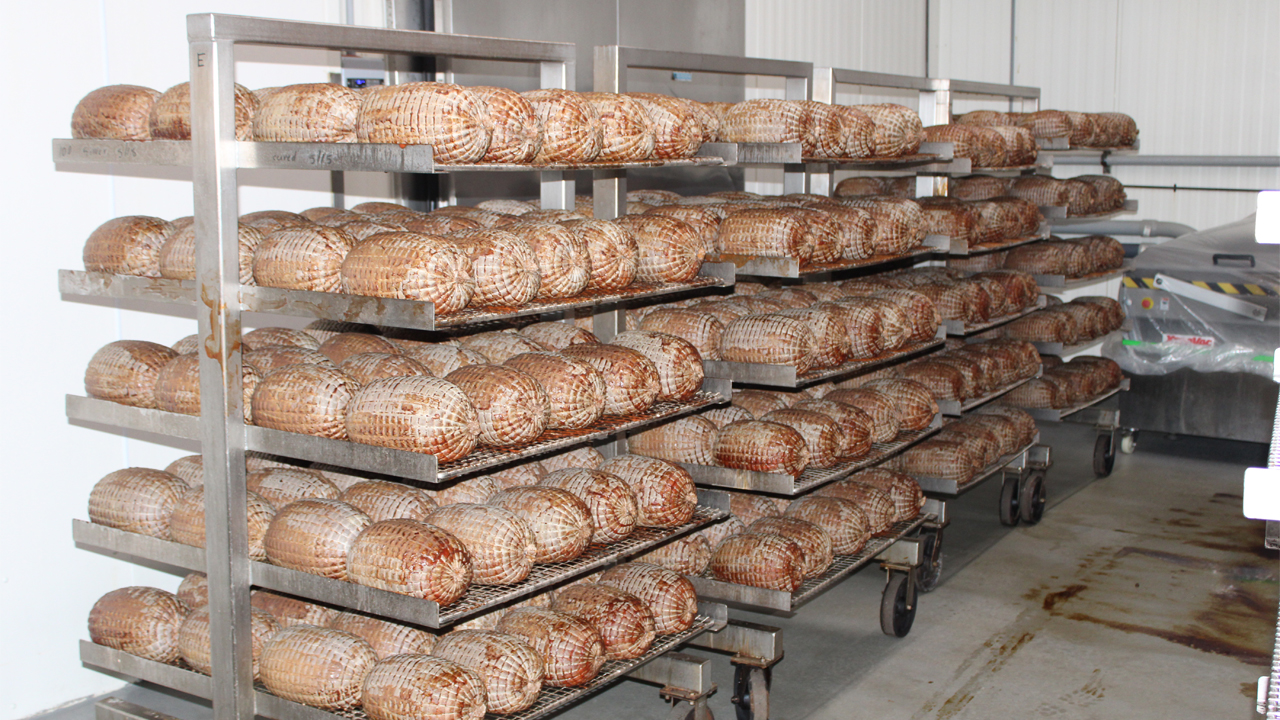
Credit: Sonia Spitz Badger Ham produces 4 million pounds of ham per year at its Milwaukee plant.
Jacob later handed the company off to his son Jerry, who together with his son Mark operated the business for 44 years. The duo secured two of Badger Ham’s game-changing clients – Cousins Subs and Roundy’s – which helped give the business notoriety in the Milwaukee market and beyond.
“That helped the business grow and succeed up until today really,” Quinn said.
In the past five years, Quinn and Brian have made major investments into Badger Ham’s facility, including the purchase of a $650,000 slicer, which cost nearly $1 million to install due to its size and required infrastructure removal, a $250,000 robotic palletizer, new cooling systems, an X-ray machine for final checks and software for training, inventory management and food safety programming. With its upgrades, the plant now produces about 12,000 pounds of ham each day, and roughly 4 million pounds of ham each year.
The company also hired a new vice president of operations, Ben Schroeter, in August 2025. Schroeter’s background in engineering and his previous work with several Fortune 500 companies helped Badger Ham input software for preventative maintenance.
“He is the perfect person to join us on this journey of keeping Badger Ham going for the next 80 years,” Quinn said.
Plans to include Schroeter in the company’s next phase of growth and ownership are in the works.
Brian is in the midst of transitioning out of the business. In his transition, Quinn is solidifying plans for what success will look like for the future of Badger Ham.
“I didn’t realize how rare of a bird we are,” Quinn said. “There aren’t many of us left. (We are) a midsize, independently-owned meat processor using quality ingredients, treating our employees right, and we aren’t interested in hedge funds or private equities. We’re just doing our thing, and that’s really rare.”
Quinn is committed to continuing the production of the company’s namesake products and carrying on the legacy of Badger Ham set before him. While the new facility will have capacity to expand its product line beyond ham, he first envisions doubling down on ham-making at the highest quality and quantity possible. New proteins are on the books for growth but will require an “iterative process” before making it to production, Quinn said.
Elizabeth Morin is a writer based in Virginia Beach. She is passionate about local sports, politics and everything in between.
Have any Virginia Beach-related news published on our website? Email us at admin at thevirginiabeachobserver.com.