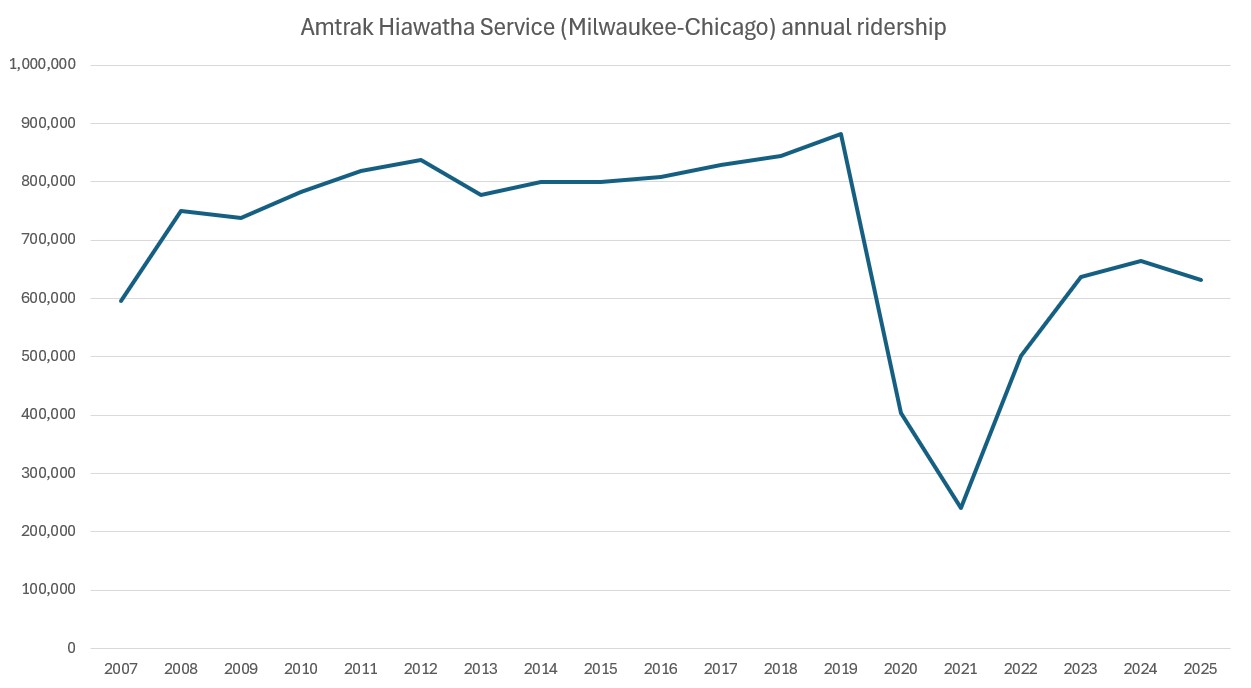
Amtrak’s Hiawatha line, which runs from Milwaukee Intermodal Station to Union Station in Chicago, saw a $6.7 million increase in revenue from last fiscal year, even though ridership was down 30,000 passengers from a year ago.
For the Hiawatha line, Amtrak reported $28 million in revenue for fiscal year 2025, up from $21.3 million last year. Ridership landed at 632,000 passengers, down from over 665,000 last year. Amtrak’s fiscal year ends on Sept. 30.
The Hiawatha’s revenue increase is the result of more riders paying top ticket rates amidst an ongoing train car shortage, according to Marc Magliari, a spokesman for Amtrak.
“You take 60 cars out of our network, it’s going to have an effect in all sorts of places, especially here in the Midwest where those cars were primarily used,” Magliari said.
Many of the 60 inoperable cars are facing damage from salt and corrosion, some of which are beyond repair.
To compensate for the loss in capacity, Amtrak deployed dynamic pricing across its Midwest routes, a tactic the company has used for years, Magliari said. Less seats sold, but at higher prices helped Amtrak close the gap from a decrease in capacity.
Amtrak also began using several state-issued train cars, which brought its Hiawatha line operating costs down nearly $10 million from last year.
Though Amtrak still spends more to operate the Hiawatha train than it earns from tickets sales, its deficit was only $200,000 this fiscal year, compared to $9.7 million last year.
“A combination of cost control, continued deployment of state-owned cars and some higher fares for the last few seats are making a difference,” Magliari said.
Amtrak is also offering ticket packages to increase ridership. Ten-ride tickets are good for 90 days and are sold at $230 for Hiawatha trains. Monthly tickets, which are unique to the Hiawatha lines, are sold at $650.
Capacity has become an overarching issue among other Amtrak lines as well.
Amtrak’s Borealis line, which started service in May 2024 and runs between Chicago and the Twin Cities through Wisconsin, was also affected by insufficient capacity.
Though Borealis performed well in its first year of service, “the train itself is just undersized,” Magliari said.
Borealis pulls from Amtrak’s national pool of trains, which is not as deep as it would like.
Borealis reported an $11.6 million increase in revenue and nearly 125,000 more passengers than last year in ridership. In July, Amtrak reported that the Borealis train carried its 250,000th rider over the 4th of July weekend.
To combat the capacity issue, Amtrak will displace some cars from the northwest and northeast regions of the country, but not until 2026, which is “several sunsets from where (Amtrak) is now,” Magliari said. For the time being, it will continue using state-owned cars in addition to its own fleet.