Live music is woven deeply into the fabric of Milwaukee’s culture.
We’re the birthplace of icons like Violent Femmes, Steve Miller, The BoDeans and Al Jarreau, and every summer since 1968 “The World’s Largest Music Festival” has brought some of the industry’s biggest acts to perform on the shores of Lake Michigan in front of thousands.
As Milwaukee’s live music scene has grown through the decades, it’s given rise to an ecosystem of entertainment venues where music of all genres is performed and enjoyed year-round. And much like Milwaukee’s restaurant scene – largely run by independent operators – most of the city’s music venues maintain local, independent ownership.
From 2,000-capacity theaters to intimate clubs and bar-based stages, there are at least 20 independent venues in and around the city with active booking calendars. The Pabst Theater Group alone – as Milwaukee’s largest independent promoter and venue operator – puts on more than 800 events annually across its six locations. Milwaukee has also tapped into the booming stadium and arena tour sector in recent years with big names selling out American Family Field and Fiserv Forum.
Still, a long-running narrative among many local concertgoers is that Milwaukee is often overlooked and skipped by some touring artists, leaving fans forced to travel to other Midwestern cities to see their favorites.
Why does Milwaukee lose out on those acts? There are a variety of potential explanations including our proximity to other cities, artist preferences, the mix of venues in the city, and industry dynamics.
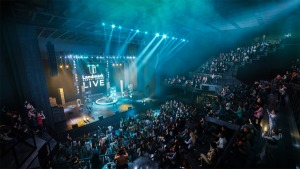
Finishing touches were being put on the exterior of Landmark Credit Union Live in mid-January, about a month ahead of its opening. Photo credit: Maredithe Meyer/BizTimesNow, a newly built 4,500-capacity live music venue, backed by the world’s largest concert promoter, could soon help fill a need in the Milwaukee market for a midsized, standing-room venue with modern amenities – but some are concerned about the impact it will have on the local live music marketplace.
Landmark Credit Union Live will open in late February in downtown Milwaukee’s Deer District, booking a wide range of artists, including some who may have overlooked Milwaukee in the past. In its opening year, the venue anticipates hosting more than 70 events, drawing an estimated 250,000 people downtown.
The venue’s developer is Madison-based concert promoter FPC Live, an affiliate of Beverly Hills, California-based entertainment behemoth Live Nation, a $34 billion company that owns, operates or has exclusive booking rights for nearly 400 venues – and growing – around the world.
FPC Live, which owns four venues in Madison and four more in Missouri and South Carolina, has marketed its newest spot as key to making Milwaukee a “must-play stop” for artists and has promised a positive impact on the city’s economy and on the live music scene, including other concert halls.
“This venue is additive to the market,” said Joel Plant, CEO of FPC Live parent company Frank Productions, in an October interview with BizTimes. “It will necessarily attract artists who are not coming here now. It’ll provide much more of a vertical for artists to play in the market, which will make all the other rooms in the market more interesting and viable to artists.”
But since it was first proposed in 2021, the project has sparked opposition and stoked fears of Live Nation’s tremendous – and allegedly monopolistic – influence over much of the increasingly competitive entertainment industry, and many independent venue operators view the corporation’s growing presence in the local market as an existential threat. Some argue that Live Nation’s backing gives Landmark Credit Union Live a huge advantage in booking acts and that the new venue won’t bring in new shows as much as it will divert bookings away from existing venues, cannibalizing the market.
If the detractors are right and competing venues are ultimately forced to close, it would be a hit to the communities that benefit from the foot traffic and business activity generated by those entertainment venues. Consumers would also lose pricing power with fewer choices.
If FPC Live is right and its new venue really does “grow the pie” for the Milwaukee live music scene, as promised, local fans won’t have to travel as far to see more of their favorite acts.
So, will Landmark Credit Union Live actually be additive to the market or will it cost existing venues shows they count on? Only time will tell.
What remains constant in either scenario is a business environment that since the pandemic has only grown more competitive and challenging for independent venues here and across the country.
Setting the stage
By the time FPC Live broke ground on its new venue in May 2024, the project had gone through a couple iterations and a location change. Originally, the company wanted to build a two-venue facility (with an 800-cap room and 4,000-cap room) in Milwaukee’s Historic Third Ward, on a surface lot just west of the Summerfest grounds. But many Third Ward residents and business owners expressed opposition to the project and showed up at public input sessions to voice concern over neighborhood issues like safety, noise, parking, traffic and property values.
Then in May 2022, FPC Live dropped its plans for the Third Ward and instead struck a deal with the Milwaukee Bucks to put the project on a portion of the former Bradley Center site in Deer District. Operators of several local venues, including Pabst Theater Group, Cactus Club, The Rave/Eagles Club and Shank Hall, joined forces as “Save MKE’s Music Scene” to campaign against the project, voicing their objections during city meetings. City officials’ stance remained that issues of competition and antitrust were not for them to sort out and ultimately the Common Council greenlit the project in November 2022.
Ten months later, FPC Live changed course again – scaling the project back from a two-venue facility to a single 4,500-capacity venue – as a result of increased construction costs and higher interest rates.
The naming rights deal with Brookfield-based Landmark Credit Union was announced in October at a media preview event for the venue, then in its final stages of a year-and-a-half-long construction effort, previously estimated at $70 million.
Of the 11 shows announced so far for the new venue – ranging in genre from power metal to hip-hop – two feature acts who have not yet performed as headliners in Milwaukee: Mariah the Scientist, an up-and-coming R&B singer and songwriter from Atlanta, and Bob Moses, an EDM duo.
The missing piece
The venue builds on its operator’s existing presence in the Milwaukee market. Frank Productions, which started in Madison as a family-run ticketing and event promotion outfit in the 1960s and grew into one of the top independently owned concert promoters in the country, has been producing shows at venues in Milwaukee for decades, according to Plant, who’s led the company since 2017.
FPC Live launched in 2018 from a merger between Frank Productions Concerts and another Madison brand, Majestic Live. That was also the year Frank Productions sold a majority interest to its rival, Beverly Hills-based Live Nation Entertainment, which had its own history of promoting shows in the region, including as the longtime operator of Alpine Valley Music Theatre in East Troy.
Since the Live Nation deal, Frank Productions and FPC Live have gradually gained a stronger foothold in the Milwaukee market.
A 2019 agreement with Summerfest operator Milwaukee World Festival Inc. has helped boost concert activity at the American Family Insurance Amphitheater and BMO Pavilion on non-Summerfest dates, with the annual average number of concerts jumping from five to 17. The amphitheater also underwent a massive $51 million renovation, completed in 2021.
“We’re really excited about how that’s extended our season and really brought more people to the lakefront to enjoy live music,” said Sarah Pancheri, president and CEO of Milwaukee World Festival. “It was a wonderful confluence between having the new venue as well as the preferred promoter relationship in place.”
Additional FPC Live deals with the Bucks and Brewers have attracted big-name headliners to Milwaukee, helping put both Fiserv Forum and American Family Field on Pollstar’s national lists of the top-grossing arenas and stadiums for concerts.
FPC Live promotes “hundreds” of shows in Milwaukee, currently at about a dozen venues across the city, including those operated by Pabst Theater Group as well as the Bradley Symphony Center, and that won’t change once Landmark Credit Union Live opens, said Plant.
“What we’re providing, whether it’s at Landmark Credit Union Live or a third-party venue that we don’t own or operate, is optionality,” he said. “Our role as a promoter is to help an artist grow their career in the Milwaukee market and in order to do that well, we have to have options for the artist as their career grows and expands. Landmark Credit Union Live gives us what is currently a missing piece in the market.”
With a ballroom-style layout that includes general admission standing room, reserved seating and premium suites, the space was designed to be scalable for artists at varying levels.
“The highest capacity is 4,500, but every show we book will be different and unique,” said Plant. “Some artists will choose a lower capacity to create a more intimate experience or to accommodate specific production needs for their show.”
The venue was also built to host private events. Among the first will be Milwaukee Brewers star Christian Yelich’s fourth-annual Home Plate Charity Concert, set for May 21, with country singer Jake Owen as the headliner.
Yelich and his team approached FPC Live last year. The fundraiser, which supports various Milwaukee-area charitable organizations, had been held at The Pabst Theater the past two years but had ultimately outgrown the 1,339-seat venue, said Yelich.
“As the event has continued to grow, we felt it was the right time to take the next step,” he told BizTimes via email. “Not to move away from what made it special, but to build on it. Landmark Credit Union Live gives us the opportunity to welcome more people, raise more funds, and most importantly, shine a brighter spotlight on the nonprofit organizations doing impactful work across Milwaukee.”
He noted the appeal of a brand-new venue was a selling point in booking performers for the event, as it likely will be also for the 4,000 people expected to attend.
“Can’t compete with a monopoly”
Landmark Credit Union Live is one of 18 new venues Live Nation is opening across the country as part of a $1 billion investment targeting the midsized touring sector, mostly in small-to-midsized metro areas such as Portland, Maine; Birmingham, Alabama; Raleigh, North Carolina and Nashville. L.A.-based AEG, another major player in the live entertainment space, is also driving the trend with a handful of similar projects in the works.
Live Nation says its recent wave of investment in the country’s venue infrastructure will generate $1.4 billion in annual economic impact for local communities nationwide once these new venues open. On its face, that kind of windfall would presumably be music to the ears of city leaders seeking to drive economic growth, even more so in Milwaukee’s case: FPC Live’s project was privately funded with no need for a subsidy, and it came with community benefits agreements.
Landmark Credit Union Live’s 200 employees will be represented by the Milwaukee Area Service and Hospitality Workers Union, furthering efforts to increase living-wage employment opportunities for service workers in Deer District. A project labor agreement with the Milwaukee Building & Construction Trades Council helped create 150 to 200 full-time jobs during construction, which was led by Neenah-based Miron Construction Co. Inc. and Milwaukee-based JCP Construction.
However, Live Nation, the parent company of Ticketmaster since 2010, is being sued by the U.S. Department of Justice and 40 state attorneys general, who allege the company has illegally maintained a monopoly by gaining control of every major part of the live events industry, including concert and festival promotion, venue operations, primary ticketing, artist management and sponsorship and advertising.
Live Nation operates under a “flywheel” business model centered on its concert segment as the main driver of revenue and reach for its high-margin ticketing and sponsorship segments. Profits from those two segments are reinvested back into the less-profitable concert segment, allowing Live Nation to comfortably break even or take a loss on its shows or approach artists with exclusive contract offers other promoters can’t compete with, the DOJ complaint states.
The entertainment business has historically been one based on relationships, said Bryan Kroes, an entertainment attorney with Wauwatosa-based Hurtado Zimmerman SC. The standard across the industry used to be – and still is for many independent operators – that agents would cultivate a relationship with a certain promoter or venue and that’s who they’d book with every time they’d come to town.
“Now, let’s say the management company, or the agency that represented the act got bought by Live Nation, or maybe that act just decided to sign with Live Nation because Live Nation gave them a great deal,” Kroes said, posing a hypothetical scenario. “Me, as the venue owner, I couldn’t do anything because no matter how good my relationship was, if that particular management company or agency is not sending the acts my way, they’re sending it internally to their own venues, what am I to do?”
Live Nation denies the DOJ’s allegations and is seeking to have the case dismissed, a legal fight that could reshape how concerts are booked, promoted and ticketed across the live music industry.
When it comes to development decisions, an advocacy group representing independent live entertainment venues argues local and state governments should be wary of Live Nation’s power and take more action to protect and support local entertainment businesses who have a vested interest in the community.
“Pabst Theater Group, and so many other venues across Milwaukee have been giving back to their communities and operating small businesses and doing the hard work for generations, without government assistance,” said Stephen Parker, executive director of the National Independent Venue Association, in an interview with BizTimes.
“And now the county and city are basically allowing a monopoly with a long track record of anticompetitive practices … ultimately they have let in a threat, and they have let them in with free land,” Parker said, referring to the former Bradley Center site, which the Bucks purchased along with the rest of what is now Deer District, from Milwaukee County for just $1.
NIVA was founded in 2020, initially to lobby for federal relief during the COVID-19 pandemic when government shutdowns left venues without revenue for weeks. One of its founding members is Gary Witt, who has led the Pabst Theater Group since 2002, growing it from one venue to now six.
During NIVA’s fourth-annual conference held last summer in Milwaukee, Witt spoke on a panel with leaders from other cities where Live Nation has recently expanded its presence.
“If anyone’s met me, they know that I love competition,” said Witt. “I’m not afraid of someone coming to our city and putting a venue here and competing with us, that’s a wonderful thing, we grow the city, we grow the pie. … But the problem always just comes down to the monopoly. You can’t compete with a monopoly.”
Witt declined to speak to BizTimes for this story, instead providing a statement that underscores the value of a “vibrant nightlife ecosystem,” not just to the culture of a city, but also to its economy.
“Our continued belief in the exponential growth of Milwaukee’s live entertainment market is rooted in its proven ability to drive economic success for our entire city,” said Witt in the statement. “Live entertainment attracts investment, generates direct job creation and provides crucial, year-round revenue for local businesses and artists. This sector is essential to attracting talent and building the dynamic urban core vital for Milwaukee’s future.”
An industry under pressure
Competition from corporations like Live Nation – whether it is monopolistic or not – is just one of the many pressures placed on independent live music venue operators these days. Like businesses across many sectors, venues are dealing with the impacts of inflation and the increasing costs of labor, rent and insurance. Combine that with rising artist fees, and it’s easy to see why 64% of independent venues across the U.S. failed to make a profit in 2024, according to NIVA’s recent “State of Live” report.
Independent venues generally operate on razor-thin margins, relying heavily on concession sales as a key source of revenue while ticket sales – the primary revenue source – are largely absorbed by artist fees and the costs of putting on the show.
“Basically, those tickets pay the artists to be there to play their songs,” said Adam Powers, co-founder of The Argo, a 700-capacity venue that opened in early December at the former Fox Bay Theater in Whitefish Bay. “Depending on the deal, we barely make anything off of (ticket sales), it’s all F&B sales or (private event) rentals.”
As the NIVA study points out, venues’ primary revenue streams are currently being squeezed.
Scalpers and third-party resale sites have been criticized for inflating ticket prices beyond face value, ultimately weakening venues’ control over pricing, data and customer relationships. Presumably, the more a fan spends on their ticket, the less they have to spend at the venue, said Parker, “because everybody has a finite amount of income.”
Plus, broader shifts in consumer behavior show a decline in alcohol consumption among younger generations, “and that’s where everyone makes their money,” said Peter Jest, who opened Shank Hall in 1989 on the city’s East Side and promotes shows there and at other venues through his company, Alternative Concert Group.
“Not unlike the restaurants that you see in the news that are closing and need local help, same thing with night clubs, music venues and bars,” he said. “Expenses are going up and it’s harder to survive.”
Topping the list of operational challenges NIVA members cited in the survey was bringing in an audience, which gets at a larger problem facing the entire out-of-home entertainment sector.
“Sure, you’ve got the SEO and the advertising that you need in order to get in front of these potential fans and potential customers, but do you have the ability to convince them to avoid what is a plethora of entertainment, even in their house? There’s a lot more entertainment actually in the home now than there was pre-pandemic,” said Parker.
Some competition is more market-specific, like Packers games on three Saturdays in the span of a month. Shank Hall had to cancel the band that was booked for the night of the Packers’ playoff game, said Jest.
One remnant of the pandemic is an elevated rate of no-shows. People will purchase a ticket and then won’t attend, which ultimately hurts the venue that depends on concertgoers spending money on alcohol and food. The Argo has seen a roughly 15% to 20% no-show rate at its events so far, said Powers.
“It sucks for us because we expect people to come in and spend at least $15-$20 on food and drink,” he said.
To that end, The Argo is making a point to position itself as “more than a music venue.” In addition to the main concert hall – with nearly 40 acts booked so far over the next eight months – it has a lounge that serves craft cocktails and food, with a menu designed by acclaimed Milwaukee restaurateur Dan Jacobs. Its 200-capacity ballroom on the second floor is available to rent for weddings and other private events. Built into The Argo’s business model is a $1 donation from every ticket to music industry wellness efforts, “to help keep this kind of thing going for musicians,” said Powers, a musician himself.
The former Fox Bay theater space was large enough that it could have been converted into a 1,000-cap room without the other amenities, said Adam, but he and his co-founders, Josh Bryant and Andrew Coate, saw potential for something bigger.
The $7.5 million project included hefty investments in top-of-the-line sound systems and soundproofing so that concerts and private events can take place simultaneously with minimal noise interference. The lounge is also fully soundproofed from the performance space, allowing patrons to talk, dine, and drink without disruption.
“When you come to The Argo, it’s not just a place you can see a concert, it’s an experience throughout,” he said.
And it’s an experience he believes the market will support.
Author
-
 View all posts
Elizabeth Morin is a writer based in Virginia Beach. She is passionate about local sports, politics and everything in between.
Have any Virginia Beach-related news published on our website? Email us at admin at thevirginiabeachobserver.com.