
In Milwaukee, only 9% of fourth grade students meet grade level expectations for reading.
That’s based on the most recent National Assessment of Educational Progress exam results, which show that Milwaukee’s fourth grade reading scores rank among the lowest urban districts in the nation. Even fewer of Milwaukee’s Black fourth grade students were considered proficient.
But Milwaukee’s literacy crisis isn’t new. The problem goes back decades, says national education reform advocate and former Milwaukee Public Schools superintendent Howard Fuller, Ph.D.
“Back then, it was mostly older Black teachers who were telling me, ‘Dr. Fuller, we’re not teaching our kids how to read,’” said Fuller, who served as superintendent of MPS from 1991 to 1995.
Today, Fuller is a leader of a community effort to address this widespread issue.
Milwaukee Reading Coalition co-chairs JoAnne Anton and Howard Fuller, pictured at ThriveOn King in Milwaukee. Credit: Kenny YooForming the coalition
It was the Saturday following the U.S. presidential election in November 2024 when Fuller spoke to a group of youth leaders at ThriveOn King in Milwaukee as part of a conference. He expressed concerns over division, both locally and nationally, and saw an opportunity to unite the community around literacy.
“What I said was, ‘Look, I think over the next four years, there’s going to be a concerted effort to tear us apart as a community, not just in Milwaukee, but in the country,’” Fuller said. “One of the things I thought we should try to do is to figure out, what can we work together on as a community in response to this overt effort to separate us, tear us apart, et cetera. In my mind, the one thing that I thought we could get broad agreement on was the reading problem in the city of Milwaukee.”
Fuller’s idea sparked what would eventually become the Milwaukee Reading Coalition.
In 2023, Wisconsin passed a literacy bill that requires all schools to provide science-based early literacy instruction. Called Act 20, it would eventually be critical to Fuller’s idea coming to fruition.
JoAnne Anton, president and CEO of Herb Kohl Philanthropies, attended the November 2024 conference at ThriveOn King, along with her colleague Sally Vliet and Jeannie Fenceroy, a senior portfolio manager at the Greater Milwaukee Foundation.
When Fuller spoke about the need for a community-based approach to improving reading proficiency in Milwaukee, their eyes all met, Anton said.
“We were like, we need to talk about this,” Anton said. “Why can’t we do this? That is literally, in its most literal sense, the moment that we started going to work on, what would this look like? How would we do it?”
The Milwaukee Reading Coalition has brought together leaders from across sectors – uniting business, civic, community and education leaders – to rally around improving early literacy among the city’s youngest students, be they in MPS, charter or private schools.
Fuller and Anton are co-chairs of the coalition. Former MPS board member Mark Sain was also a co-chair of the coalition before he died in November at the age of 66.

“(Sain) wanted to improve the lives of all of Milwaukee’s children and brought that important voice to the Milwaukee Reading Coalition,” Anton and Fuller said in a joint statement about Sain’s commitment to the Milwaukee community. “He followed this north star up until the very end, working to try to make a difference.”
The coalition officially launched at the Greater Milwaukee Committee’s September member meeting. With this launch, the Milwaukee Reading Coalition also announced the coalition’s first step: the formation of the Milwaukee Reading Commission.
The commission will distribute funding to Milwaukee schools to help cover the cost to train K5 through third grade educators in the science of reading, which is rooted in phonics. It’s an alternative method to how many children have been taught how to read.
The Milwaukee Reading Commission will provide necessary instructional materials and offer $1,500 stipends for the educators, according to the MRC’s announcement in September. Five commissioners and a consultant-director will soon be named to the inaugural Milwaukee Reading Commission, Anton said.
At the time of its launch, the Milwaukee Reading Coalition included 86 organizations and 115 individuals who all pledged support. Companies and organizations that have signed on include Northwestern Mutual, Husco International, the Metropolitan Milwaukee Association of Commerce and many more, according to the coalition’s website.

“This is our future workforce, these are our future entrepreneurs, these are the future citizens of the community, and the best asset that the business community has is an educated citizenry,” said Tim Sheehy, senior advisor at MMAC and member of the Milwaukee Reading Coalition leadership committee. “And you can’t get there if you can’t read. This is a foundational block in creating educated citizens, which are the best resource the business community has.”
Steve Radke, president of the Northwestern Mutual Foundation, is one of the many area business leaders who have pledged their support for the Milwaukee Reading Coalition.
“Early literacy gives students the foundation for strong academic success,” Radke said in a statement. “Northwestern Mutual values Milwaukee Reading Coalition’s leadership to advance early literacy and the development of educators. Their efforts are integral to our company’s broader, long-term commitment to foster quality education in our hometown of Milwaukee.”
Greg Wesley, president and CEO of the Greater Milwaukee Foundation and member of the Milwaukee Reading Coalition leadership committee, said he hasn’t “quite seen us approach something we’ve identified as a roadblock for our progress as a community in such a broad, cross-sector way.”
“That’s a big win,” Wesley said. “Particularly on an issue that has had a history of division and fracture, for people to step up, even though they may see ways of approaching the problem differently but agreeing to try to come at this together – it’s a big deal to me.”
Funding professional development for teachers
With the state’s implementation of Act 20, $37.1 million in public funding has been allocated for early literacy curriculum reimbursement and professional development training. That funding must be spent by June 30, 2027.
Act 20 required administrators to complete professional development training by July 1, 2025, and educators to enroll in professional development training by that date.
The state also allocated about $9 million for the early literacy coach program.
“To date, the DPI has distributed approximately $8 million for early literacy curriculum reimbursement (all at 50% of the total purchase price) and $1.9 million for professional development training,” a Wisconsin Department of Public Instruction spokesperson said at the end of January.
The Milwaukee Reading Coalition is seeking a portion of the Act 20 funds dedicated to professional development training for the Milwaukee Reading Commission.

“(DPI is) trying to determine how they want to get those out to school districts, so we’re all kind of anxiously awaiting for how they’re going to interpret the law and get those funds out to schools and to any other entity to which they believe will benefit children,” said Brenda Cassellius, superintendent of MPS and member of the Milwaukee Reading Coalition leadership committee.
Sheehy said the hope is to receive between $2 million and $4 million from DPI to support the Milwaukee Reading Commission’s efforts.
The funds from DPI, combined with those raised philanthropically, would allow the commission to pilot its program across Milwaukee and learn best practices, Sheehy said.
The Milwaukee Reading Coalition already received $600,000 in private funding to create the Milwaukee Reading Commission, Fuller said in November. That includes a $50,000 grant from the nonprofit-nonpartisan MKE 2024 Host Committee for the Republican National Convention, held in Milwaukee in August 2024.
The MRC will continue pursuing public and private funding to support its efforts. To strictly focus on making sure all K5 through third grade educators in Milwaukee are trained to teach the science of reading could require up to $15 million, Fuller said.
“There’s no way that we’re going to have enough money to even train all of the teachers,” Fuller said. But demonstrating that the commission’s model works could allow the program to receive greater funding in the future.
The Greater Milwaukee Foundation and Herb Kohl Philanthropies are working to help fund the Milwaukee Reading Commission.
A unique aspect of the commission’s model involves providing teachers with a stipend as they complete the necessary training in the science of reading, Anton said.
“It isn’t fair to say you have to do even more on your own time, or squeeze it into the day, (when) you’re also trying to dedicate yourself to children and teaching,” Anton said.
The science of reading is not widely taught at colleges and universities, Anton said.
“There’s been some head scratching from folks who say, ‘Are you telling me teachers don’t know how to teach?’ And we are not saying that,” Anton said. “We know teachers know how to teach, and we know teachers are the service delivery model that we have to rely upon. We also know that it is a profession that requires constant adaptation and constant refreshing, and this is one of those things.”
Comparing 4th grade reading scores
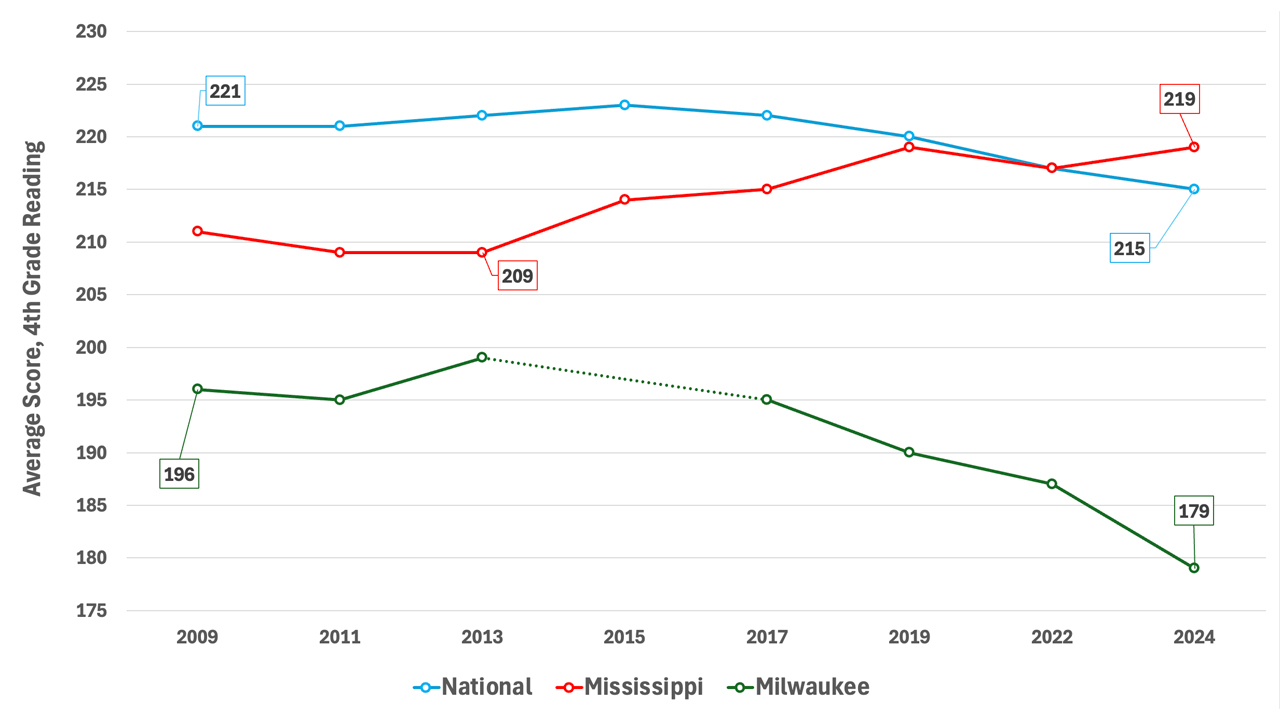
This line graph shows the average reading scores for fourth grade students in Milwaukee, Mississippi and the U.S. Average reading scores among Mississippi’s fourth grade students began to trend upward after the state implemented its early literacy law in 2013.
This graph shows the reading achievement level percentages for fourth grade students in Wisconsin, Mississippi and Milwaukee. While a smaller percentage of fourth grade students in Mississippi are scoring at “below basic” reading levels since 2009, Milwaukee and Wisconsin have seen an increasing percentage of fourth grade students scoring “below basic” in reading during the same timeframe.
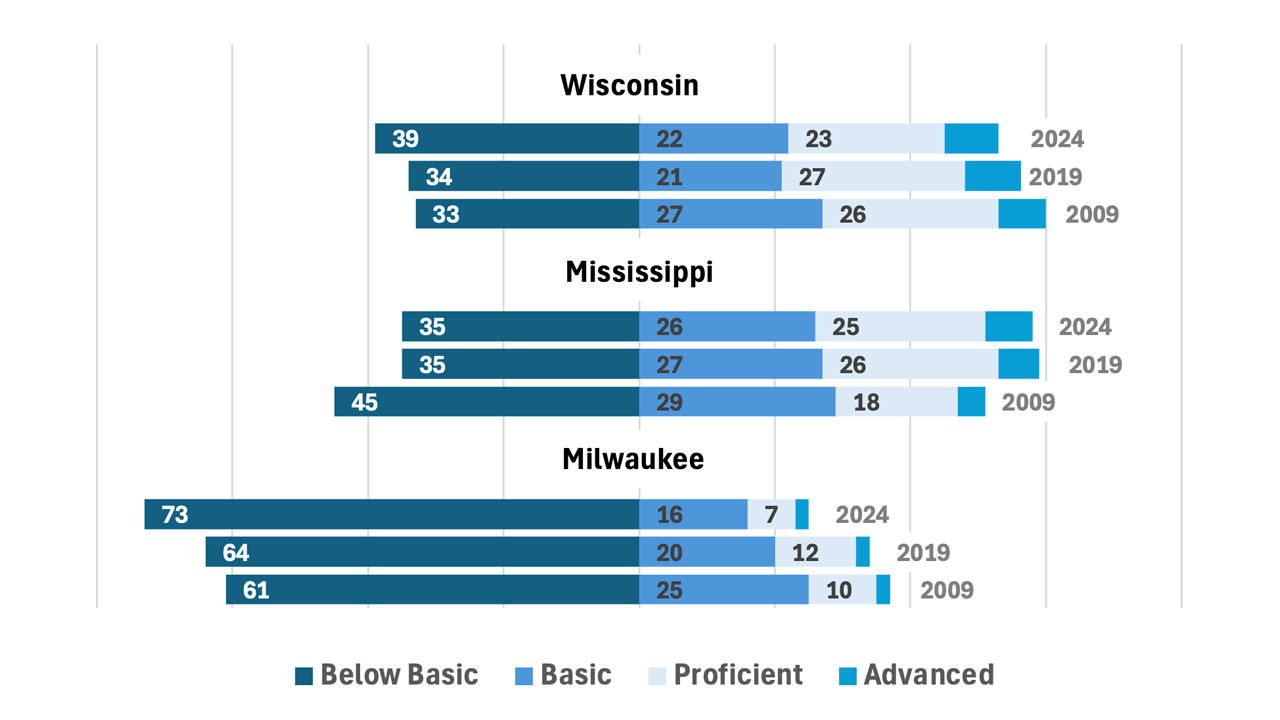
Source: National Assessment of Educational Progress
Looking to Mississippi
When developing its plan for the Milwaukee Reading Commission, the Milwaukee Reading Coalition took inspiration from what has been called the “Mississippi Miracle.”
In 2013, the state of Mississippi was ranked 49th in the U.S. for fourth grade reading. Eleven years later, the state ranked ninth for fourth grade reading, according to the 2024 NAEP assessment results.
Mississippi passed the Literacy-Based Promotion Act in 2013. Much like Act 20 in Wisconsin, the Literacy-Based Promotion Act created a statewide strategy to improve early literacy.

Mississippi’s law included approving professional development training for teachers in the science of reading, deploying literacy coaches to schools, identifying universal screeners for schools as well as engaging parents with resources and involving them in the intervention process if their child was identified as having a reading deficiency, said Kymyona Burk, senior policy fellow of literacy at Florida-based nonprofit ExcelinEd.
Burk served as state literacy director at the Mississippi Department of Education from August 2013 to May 2019. Her office was dedicated to implementing all of the components of the Literacy-Based Promotion Act.
“We wanted to prevent reading difficulties in kids, and we knew that empowering teachers and administrators with knowledge was our way to do that,” Burk said. “During that time, there was a shift in a lot of ways that we did education here in Mississippi.”
States that are considering passing similar early literacy laws must have an office dedicated to implementation of the law, Burk said.
“There just needs to be a dedicated effort to ensuring that things are not just in place, but monitoring its effectiveness,” Burk said. “Being able to monitor along the way, and also to be able to course correct.”
Before the early literacy law was implemented, teachers across Mississippi taught reading differently, even within the same school, Burk said.
“Our teachers were being trained differently, depending on where they went to school,” Burk said. “As a state, we felt that it was extremely important for us to establish this baseline. What is this knowledge that teachers need to have in order to teach reading the right way? We adopted LETRS (Language Essentials for Teachers of Reading and Spelling) training during our first year and began training our literacy coaches and teachers. Coupled with that training was job-embedded coaching, where coaches were assigned to schools.”
Mississippi currently uses AIM Pathways for professional development for teachers and leaders.
As a former teacher, Burk said the culture of teaching often leaves room for teachers to be creative in how they educate students.
“We go into our classrooms, we close our doors, and then we’re able to teach and be creative and do all the things, and that’s great,” Burk said. “Sometimes what’s fun for teachers is not mastery for students. And so, at this point, allowing teachers to open their doors to learn from each other, to learn about the right ways to teach reading, to have coaches to help them do that, has really been beneficial.”
Mississippi has now trained around 30,000 teachers in the science of reading, Burk said.
“These reading wars have been around for decades where there’s researchers’ or educators’ opinions of how best to teach children how to read,” Burk said. “But now there’s evidence.”
Instruction focused on the science of reading teaches children how to read “beginning with the smallest units of sound, with the phoneme, and of course building up to words and sentences and paragraphs, and books,” Burk said.
“So, there’s a science to how children learn how to read, step by step,” Burk said.
Mississippi eventually added an additional component to its literacy law that created a licensure assessment grounded in the science of reading, which was required for candidates looking to be elementary school teachers. Wisconsin has also adopted an educator preparation program assessment.
“Wisconsin has adopted many of those policies, the same policies that Mississippi has,” Burk said. “I know that there are some of the policies that are for future implementation, as far as your retention component and your science of reading training. But Wisconsin now has the framework for this to actually be implemented in Wisconsin.”
In Mississippi, third graders can be held back if they do not meet reading standards. This is a policy that Wisconsin has not adopted.
The Milwaukee Reading Commission looks to model the mix of public and private funding that supported early literacy in Mississippi.
“You always want to look at proof of concept, and we were not the first,” Anton said. “Wisconsin’s often been the first, historically, to do good things, but we are now toward the end of the number of states that have decided to make this transition. There are a lot of states that have made this investment long before us, and we can look to them to see where their progress has been.”
Teaching children how to read
Act 20 establishes a standardized framework for teaching children the foundational skill of reading.
The Milwaukee Reading Coalition aims to support the professional development of teachers across sectors – public, public charter and private schools – to standardize best practices for implementation in the city.

“What I think is the dynamic nature and the beauty of the system that we have, is that we can learn in different spaces,” said Colleston Morgan, executive director of City Forward Collective and a Milwaukee Reading Coalition leadership committee member. “MPS can grab the best of what happened in a public charter school or a private school, and not all of that’s going to exactly fit their context, but some of it will.”
While there has not necessarily been a standardized way of teaching children how to read, the three-cueing system was a widely used, balanced literacy approach that taught students to guess words based on pictures or other contexts. Wisconsin is one of the growing number of states that have banned three-cueing in recent years. Mississippi, though it has seen significant increases in student reading proficiency, has not yet banned three-cueing.
“Balanced literacy overwhelmingly was grounded in the belief that exposure of print was enough for kiddos to learn how to read and write,” said Gabriela Bell Jiménez, academic superintendent of literacy at MPS.
Bell Jiménez joined the district in July after serving as director of instruction for literacy, biliteracy, arts, world language and humanities at the Madison Metropolitan School District.

As MPS is a partner of the Milwaukee Reading Coalition, Bell Jiménez has contributed to the coalition’s discussions about professional development and daily instruction. Cassellius said the district is “trying to find out where the best place of intersection would be for MPS to partner with the (Milwaukee) Reading Commission in a way that’s most meaningful to our teachers and most meaningful to the commission.”
In line with Act 20, MPS is in the early stages of implementing its literacy plan that focuses on delivering daily science-based early literacy instruction.
Beginning last year, MPS integrated reading and writing instruction to support the science of reading.
“In elementary schools, we have a daily 90-minute block where reading and writing are coming together,” Bell Jiménez said. “The other thing that we are doing, and that I’m really, really proud and excited for how nimble the organization has been and our teachers have been, is securing instructional minutes for the explicit teaching of word recognition.”
Students in K5 through third grade have a daily 60-minute block of instruction focused on word recognition, which engages them in phonemic awareness, phonological manipulation and explicit phonics, Bell Jiménez said.
As required by Act 20, MPS utilizes an early literacy screener called aimswebPlus to measure progress in student reading proficiency. MPS aims to have 20% of the students score above the 40th percentile on the universal screener by spring 2026, then have 45% of students score above the 40th percentile by spring 2027. MPS aims for 60% of students taking the test to score above the 40th percentile by spring 2028. The screener will be administered three times per year.
“Our goal is to get every child to the 40th percentile, because that’s a predictor of them reading on grade level by grade three,” Cassellius said. “We are really beginning to drive that throughout the organization, shift the culture around literacy and reading, and then giving teachers the tools in order to succeed.”
The district’s literacy plan allows for intervention to happen sooner. If a child scores below the 25th percentile on the universal screener, they will complete a diagnostic reading assessment to identify their specific needs and have a personal reading plan created for individualized support. Families will receive their child’s assessment results as well as – if the child is considered “at risk” – their personal reading plan.
“Our literacy plan moves us away from a framework that waited for students not to do well for us to be able to intervene,” Bell Jiménez said. “Rather than waiting for kiddos to sort of drown, we’re teaching everybody how to swim.”
Bell Jiménez said literacy is essential “for communities to be able to access health and wealth.”
“I cannot imagine not being able to read a contract for a lease or not being able to understand the fine print on a credit card offer or not being able to fully understand an insurance policy, and all of those things require us to be able to read and write,” she said.
Research indicates that if a child cannot read by third grade, they are significantly less likely to graduate from high school, Fuller said.
“If our kids can’t read, what chance do they have, really, to have a significant life?” Fuller said. “What are your chances in life if you can’t read?”

Author
-

Elizabeth Morin is a writer based in Virginia Beach. She is passionate about local sports, politics and everything in between.
Have any Virginia Beach-related news published on our website? Email us at admin at thevirginiabeachobserver.com.
View all posts