The Kenosha-Racine-Milwaukee commuter rail proposal is making its return under a different name with several new components aimed at adhering to modern transit habits of southeastern Wisconsin residents.
The MARK Rail, named for its route through the Milwaukee area, Racine and Kenosha, is gaining momentum, prompted by a 2025 notice from the U.S. Department of Transportation’s Federal Railroad Authority offering federal funding for intercity rail projects under the FRA Corridor Identification and Development Program.
The notice served as a catalyst for the formation of the MARK Passenger Rail Commission, which is spearheading the project’s study alongside Germany-based rail engineering firm Deutsche Bahn and Raleigh, North Carolina-based engineering firm Kimley-Horn.
The commission, comprised of leaders from participating cities and the Southeastern Wisconsin Regional Planning Commission, will guide the rail project in applying for the FRA’s Corridor ID Program. The project’s study would be majority funded by a federal grant if approved, according to Kevin Muhs, city engineer for the City of Milwaukee and former executive director of SEWRPC.
KRM’s demise
Nearly 20 years ago, leaders from Kenosha, Racine and Milwaukee formulated plans for a commuter train, then called the KRM, to run along the lakeshore between the three cities in an effort to improve commuter transit across the region.
However, the KRM implementing agency – the Southeastern Wisconsin Regional Transit Authority – was disbanded after the state Legislature in 2011 repealed legislation allowing RTA’s to exist and thus, the KRM project was scrapped.
Though the KRM’s development had gone cold, a collection of local leaders remained steadfast in their efforts to introduce the region to rail commuting, later giving rise to the MARK Rail proposal.
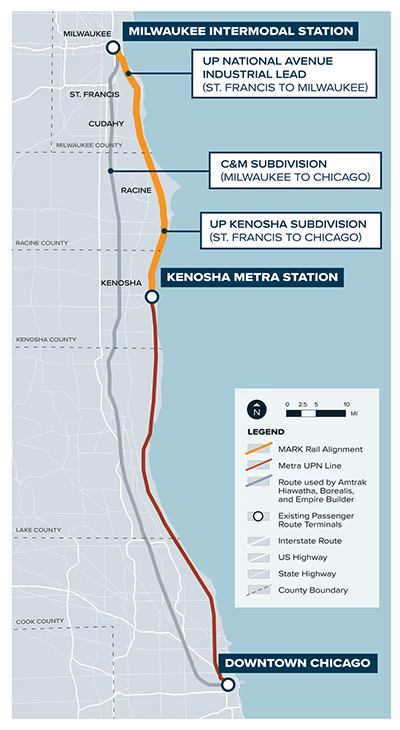
A map showing the proposed MARK Rail route and its connection with Metra’s UP-N line. Credit: MARK Rail
Features of the MARK Rail
Preliminary plans for the rail service have already begun with a $5 million federal grant given to the City of Racine in 2022. The funding allowed commuter rail plans to resurface and rebrand as the MARK Rail.
“The main difference (between the KRM and MARK Rail) is that the funding framework at the federal level has evolved since almost 20 years ago,” Muhs said. “The other piece is that post-COVID commuting patterns have changed, so there may be less demand for a daily round trip.”
Plans for the MARK Rail now include fewer stops between downtown Milwaukee’s Intermodal Station and Kenosha, where Chicago commuter rail service Metra’s Union Pacific North Line would meet the MARK Rail.
Also new with the MARK Rail proposal is cooperation from Metra, which runs passenger trains daily from Kenosha to Chicago. Metra has not committed to any financial investment in the MARK Rail project, but it has agreed to share information with the commission as the project progresses, according to Racine Mayor Cory Mason, member of the MARK Passenger Rail Commission.
“The perfect plan would be that this is a Metra operation,” said Milwaukee Ald. Bob Bauman, member of the MARK Rail Passenger Commission. “They use their equipment, their locomotives, they extend trains from Kenosha to Racine to downtown Milwaukee, and the local communities would be responsible for their own stations.”
Bauman added that there would ideally be a purchase of service agreement in which some entity, like the former SERTA agency, would pay Metra a fee to operate the service.
The MARK line would run on existing tracks previously used for a freight line that ran north of Kenosha’s UP-N passenger line. The freight portion of the UP-N rail line was used to transport coal to and from We Energies’ Oak Creek power plant. Recently, however, We Energies’ efforts to convert its coal-powered plants to natural gas have reduced freight traffic on the rail line. As of June 2025, the company plans to retire its last two remaining coal-powered units by the end of 2026.
“What’s compelling about this story and this application compared to other parts of the country that might be applying, is it’s on an already existing line,” Mason said. “It’s not like we have to acquire land or put something in the space, and it’s connecting two of the busiest metropolitan areas with one another.”
The funding hurdle
The MARK Passenger Rail Commission met for the first time in December 2025 and agreed to apply for the FRA Corridor ID Program, which will partially fund the three-phase study.
The study’s first phase includes a scoping exercise to understand the Corridor ID process and what it will look like on a local scale. The first phase is the only phase that will be 100% federally funded with no local match necessary.
The second phase includes the creation of a service development plan, which will investigate necessary infrastructure and vehicles and how often the service is going to run in order to lay the foundation for preliminary engineering. The second phase will be 90% federally funded, with a 10% local match requirement.
The third phase of the program is preliminary engineering, which will include conducting an environmental review and applying for permits. This final phase will be 80% federally funded and will require a 20% local match.
The biggest hurdle in getting this project off the ground will be obtaining proper funding, Bauman said. While it’s too soon to estimate a total project cost, Bauman estimates that the project will cost half a billion dollars if a complete upgrade of the 36-mile track is required.
The existing track is a single track, but future plans could include the addition of a second track in order to run trains going opposite directions at the same time.
“Adding a second track would be a big expense,” Bauman said. “In a perfect world, you’d have a second track, and in a really perfect world, you’d electrify the whole thing.”
The MARK Rail will use either traditional diesel locomotive-hauled trains, similar to those currently used by Metra, or diesel-electric multiple-unit trains, which have gained popularity across the country in recent years, according to preliminary study information from the MARK Rail project.
Though the total number of stops has not yet been decided, supporters of the project say the stations and other infrastructure that would be built along the rail line would help increase property values, generate higher levels of business investment and create jobs in the communities that are served.
“If you look at other models that have done this, they’ve found ways to leverage the real estate development around the stations as a possible way of funding the local piece of it,” said Mason. “Some of it will also come from fares.”
At its next meeting this spring, the MARK Passenger Rail Commission will hash out the details of the FRA application. The commission will then be able to apply for the program once the FRA puts out its next round of funding as early as summer 2026.
If the FRA selects the MARK Rail to participate in its Corridor ID Program, the study is estimated to take roughly five years to complete, Mason said, “assuming there’s no long government shutdowns or other unforeseen COVID-related events that slow things up.”