By any measure, the Village of Raymond looks much the way it always has. Wide-open fields stretch between farmhouses. Families trace their roots back generations. Until recently, the village had a 5-acre lot minimum for single-family homes.
But the Racine County municipality’s finances have grown increasingly strained, forcing village leaders to confront the reality that the community’s low-density, low-tax model cannot sustain the services it needs.
Raymond is now looking to I-94 as a financial lifeline.
With a new village president and a key utility connection coming in 2027, Raymond officials for the first time are pursuing development along the village’s six-mile stretch of the freeway.
“The opportunity is right there in front of us,” said Doug White, who became village president in April. “I’m just desperately trying to get people to understand that building around the interstate is the only thing that’s going to save this village.”
Raymond is the only municipality that borders I-94 between Milwaukee County’s southern border and the Illinois state line that hasn’t seen any modern industrial or housing development take hold along the freeway.
While Kenosha, Pleasant Prairie and Mount Pleasant have captured a lion’s share of the I-94 corridor’s development activity, several other nearby communities have also leaned into freeway-adjacent growth. In Kenosha County, Bristol and Somers have added multiple Class A industrial buildings, including facilities now occupied by pharmaceutical giant Eli Lilly. In Racine County, Yorkville and Caledonia are actively building out business parks to attract employers and expand their tax bases.
Raymond’s freeway interchanges are primarily utilized by fireworks stores, truck parking and the 7 Mile Fair flea market.
“We’re the place you go to get your fireworks,” White said of the village’s reputation to outsiders. “We’re working with many very reputable organizations to see if we can find a way to change that.”
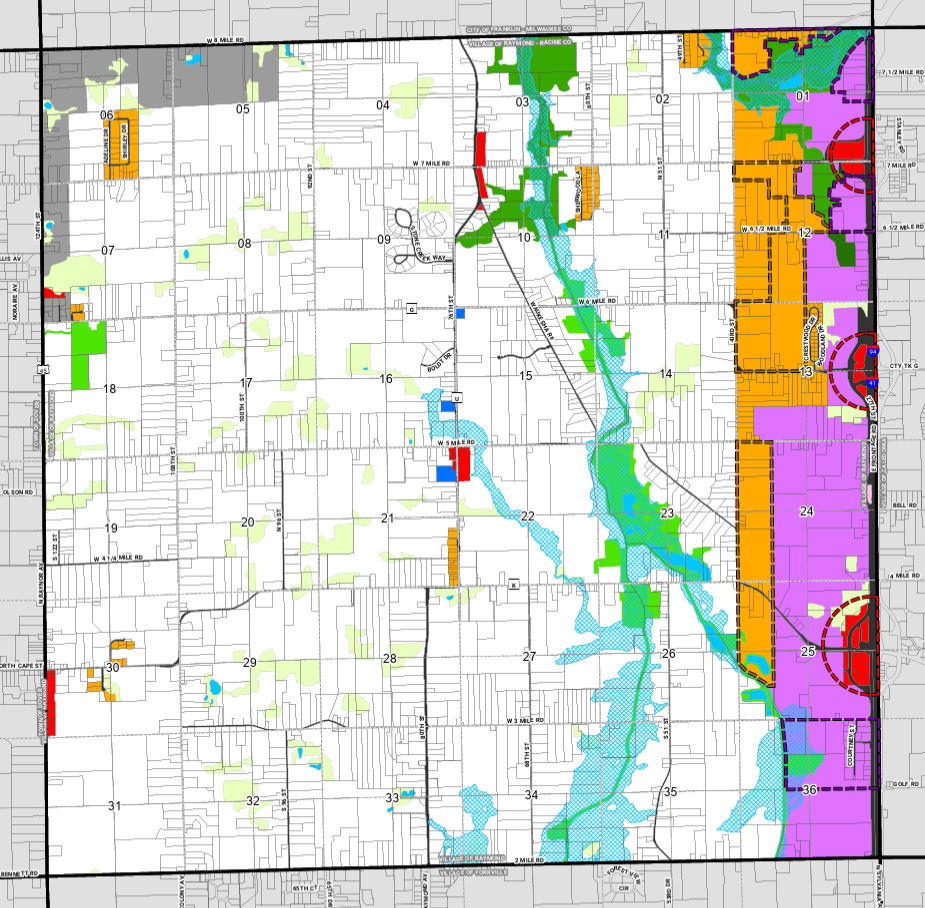
Raymond’s 2050 land use map: Purple indicates land envisioned for business park-type development opportunities, red indicates commercial development opportunities and orange indicates urban residential development opportunities.
Financial pressures mount
Raymond’s population has grown by just 75 residents since 2020. Typically, four or five new homes are built each year, often million-dollar houses on large lots. Despite their high value, those homes generate only about $1,000 annually in property tax revenue for the village.
At the same time, the village’s costs have risen sharply.
For much of its history, Raymond operated as a town. That changed in 2019, when Raymond reincorporated as a village under a special state statute passed in response to the Foxconn deal, which allowed towns bordering Mount Pleasant to become villages without going through the traditional incorporation process.
The move gave Raymond more local control, but it also shifted significant responsibilities onto the village’s balance sheet. Services that had previously been handled by the county, from certain public safety functions to road maintenance to building inspections, now had to be funded and managed locally.
Raymond’s entire annual budget is about $2.5 million. Its mill rate (the amount of tax levied per $1,000 of assessed value) is the lowest of any village in Racine County and among the lowest 15% statewide, according to state records.
The result is a familiar municipal dilemma: residents want low taxes and low density, but they also want high-quality services, which exist in three circles that don’t all intersect.
White says the village needs to increase its tax base and he believes I-94 is the place to do it. Without a change in direction, White said, Raymond could eventually face annexation into neighboring communities.
Raymond’s ‘picture perfect’ opportunity
That’s why White is motivated to leverage the village’s adjacency to I-94 by attracting new development to the village’s six-mile stretch of freeway-fronting land.
Under its 2050 Comprehensive Plan, the village wants to develop all of the land directly abutting the freeway with “business park” facilities and commercial space. Just west of that, the village envisions “urban residential” development, including apartments, condos or denser single-family neighborhoods than the village typically sees built. The village currently has a 3-acre lot minimum for single-family homes, which was reduced from 5 acres last year.
Everything west of 43rd Street – which runs about one mile west of I-94 – would remain as agricultural or rural residential land.
“I’m not looking to raise anybody’s property taxes or change their way of life,” White said. “It’s just the opposite. I want to keep our property taxes low and maintain our rural character, but the only way you can do that is to develop the I-94 corridor.”
This year, the Milwaukee Metropolitan Sewerage District is planning to start construction on a sewer line extension to the Racine County line, which could enable Raymond to build out its sewer and water utilities east of 43rd Street.
To support this, the village is exploring the creation of a $27 million tax incremental financing district to help pay for sewer and water build-out east of 43rd Street.
Now, the city is seeking what it’s calling an anchor development to trigger the TIF district and utility build-out. While the village is not prescribing what that tenant should be, White said it would likely be an industrial user or developer rather than a housing-based proposal.
“We’re in a classic chicken or the egg scenario,” White said. “We believe that if we spend the money to put the water and sewer in, that the development will come. But we need development to come in order to make that investment.”
Balancing vision with market realities
The timing, however, is complicated.
Industrial real estate development along the I-94 corridor has cooled after a surge of speculative development in Kenosha and Racine counties. Industrial space vacancy rates currently sit at about 10.6% in Kenosha County and 9.2% in Racine County, according to the most recent data from the Commercial Association of Realtors Wisconsin.
“As you look at 2026, I still don’t get the sense that the development community is hopping back in the pool to develop in this corridor,” said Jeff Hoffman, industrial real estate broker and principal at Cushman & Wakefield | Boerke. “I think, nationally, the lender and equity markets are still looking at the (North-South) I-94 corridor, particularly Kenosha, with a little bit of a red flag because of the vacancy issues.”
That said, Hoffman sees Raymond less as an extension of Kenosha and more as part of the southern Milwaukee County market, alongside Oak Creek and Franklin.
“Oak Creek is getting to the point of saturation with industrial, and they’re going to be very particular with what they want to see developed,” Hoffman said. “Franklin just has a couple sites. So, southern Milwaukee County is getting to the point where it’s getting tapped out, and that growth is going to continue to migrate south in time.”
Several major developers already have land assembled elsewhere, though. Milwaukee-based Zilber Property Group is building out a business park in Caledonia, as is New York City-based Ashley Capital, and Chicago-based HSA Commercial has undeveloped land holdings in Mount Pleasant.
“The developers are pretty well situated for possible sites to build,” Hoffman said. “I don’t really think there’s a need for another developer-led business park in Raymond.”
Instead, Hoffman said, Raymond’s best opportunity may lie in attracting owner-users or build-to-suit projects.
“If you’ve got a proactive community like Raymond that’s saying, ‘Hey, this is important to us. We want to figure this out, and we’re ready to do a TIF to do it,’ that is a differentiated position than a lot of the suburban communities in Milwaukee right now,” Hoffman said.
White acknowledges that his development vision along I-94 will not be universally embraced by residents. However, he said that the village board has so far been generally supportive of the vision.
“We need to end the mob rules,” White said. “There are some people out there who think, ‘It’s always been this way, and it will be forever and it’s going to be just fine,’ but we are really in a dire situation financially.”
“We have a big opportunity here. It’s just all picture perfect,” White said. “But, we have to embrace it.”