Thinking about visiting the Orange Garden in Rome? In the article below you will learn more about Giardino degli Aranci (as the locals call it), its history, how to get there, whether it’s worth visiting, and the best time of the year to visit.
Where is the Orange Garden in Rome Located?
The Orange Garden in Rome, or Giardino degli Aranci in Italian, is a park located at the top of the Aventine hill, one of the seven hills in Rome. The address is Piazza Pietro D’Illiria, 00153 Roma RM, Italy. The phone number of the park is +390667105457 and its official website is at https://www.sovraintendenzaroma.it/i_luoghi/ville_e_parchi_storici/passeggiate_parchi_e_giardini/parco_savello.
Orange Garden Opening Hours
The opening hours of the Savello Park (the official name of the Orange Garden in Rome) are as follows:
- from October to February 7 AM – 6 PM
- from March to September 7 AM – 8 PM
- from April to August 7 AM – 9 PM
The Orange Garden in Rome is a public park and as such the access to it is free.
How to Get to the Garden of Oranges by Subway or Bus
The Orange Garden is easily accessible by both bus and metro. The standard price for a single metro ticket (BIT ticket) in Rome was €1.50. This ticket is valid for 100 minutes from the time of validation and can be used on Rome’s metro, buses, trams, and certain regional trains.
The metro tickets in Rome can be purchased from ticket machines located in all metro stations, newsstands, ATAC ticket offices at major metro stations, and via the ATAC Mobile App, called TicketApply.
To download the TicketApply app, visit https://www.ticketappy.com/, scroll to the bottom of the page and click on the Google Play or Apple App Store icon.
How to Get to the Orange Garden in Rome by Train
The closest subway stop to the Orange Garden in Rome is Circo Massimo (11 Cotes Dr, Municipio Roma I) which is on line Line B of the Rome Metro. It takes about 8 minutes on foot to get from the metro station, located near the eastern end of the ancient Circus Maximus, to the park.
How to Get to the Orange Garden in Rome by Bus
There are multiple bus stops near the Orange Garden, but most of them are further away from the park than the metro stop and require more walking:
- Buses 23, direction “Clodio” (schedule) or 280, direction “Mancini” (schedule): These buses stop at “P.Za Monte Savello” stop which is a 12-minute walk from the Orange Garden.
- Bus 716, direction “Teatro Marcello” (schedule) – the closest stop to the Orange Garden would be “Marmorata/Caio Cestio” which is a 12-minute walk to the Orange Garden or “Marmorata/Galvani” which is 9-minute walk to the park.
- Busses 81, direction Malatesta (schedule); 85, direction “Arco Di Travertino” (schedule); 87, direction “Giulio Cesare / Lepanto” (schedule); 160, direction “Montagnola” (schedule); 628, direction “Baronio” (schedule) to “Greca” stop which is a 6-minute walk to the Orange Garden are also options for reaching Giardino degli Aramci / Orange Garden.
- Tram #3 to “Aventino/Circo Massimo’ stop which is a 10-minute walk to the Orange Garden.
Please note that the climb from the bottom of the hill to the park is steep but manageable. Also, wear comfortable shoes because you will walk a lot.
What to See in the Orange Garden
The main attraction of the Orange Garden are the orange trees. However, there are a few other sights to check out during your visit of the park.
The Fountain of the Mask

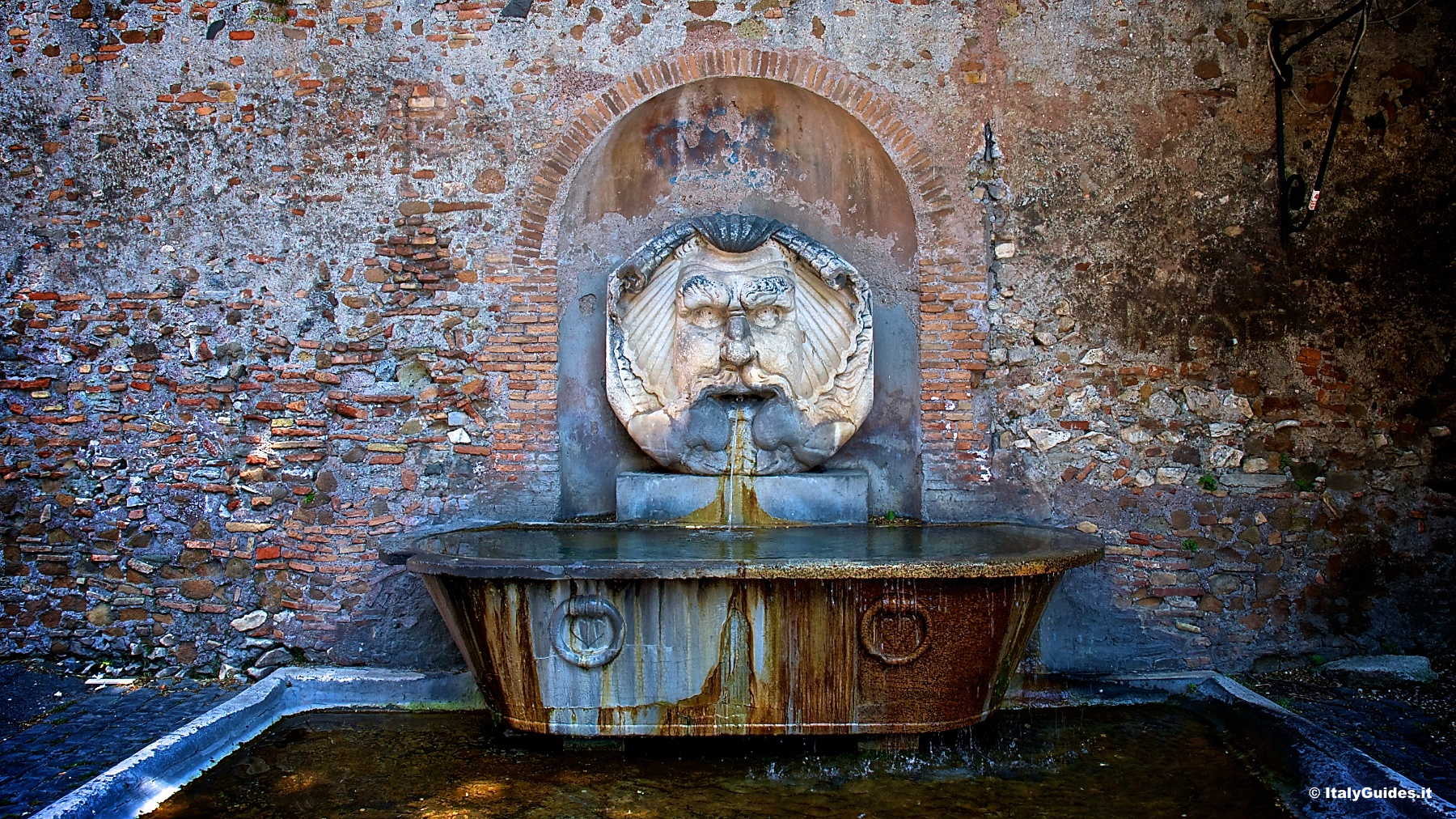
The Fountain of the Mask, a water fountain, is located at the entrance of the park. The mask is a face of a grumpy man, spitting water into a large stone tub. Please note, that the water from the fountain is not potable.
The Fountain of the Mask has an interesting history. It consists of two separate pieces. The base of the fountain (an oval-shaped basin carved from grey granite) is an ancient Roman thermal bath.
The mask was created by the sculptor Giacomo della Porta in 1593 for a different fountain located in the Campo Vaccino, which was a cattle market in central Rome.
In 1936 Antonio Munoz assembled both pieces and they were placed in the Orange Garden and that’s how the Fountain of the Mask was born.
The Orange Trees

The orange trees in the Orange Garden in Rome are the main attraction. The main variety of orange trees is the bitter orange, known for its aromatic flowers and bitter-tasting fruit.
In the spring the orange trees start to bloom, and the air fills with a sweet, citrus scent. The blooming white flowers also symbolize rebirth and renewal, according to the locals.
In the summer the flowers turn into fruit and the orange trees become heavy with ripe, bright oranges.
In the fall, the oranges that remain on the trees start to mature fully, and the leaves begin to tallow slightly, reflecting the seasonal transition.
In the winter the orange trees have no fruit. Yet, the bare branches against the winter sky create a peaceful landscape that offers a different kind of beauty.
The Terrace with Its Panoramic View to the Roman Skyline

The Terrace in the Orange Garden is located in the far end of the garden. It can be reached by walking along the main pathway through the garden.
Because of its elevation the Terrace provides an unobstructed view of the city. From there you can see St. Peter’s Basilica and the Tiber River, to mention a few.
The Terraces perfect location makes it a favorite spot for both locals and tourists for enjoying the sunset or a peaceful view of the city’s skyline.
Wooden Artwork by Andrea Gandini

The artwork of Andrea Gandini in the Orange Garden in Rome is located on the right side of the central path that leads to the observation deck.
Andrea Gandini is an Italian artist, known for his unique work with tree stumps.
His work in the Orange Garden in Rome is a part of a broader artistic project that turns tree stumps into beautiful carvings and sculptures.
There is only one of his artworks in the Orange Garden but there are more of them throughout Rome in Trastevere, Testaccio, Monti, Piazza Vitorio, Villa Borghese, and Via del Pigneto.
What is the Best Time of the Year to Visit the Orange Garden?
The best time of the year to visit the Orange Garden is in the spring when the orange trees are in bloom (you will love the aroma) or early summer and the weather is not that hot.
Spring (March to May) and early summer (June) are considered tourist season so you will likely see more people in the park but won’t be as crowded as it is in July and August, which are considered the peak tourist season.
What is the Best Time of the Day to Visit the Orange Garden?
The best time of the day to visit the Orange Garden in Rome is either early in the morning to avoid the tourist crowds or before the sun goes down for the magical sunset views.
Early morning and late afternoons, especially in spring and early summer, are the favorite time of the day for photographers to take breathtaking pictures.
What’s Near the Orange Garden in Rome?
So, you visited Orange Garden, now what? Luckily, the park is in close proximity to other unique Rome sights.
Basilica of Santa Sabina
The Basilica of Santa Sabina is located at Piazza Pietro d’Illiria, 1, 00153 Roma RM, Italy. It’s situated on the Aventine Hill in Rome.
Getting to the basilica from the Orange Garden takes no more than 1-2 minutes on foot. That’s why most of the people that visit the Orange Garden visit the Basilica of Santa Sabina as well.
The church is one of the oldest in Rome, dating back to the early 5th century. What visitors like the most about the Basilica of Santa Sabina is its wooden doors, especially the door that depicts scenes from the Bible.
The Aventine Keyhole

The Aventine Keyhole is located at Piazza dei Cavalieri di Malta, 3, 00153 Roma RM, Italy. This keyhole is actually part of the gate of the Priory of the Knights of Malta on Aventine Hill.
It is roughly 140 meters away from the Orange Garden and takes 2-3 minutes on foot to get to.
The Aventine keyhole is a keyhole in a door that offers a stunning view of St. Peter’s Basilica in the Vatican, aligned through a garden.
Because of its uniqueness, the Aventine keyhole has become a popular spot for both tourists and photographers.
The Rose Garden (Roseto Comunale)

The Rose Garden, known as Roseto Comunale, is located at Via di Valle Murcia, 6, 00153 Roma RM, Italy. It’s situated on the Aventine Hill, near the Circus Maximus in Rome. It is 3-5 minutes away on foot from the Orange Garden.
The Rose Garden is a botanical garden that displays over 1,000 varieties of roses from all over the world.
The best time to visit the Rose Garden is in late spring, between May and June, when the roses are in full bloom.
Circus Maximus

Circus Maximus is located at Via del Circo Massimo, 00186 Roma RM, Italy, between the Aventine and Palatine hills in the historic center of Rome.
It takes 6-8 minutes on foot to get from the Orange Garden to Circus Maximus.
Circus Maximus is one of the largest and oldest chariot racing stadiums in ancient Rome, with a history dating back to the 6th century BC.
In its prime, Circus Maximus could accommodate over 250,000 spectators, making it one of the largest sports venues in the ancient world.
It was primarily used for chariot races, as well as other public events such as festivals, games, and celebrations.
Today, Circus Maximus is a public park and a significant archaeological site that offers insights into ancient Roman culture and architecture.
The Palatine Hill

Palatine Hill is located at Via San Gregorio, 30, 00184 Roma RM, Italy. It is one of the most ancient parts of the city, situated just above the Roman Forum.
It is one of Rome’s seven hills and is historically significant as it contains ruins of ancient palaces, temples, and other structures.
It takes approximately 15 minutes on foot to get to it from the Orange Garden, depending on the exact start and ending points.
It is considered the birthplace of Rome and is steeped in Roman mythology, including being the location of the cave where Romulus and Remus were found by the she-wolf.
The Palatine hill is home to the ruins of several important ancient Roman buildings and palaces, including those of emperors Augustus, Tiberius, and Domitian.
The Palatine hill provides stunning panoramic views of the Roman Forum, Colosseum, and the city of Rome.
Roman Forum

The Roman Forum is located at Via della Salara Vecchia, 5/6, 00186 Roma RM, Italy. It lies in the heart of ancient Rome, between the Palatine Hill and Capitoline Hill.
Nowadays it is an expansive archeological site but historically, it was a central area in ancient Rome, consisting of various important government buildings, temples, and public spaces.
The Roman Forum is 15-20 minutes away on foot from the Orange Garden.
In its heyday the Roman Forum was the center of day-to-day life in ancient Rome, hosting important public, political, and religious activities.
The Forum contains the ruins of several ancient Roman government buildings, temples, and monuments, like the Temple of Saturn, the Arch of Titus, and the Basilica of Maxentius.
Nowadays, the Roman Forum is a major tourist destination, offering a glimpse into the ancient world and Rome’s imperial history.
Who Should Visit the Orange Garden and Who Should Not?
The Orange Garden in Rome is fabulous but not everyone will enjoy it.
Who is the Orange Garden in Rome Best Suited for?
- Nature Enthusiasts – the beautiful orange trees make it the perfect place for those people who love nature and seek a peaceful retreat from the city’s hustle and bustle.
- Romantic Outings – with its picturesque views, the garden is ideal for couples looking for a romantic spot.
- Photographers and Artists – the panoramic views of Rome and the beauty of the garden itself provide fantastic opportunities for photography and artistic inspiration.
- History and Culture Buffs – people interested in Rome’s history and cultural heritage will appreciate the garden’s historical significance and its location on the Aventine Hill, rich in historical landmarks.
- Families – the garden is a good place for families looking for a quiet and safe area for children to explore, though the interest level for younger kids might vary.
- Sunset Seekers – the garden offers one of the best sunset views in Rome, making it perfect for those who enjoy scenic vistas.
Who is the Orange Garden in Rome Least Suited for?
- Adventure Seekers – people looking for high-energy activities or extensive physical challenges might find the garden less exciting, as it’s more about relaxation and enjoying the view.
- Young Children – while the garden is family-friendly, very young children might not find as much to engage in in a quiet garden setting.
- People with Mobility Issues – because of its location on a hill, the garden might pose challenges for those with mobility issues, though it largely depends on the individual’s condition and the accessibility of the path leading to the garden.
- Visitors Seeking Extensive Botanical Variety – while beautiful, the garden primarily features orange trees and standard park flora, so those seeking a diverse botanical experience might prefer a larger botanical garden.
The Orange Garden in Rome Travel Journal Download
I am confident that you will enjoy your visit of the Orange Garden in Rome. From personal experience, I can tell you that in a few months you will have forgotten most of it. That’s why I created this one-page Orange Garden travel journal. In the journal you can write down when you visited the garden, how you got there, what were you thinking at that moment and what you visited next.
It is completely free to download – you don’t need to provide your email for that, nothing. Just click the download link to download the Orange Garden travel journal.

