When president Donald Trump returned to the White House in January, immigration law enforcement and immigration policy reform were among his signature priorities.
Nearly eight months later, the administration’s moves on immigration have catalyzed fear and confusion across immigrant communities, sparked street and workplace protests, spurred a showdown between the executive and judicial branches, brought illegal border crossings to near-historic lows, and, as of June, led to the first decline in the immigrant population nationwide since the 1960s.
This year, more than 1.2 million immigrants disappeared from the labor force nationally from January through the end of July, according to preliminary Census Bureau data analyzed by the Pew Research Center. That includes people who are in the country illegally as well as legal residents.
Immigration arrests in Wisconsin have more than doubled since Trump took office, according to data released in July from U.S. Immigration and Customs Enforcement. While that increase is less steep than most states, the data shows ICE agents have arrested an average of 85 people per month since January in Wisconsin, up from 37 per month under former President Joe Biden.
To explore how the issue is playing out in Wisconsin – and to understand the impact of the immigrant workforce on the local economy – BizTimes reached out to academics, trade groups, staffing agencies, immigration attorneys and more than 60 employers. Few were willing to discuss the issue, but among those who were, perspectives vary widely.
Immigration attorneys and staffing firms report that fear and uncertainty have taken root in immigrant communities, even among those with legal protections.
Meanwhile, leaders of trade groups say they haven’t yet seen widespread disruptions to their industry’s operations.
But with a historically tight labor market and key industries like agriculture, manufacturing, logistics and construction heavily reliant on immigrant workers, many are quietly bracing for longer-term impacts.
“No one is immune to the challenges of what this workforce disappearing could look like, whether that happens now or some unknown time in the future,” said Ryan Festerling, president and CEO of QPS Employment Group, a Brookfield-based staffing agency. “And anyone that says they are immune, in my opinion, is being very naïve.”
Fear and fallout in immigrant communities
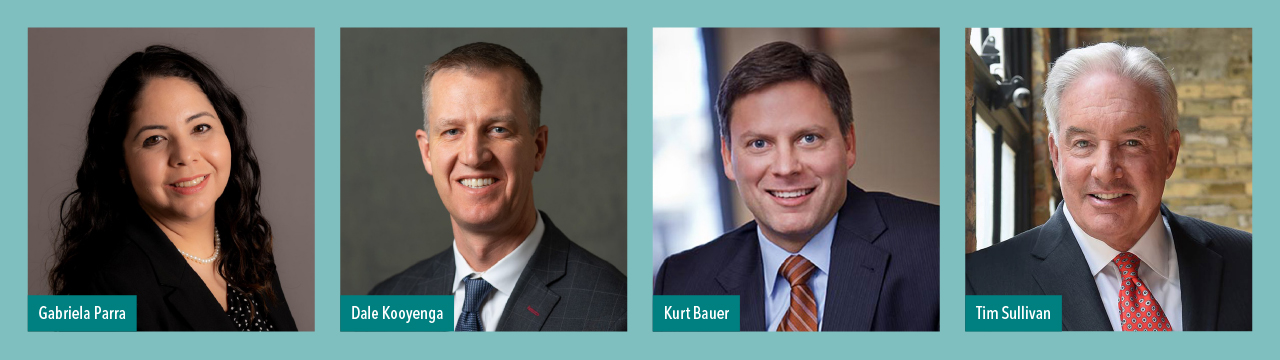
Gabriela Parra, a partner at Milwaukee-based immigration law firm Layde & Parra, has witnessed a significant increase in cases since the beginning of Trump’s second term. During the Biden administration, Parra said she received calls about once a month from people facing detention or removal. Under the current administration, that number has surged to three or four calls a week, sometimes more. Other immigration attorneys report similar increases at their firms.
Fear has infiltrated the immigrant community, even immigrants that entered the country with some sort of legal protection, she said. Due to a flurry of policy changes since Trump took office, thousands of people who were authorized to live in the U.S. when they arrived are no longer authorized to do so. It’s unclear how many of these people have been living in Wisconsin.
“Everything’s good until policy changes around you,” Parra said.
An executive order issued in January imposed a near-total ban on asylum access, leading to increased detentions and deportations of asylum-seekers already in the U.S. This order was blocked by a federal judge in July.
Also in January, Trump ordered the termination of all categorical parole programs, including the Cuban, Haitian, Nicaraguan and Venezuelan parole program, which was established by the Biden administration and allowed 531,000 people to live temporarily in the U.S. with a financial sponsor. The Supreme Court upheld this move, allowing the administration to begin removing legal status from CHNV beneficiaries.
Additionally, the administration reversed course on the CBP One program, which the Biden administration had used to grant more than 900,000 migrants temporary entry and work authorization through a free mobile app. Under the Trump administration, these people have been urged to voluntary self-deport using the same app they entered with.
While many of these changes are still tangled in legal battles, there have been immediate psychological effects on immigrant communities: foot traffic in local businesses in areas with a large immigrant population is down, some neighborhood and community festivals have been cancelled, according to local immigration attorneys, though Milwaukee’s annual Mexican Fiesta was still held at the Summerfest grounds last month.
“Immigrants do not want to use their purchasing power anymore because they’re just fearing that they’re going to get stopped and deported,” Parra said. “I’ve talked to different businesses in Milwaukee, and they tell me people are just not coming to the store purchasing that much anymore.”
The fear also extends to the workplace, according to Festerling with QPS. The staffing firm works with 250 to 300 companies primarily in manufacturing, logistics and warehousing, and Festerling, who notes the definition of “immigrant” can be subjective, estimates about a third of the workers they place could be considered immigrants.
“When legal or illegal immigrants are scared, what do they do? They pull back and they don’t participate in the economy as much and they don’t participate in the workforce,” Festerling said.
Quiet concern
To understand how employers are feeling about the issue, BizTimes contacted 65 Wisconsin companies across a variety of sectors. All but three declined to comment or did not respond, and those that did requested anonymity, citing the political sensitivity of the issue or concerns about drawing unwanted attention to their workforce.
“I think there’s just a lot of extreme opinions out there,” a roofing company executive said. “It’s completely untrue that a vast majority of labor in the roofing industry, and across the construction industry for that matter, is undocumented. That said, I don’t think the construction industry overall could operate the way people expect it to if every immigrant – yes, some of them undocumented – in the country were deported.”
The executive said he has not had any issues with immigrant workers reporting to work since January, but he has noticed more nervousness among some of his employees.
According to staffing firms, it’s difficult to quantify how many immigrants are working in Wisconsin and how many of them are authorized to do so. That’s partly because Wisconsin does not require employers to “E-Verify” like some states do. E-Verify electronically confirms an employee’s authorization to work in the U.S. by comparing the information on the employee’s Form I-9, Employment Eligibility Verification, against millions of government records.
While it’s not a foolproof system, it can provide an additional level of verification to prevent workers from presenting false documents.
E-Verify recently became a flashpoint at a cheese manufacturer in Monroe, about an hour south of Madison. In August, workers at W&W Dairy went on strike after the company was acquired by the Kansas-based Dairy Farmers of America cooperative, which implemented E-Verify to check employees’ immigration status, according to reporting from Wisconsin Public Radio.
Macro indicators stay steady
Zooming out, however, those with a more macro-level view of the state’s economy said changes to immigration enforcement and policy has not yet translated to measurable economic disruption in Wisconsin.
Dale Kooyenga, president and CEO of the Metropolitan Milwaukee Association of Commerce said he has not heard of issues with workplace ICE raids or issues with immigrant workers reporting for work from MMAC’s more than 2,000 members. Likewise, Kurt Bauer, president and CEO of Wisconsin Manufacturers & Commerce, said he has not heard of widespread issues from WMC’s more than 3,800 members.
Kooyenga outlined MMAC’s four-point immigration platform: border security, which Kooyenga believes has been accomplished; expanded work-related immigration quotas; a pathway to citizenship for undocumented workers in good standing; and a more skills-focused visa system.
While most sources agreed there have not been widespread issues with immigrant labor being detained or staying home out of fear of detention, several sources identified cheesemakers as a sector in which this has occurred. Whether that’s due to detentions, self-deportation or staying home due to fear of detention is unknown. The Wisconsin Cheesemakers Association did not respond to requests for comment.
New United States citizens were welcomed during a special naturalization ceremony in 2024 at the Milwaukee County Historical Society. Credit: WISN-TV Channel 12
Wisconsin’s dairy backbone
Of all industries in Wisconsin, agriculture may be the most vulnerable if the immigrant workforce decreases drastically, sources said. Tyler Wenzlaff, director of national affairs at the Wisconsin Farm Bureau Federation, calls labor “the number one issue” across all types of farms.
“Labor is easily our top concern. It’s the one issue that is consistent among big farmers, small farmers, crops, organics, livestock, dairy farmers,” Wenzlaff said.
The issue is particularly acute among dairy farmers. A 2023 study from UW-Madison found that 70% of the labor on dairy farms is performed by undocumented immigrants. While Wenzlaff was unable to corroborate that figure, he said it’s not surprising. Crop farmers are able to rely on the H-2A visa program, which allows them to bring in foreign workers to fill temporary agricultural jobs. Dairy farms are specifically excluded by the program, which shrinks their pool of authorized workers. While Wenzlaff said he hasn’t heard of widespread raids on Wisconsin farms or workers not showing up, the rhetoric has rattled farmers.
“Just the talk coming out of the administration — not knowing whether they’ll be targeted or not — has put some farmers on edge,” he said.
Wenzlaff said the farm bureau supports immigration reform to ensure an orderly process, but Wisconsin’s agricultural economy relies on the availability of immigrant labor.
“If there were to be as aggressive enforcement as the administration has talked about, it would be devastating to the Wisconsin economy,” Wenzlaff said. “I think people don’t understand how important Wisconsin agriculture is. You don’t put America’s Dairyland on the license plate just because it looks cool. It’s not just the 5,000 dairy farms. It’s the agribusinesses, it’s the small communities that rely on those agribusinesses and the farmers that live around those communities. It would be devastating, and that’s maybe an understatement.”
President Donald Trump shows off a signed executive order on Jan. 20 at Capital One Arena in Washington D.C. Several immigration-related orders and proclamations were signed that day. Credit: C-SPAN
A rare consensus: Immigration matters, and the stakes are high
Since 2020, Wisconsin’s unemployment rate has remained near record lows. As of July, the state’s unemployment rate was 3.1%, making access to labor among the top concerns for business leaders.
“We have a very efficient job market in Wisconsin – labor participation is high and unemployment is low. That creates a labor shortage by default,” Festerling said. “The punchline is that legal and illegal immigrants have definitely filled a need in southeastern Wisconsin and across the U.S. to make sure labor is still performing at somewhat of an efficient rate.”
Some employers are quietly taking steps to prepare for potential labor disruptions if the immigrant population declines long term. QPS has seen a notable increase in companies requesting support for “contingency planning” if their immigrant workforce is affected, according to Festerling. Another southeast Wisconsin staffing firm echoed this trend.
“So far, we haven’t seen widespread disruptions to the workforce or companies suddenly losing a large portion of their workforce,” Festerling said. “What we have seen is companies coming to us saying, ‘I have a workforce and I’m not sure if this person is legal or illegal, I don’t know, because I don’t E-Verify, but I know if I lost these five people, I’m in big trouble.’”
Despite divides over policy, enforcement and even terminology, there is broad consensus among business leaders, labor experts and immigration advocates that immigration is vital to Wisconsin’s economy.
“We need immigration in the state of Wisconsin,” said Tim Sullivan, dean of the Sullivan School of Business, Engineering and Technology at Carroll University and former CEO of several Milwaukee companies, including REV Group and Bucyrus International. “If we don’t have immigration, our economy will falter.”
Sullivan, who spent years leading large manufacturing firms in Milwaukee, said roughly 30% of the workforce at Bucyrus was Hispanic, many of them immigrants or the children of immigrants. He described new immigration as “critically important” to Wisconsin, especially given the mismatch between the state’s workforce and job offerings. About 33.8% of Wisconsin residents 25 and older have a bachelor’s degree or higher, according to the Federal Reserve Bank of St. Louis. But about 74% of annual job openings in the state don’t require a college degree or credential, according to the Wisconsin Policy Forum. The state has a structural labor shortage, lacking enough workers to fill jobs that don’t require a college degree.
Immigration has helped to boost Wisconsin’s population, but the state has seen slow growth in recent years. Its population grew 3.6% from 2010 to 2020 and only 1.1% from 2020 to 2024 according to the U.S. Census Bureau.
Kooyenga said that population growth is one of the few levers to grow the economy, in both common labor and also high-skilled and specialized roles, like workers authorized via the H-1B visa program, which is used by several of metro Milwaukee’s biggest companies including Fiserv, Northwestern Mutual and Johnson Controls. Higher education institutions including UW-Madison and the Medical College of Wisconsin also use the H-1B visa program, according to federal records.
“With low birth rates in the country and state, workforce growth via immigration becomes critical,” Kooyenga said. “Just as immigrants are more likely to be present in housekeeping, they’re also more likely to be in software development. We need both.”
The need for a growing workforce isn’t just an abstract economic principle, it’s something employers feel acutely, even if they’re hesitant to say so publicly.
“It’s hard to talk about this without sounding like you’re either defending illegal immigration or demonizing hardworking people,” said one warehouse operator. “The truth is, we depend on these workers.”
Exterior of Fiserv’s corporate headquarters in the HUB640 building. Image from Fiserv
H-1B visa petitioners approved by employer for fiscal year 2025
Under the H-1B program, employers can temporarily employ foreign workers in occupations that require the theoretical and practical application of a body of highly specialized knowledge and a bachelor’s degree or higher in the specific specialty, or its equivalent, according to U.S. Citizenship and Immigration Services. Here are the state’s top 10 employers of approved H-1B beneficiaries, as of June 30, 2025.
Note: Data is collected based on the employer’s address and is not necessarily reflective of how many beneficiaries actually work in Wisconsin.
Elizabeth Morin is a writer based in Virginia Beach. She is passionate about local sports, politics and everything in between.
Have any Virginia Beach-related news published on our website? Email us at admin at thevirginiabeachobserver.com.