Milwaukee County officials are beginning to sketch out how they could finance a nearly $900 million new criminal courthouse, outlining several borrowing scenarios that would raise property taxes while preserving varying levels of funding for other county capital projects.
The existing Safety Building, constructed in 1929 at 821 W. State St., has long been considered inadequate. County and court officials say that the outdated facility poses safety risks and contributes to delays and errors in the justice system— with temperatures in some courtrooms this summer reaching 90 degrees — but the project has stalled in the past due to its substantial cost and political disagreements over funding.
For years, county officials have estimated total project costs to replace the building with a new structure at somewhere between $450 million and $500 million. In the past year, that figure has landed on $490 million. But then earlier this month, the county raised its estimate to $896.6 million, saying the updated figure reflects a complete conceptual design and years of construction inflation.
Here is a breakdown of the project costs presented by county staff at a Committee on Community, Environment and Economic Development meeting on Monday:
- New Criminal Courthouse building: $712.5 million
- Enabling phase investments: $88 million. This refers to the accommodations that need to be made to allow for operations to continue during the roughly five-year construction period, including over $50 million in investment in the historic courthouse building at 901 N. 9th St.
- Demolition of the existing Safety Building: $17.4 million. This figure includes costs for hazardous material removal, primarily asbestos abatement.
- Two-level skybridge connecting the new courthouse to the historic courthouse: $14.5 million
- Upgrades to the Criminal Justice Facility: $1.3 million. This work includes upgrades of the Courtroom Docket display and related structured cabling to align with the system installed in the new Criminal Courthouse, as well as modifications to approximately 1,300 square feet of Sheriff’s Department space.
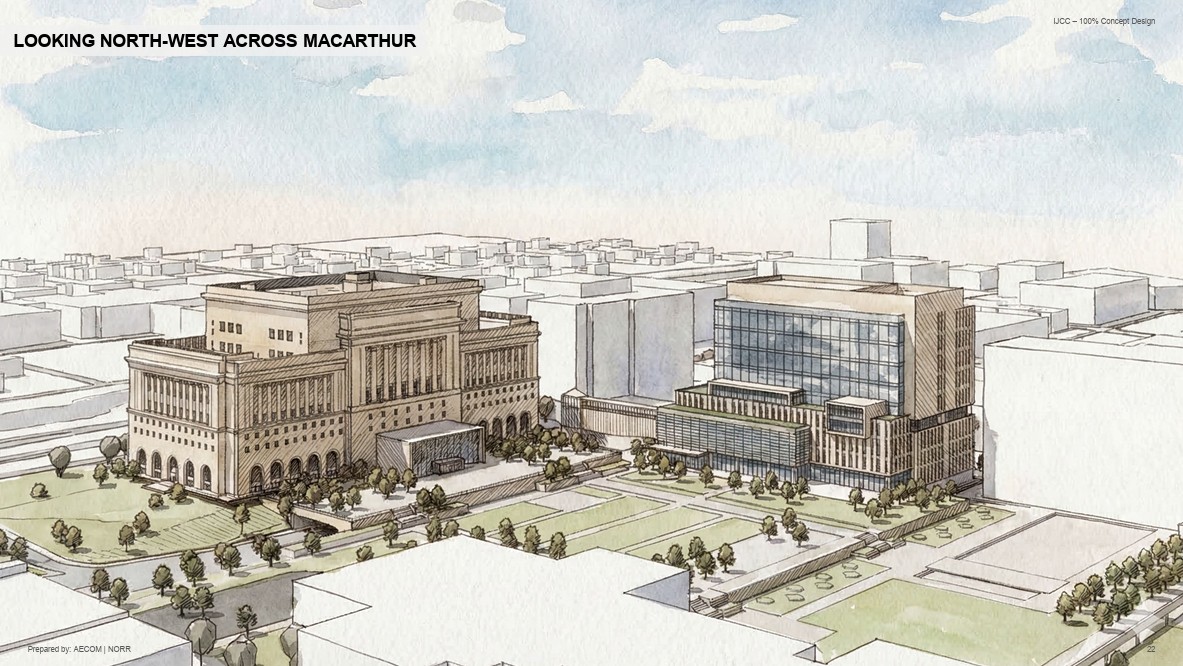
- Historic Courthouse east entry addition: $45.8 million. This project would add a modern addition to the Historic Courthouse and move the building’s primary entrance from the west side of the building to the east side facing MacArthur Square Park, which the City of Milwaukee has proposed in its 2040 downtown area plan.
- Central utility plant: $17 million. This refers to a shared facility that would generate and distribute heating, cooling and electricity for the courthouse complex, which county staff said would allow for ongoing financial benefits and advance the county toward its goal of being carbon neutral by 2050.
County staff said the project scope could still change, including adding features such as additional skybridges or removing elements such as the Historic Courthouse addition, should county officials push for changes.
Credit: AECOM
Between 2024 and 2026, the county has allocated about $38.6 million to the Investing in Justice: Courthouse Complex (IJCC) project — some of which was awarded indirectly by the state — leaving nearly $858 million left to finance. County Executive David Crowley’s administration originally sought $250 million in state funding to help finance the courthouse project, but lawmakers did not approve a direct allocation. Instead, the latest state biennial budget included new funding for expressway patrol services provided by the Milwaukee County Sheriff’s Office (MCSO). With the County Board’s approval, the administration redirected $15.8 million in property tax revenue from the MCSO budget to the courthouse project in 2026, using the new state funding to offset the change.
The Crowley administration is targeting the 2027 budget cycle to fund the $857.9 million balance, with county staff on Monday saying a request for funding could come this September. The administration’s plan for the courthouse project is to borrow for most of the balance, which will require it to raise property taxes to pay down the associated debt.
The county’s capital program (aside from the airport) is primarily funded through general obligation bonds and property tax levy. State and federal rules dictate the use of the bond proceeds, and those that are not bond-eligible are primarily funded with tax levy. Beyond the federal and state eligibility rules, the county has its own self-imposed limit on bonds to moderate debt growth, where bond-funded capital projects are limited to not more than a 3% increase over the prior year’s adopted bond amount.
The estimated debt service related to the IJCC project is about $1.48 billion.
Here are the preliminary options that county staff has evaluated:
- The IJCC project costs consume all of the available annual bonding for 12 years, which would essentially freeze out every other county capital project throughout that period. This option was eliminated because the project’s construction contract requires full budget authority in a single year instead of incremental funding. Further, freezing other capital projects would increase the county’s capital project backlog, and there are some mandated capital projects the county needs to be able to finance over the 12-year period.
The remaining options all assume full funding for the IJCC, but differ in how the rest of the county’s capital program are funded (each of these scenarios assumes an estimated five-year bonding period and a related 15-year debt service payback period):
- The county’s existing capital framework is used — keeping the 3% annual growth in the bonding cap and leaving about 49% of the county’s bonding capacity available for other capital projects — while IJCC is funded in the first year. However, the associated debt service under this scenario is the highest at $481.5 million. The estimated impact to taxpayers is $59 per year ($887 over the 15-year life of the debt), based on a property valued at $250,000. This option is considered feasible by county staff.
- Option three reduces the non-IJCC bonding capacity by about 5% annually, or about $15.5 million over five years. Based on historical patterns, this reduced cap is enough to cover contractual, mandated and continuing projects in years one and two. However, in year three, there are estimated shortfalls of about $433,000, with the shortfall growing to $2.2 million by year five, which could constrain new or discretionary project funding. The associated debt service under this scenario is the highest at $457.3 million. The estimated impact to taxpayers is $56 per year ($843 over the 15-year life of the debt), based on a property valued at $250,000. This option is considered manageable by county staff.
- Option four would require a one-year “capital holiday,” where only mandated, contractual and fleet needs can be funded before returning to the status quo in year two. This scenario would add to the capital projects backlog and prevent new or discretionary projects from being funded, but would have the lowest total debt service and cost to taxpayers. The associated debt service under this scenario is $431.9 million. The estimated impact to taxpayers is $53 per year ($793 over the 15-year life of the debt), based on a property valued at $250,000. This option is considered feasible by county staff.
The above scenarios assume that the entire debt service would be passed to taxpayers, but there is the possibility that the county could allocate about $15.8 million per year if funding for expressway patrol services continues.
County Board Supervisor Justin Bielinski has called for a binding referendum to be placed on the November ballot asking voters if they would support building the new courthouse.
“This is the biggest financial decision the county will ever make, and we’re going to be living with the consequences of this for generations, so we need to ask the people what they think,” Bielinski said at Monday’s meeting.
In order to get the referendum on November’s ballot, it needs to go through the county’s Committee on Finance this month and then get 12 votes from the County Board. According to reporting by Urban Milwaukee, Finance Committee Chairman Steve Taylor is blocking the item from the committee’s meeting on Thursday.
As of Tuesday afternoon, the referendum item was not posted on Thursday’s agenda.