As housing costs continue to rise across southeastern Wisconsin, local leaders are increasingly treating housing affordability as an economic development issue.
Ozaukee County remains among the most expensive housing markets in Wisconsin, while home prices in Washington and Sheboygan counties have also climbed beyond what many first-time buyers can comfortably afford. The shortage of attainable housing has become a growing concern not only for prospective homeowners, but also for employers trying to recruit workers and communities seeking to attract young families.
In response, several counties in the region are experimenting with new approaches to housing development. Washington County has launched a revolving-fund program aimed at producing 1,000 owner-occupied homes. Sheboygan County has created a unique public-private partnership backed by some of the area’s largest employers. And in Ozaukee County, local officials are studying whether similar efforts may be needed to address mounting affordability concerns.
Washington County seeks 1,000 homes
For Washington County Executive Josh Schoemann, the issue first emerged while he was preparing his first campaign for county executive in 2019.
As he developed his policy platform, Schoemann noticed that many young residents were leaving the county after high school.
“I started to research why that was,” he said. “The community has been talking for years about the cost of housing, transportation and child care, and it became very obvious that even back in 2019, the cost of housing was such that young people in particular couldn’t afford to get in.”
Schoemann began researching the history of housing development in the United States, examining how the previous generation had produced large numbers of starter homes. He concluded that lower government involvement in housing development, combined with the collapse of many homebuilders following the Great Recession, had contributed to today’s shortage.
“We’re kind of building something from nothing,” Schoemann said.
The result was the Washington County Next Generation Housing Initiative, a public-private partnership designed to lower barriers for developers in exchange for new homes that are attainable for working families.
The initiative’s goal is to create 1,000 owner-occupied housing units by 2032.
Under the program, all homes must sell for less than $420,000. Eighty percent must sell below $360,000 and 40% must sell below $340,000.
Developers and municipalities can access zero-interest infrastructure loans of up to $20,000 per unit to help cover costs such as land acquisition, engineering work and infrastructure installation. Those funds are repaid when homes are sold and recycled back into the program for future projects.
As of the end of May, 185 owner-occupied units had been funded through the initiative. County records show that 74 homes have been sold or are under contract, including 33 priced below $320,000. The county has allocated approximately $4.5 million of the program’s $8.2 million budget.
Projects underway include Oaks of Jackson, which features 53 single-family homes, 10 duplexes and 40 townhomes; Skyway Park in Hartford; and Regal Place Condominiums in Kewaskum.
The program has also generated an estimated $1.4 million in tax revenue, a figure that could grow to $6.8 million by 2045, the county estimates.
While Schoemann said the program has been successful, local regulations – like setback requirements, right-of-way requirements and even mailbox and light post requirements –have presented challenges.
“We’re in the process of a development in West Bend on existing county government land, and what we’ve found is for an approximately 100-unit single-family home development, the infrastructure alone will cost around $70,000 per lot,” Schoemann said. “That’s a real problem when we’re trying to build something affordable for the working class.”
The revolving nature of the fund was one of the features that attracted Milwaukee-based Lange Urban Sustainable Homes to participate in the program.
LUSH founder RJ Lange said the company plans to build six duplexes, totaling 12 condominium units, through the program. The company uses a construction method built around precision-cut components designed to reduce labor and construction time.
Lange said the biggest challenge facing many smaller builders is obtaining enough capital to begin projects.
“The biggest issue that I see most people have right now is the liquidity and ability to get the financing in place,” he said. “I know a lot of people that want to be startup builders and stuff, and they just don’t have the capital, and they can’t get access to it from banks.”
The revolving nature of the county’s fund helps address that problem, Lange said.
“With the Next Gen program, it’s getting recycled,” he said. “Next Gen solves that problem by saying, ‘You’re going to build 10 units, we’re going to give you $200,000.’ That’s going to get you the ability to start a project, and when you go to sell it, you have to sell it at that medium-income range, and then you pay that back and those funds go back into the program.”
For emerging developers, he said, the program provides more than financing.
“We’re still kind of an emerging developer,” Lange said. “We’ve gone from building two or three homes to now building close to 30, 12 of which are in West Bend. Helping someone like me to scale quicker, get an education in the process of developing is huge at this step.”
If the West Bend project succeeds, Lange said he is already exploring a second, larger project in Hartford.
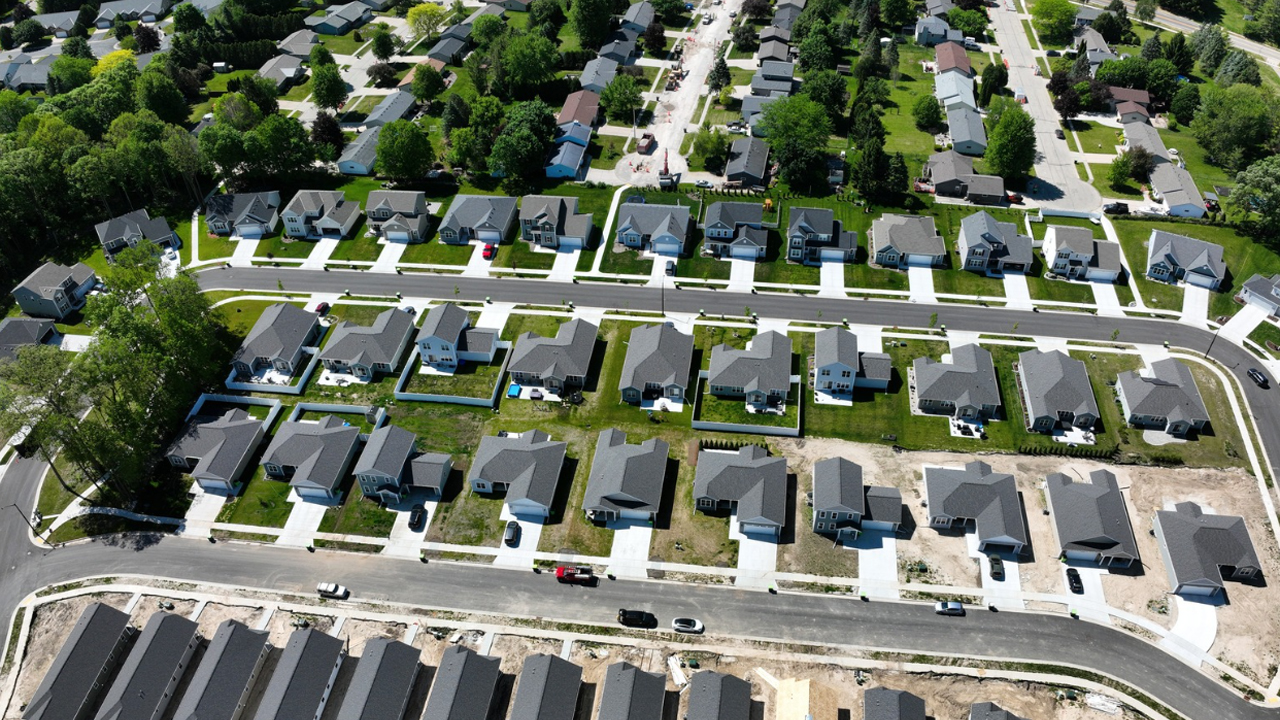
Credit: Washington Couty The Oaks of Jackson development is part of Washington County’s Next Generation Housing program.
Sheboygan County brings employers into the solution
While Washington County’s initiative relies heavily on financing tools and partnerships with developers, Sheboygan County’s approach puts major employers directly at the center of the effort.
The Sheboygan County Forward Fund launched in 2023 with $10 million in support from Johnsonville, Kohler Co., Masters Gallery Foods, Sargento and Sheboygan County.
Each company contributed $2 million, while the county added $2 million in American Rescue Plan Act funding.
Unlike many housing initiatives, the Sheboygan County Economic Development Corp. acts as the primary developer. SCEDC acquires land, manages planning and engineering work, and contracts with local builders to construct homes.
The goal is to create 600 homes.
“Construction prices are increasing and not seeming to get any better, but we found ways to keep it where these homes are all signed for in the ballpark of the $280,000 to $325,000 price point, so very reasonable and attainable for a brand-new build, three bed, two bath,” said TJ Crowns, SCEDC’s director of economic development.
The first development, Founders’ Pointe Subdivision in Sheboygan Falls, consists of 54 homes and is fully sold or under contract.
A second Sheboygan Falls development is planned for 41 homes. Five homes have been completed on a speculative basis, eight lots have been sold and another is pending. A third project, scheduled to begin in Plymouth this summer, could eventually add another 102 homes.
Combined, the projects would move the county roughly one third of the way toward its goal.
The initiative relies on several mechanisms to reduce costs, including municipal partnerships, tax incremental financing districts and using lot value as down-payment assistance for qualified buyers.
The fund is also structured as a revolving program. Rather than receiving a return on their investment, participating companies allow proceeds from home sales to be reinvested into future developments.
“It’s very unique to have public-private partnerships like this, especially in this area,” Crowns said.
To qualify, buyers must work in Sheboygan County or have accepted employment there. They do not need to work for any of the companies that financed the initiative.
Crowns said approximately 60 homes have been sold or are under contract, representing employees from roughly 50 different companies. About 76% of buyers have been first-time homeowners.
Some employers have begun incorporating information about the program into recruiting and onboarding materials, and Crowns sees the program as having downstream effects on the local economy, beyond workforce development.
“People tend to spend more money where they live than where they work,” Crowns said. “So, if we can have people that work and live in Sheboygan County, they’re more likely to spend money at restaurants, grocery stores, have a membership here.”
Ozaukee County studies its options
While Washington and Sheboygan counties are building housing through countywide initiatives, Ozaukee County remains in the evaluation stage.
At the county level, officials recently closed a request for proposals for a comprehensive housing study that will evaluate existing housing stock, identify gaps in the market and recommend strategies for meeting future housing needs.
In March, Port Washington Mayor Ted Neitzke announced plans to establish a housing task force to study housing shortages and affordability challenges.
The move followed an economic study showing property values in Port Washington have been increasing by approximately 10.5% annually.
“As we learned last month through an economic study, city of Port Washington property values are averaging about a 10.5% increase annually, and that is out pricing the ability for starter homes to be acquired in the city, or for young families to be able to move here,” Neitzke said.
“It’s having an impact on our student enrollment, and a lot of other things.”
The task force is expected to spend several months meeting with contractors, developers and property owners while examining strategies that could help increase the supply of attainable housing.
“The city of Sheboygan has taken a really aggressive role in starter homes, as has the city of Sturgeon Bay, and they’ve taken some very innovative approaches, and I’d like us to investigate those, come back to the city of Port Washington,” he said.
Elizabeth Morin is a writer based in Virginia Beach. She is passionate about local sports, politics and everything in between.
Have any Virginia Beach-related news published on our website? Email us at admin at thevirginiabeachobserver.com.