Supply and demand just checked in.
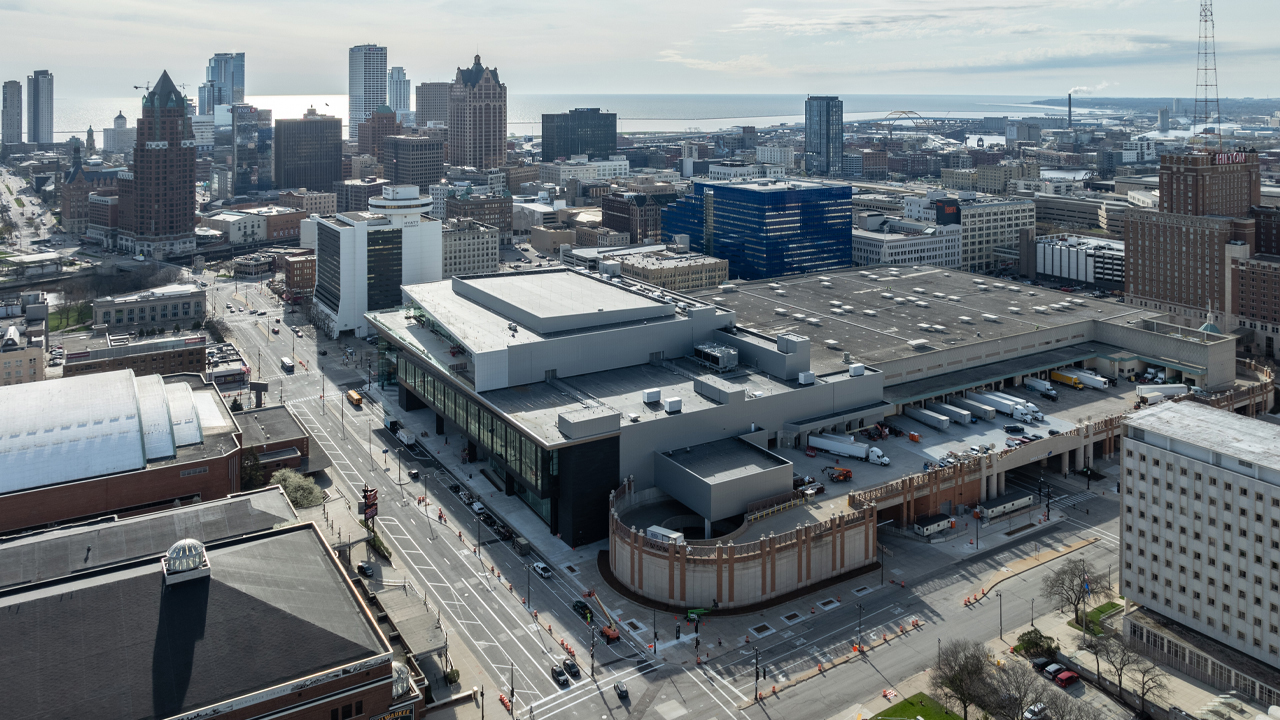
Milwaukee has already doubled down on its convention business with the $456 million expansion of the Baird Center, completed in 2024.
Now, a consultant’s report is forcing a fundamental economic question: Does the city need more hotel rooms to help attract conventions, or does it need stronger demand before adding hundreds of new rooms?
The answer could reshape downtown Milwaukee’s Westown neighborhood. A recent study, commissioned by the Wisconsin Center District, concluded that downtown Milwaukee needs a 650-room convention headquarters hotel to remain competitive with other cities in attracting conventions.
The study’s findings indicate that the best location for a convention headquarters hotel would be the current site of the historic Miller High Life Theatre.
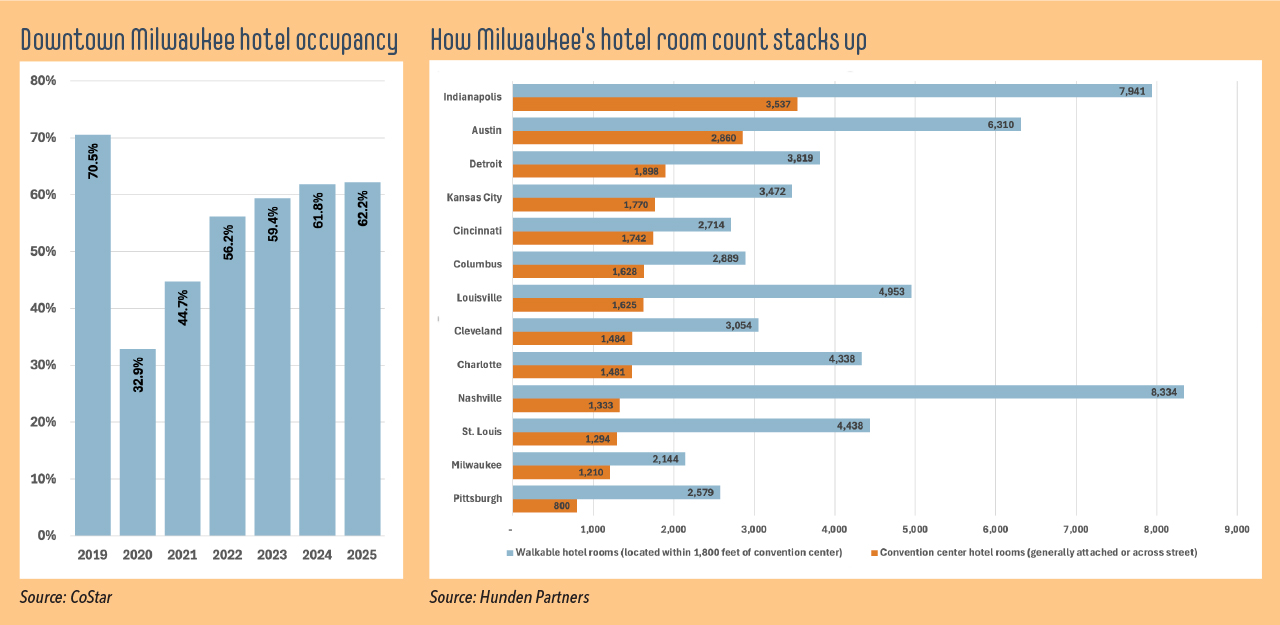
Demolishing that building to make way for a new convention headquarters hotel is a suggestion that has quickly become controversial, raising questions about public subsidies, historic preservation and whether adding supply to a hotel market with only 62% occupancy makes financial sense.
The idea remains in its early stages. No financing plan has been identified, no development partner selected and no action taken by the WCD board. But ever since the study’s release, debate has intensified over both the economics behind its recommendation and the process that produced it.
The 116-page report, prepared by Chicago consulting firm Hunden Partners, was unveiled at the end of January. It argues that the expansion of the Baird Center has left the city with abundant meeting space but too few nearby hotel rooms, particularly in the upscale and luxury categories.
In 2025, the Baird Center hosted 1.1 million visitors, up from about 780,000 in 2024, which consultants said demonstrates strong demand. But according to the analysis, Milwaukee is losing convention business because it cannot accommodate large events needing a concentrated block of hotel rooms located in close proximity to the convention center.
Hunden estimates the city will forfeit at least 330,000 hotel room nights annually between 2024 and 2027, with roughly 18% of that loss tied directly to the city’s hotel package. This breaks down to forfeiting more than 900 hotel rooms every night, with 162 of those attributed to the city’s hotel package.
“Milwaukee is now meeting space heavy, hotel room light and behind on hotel quality,” the report states, noting that event planners for conventions downtown sometimes need to contract with as many as 29 different hotels to house attendees, which is more than in competing cities.
“There’s some cities that really have great convention packages,” said Matthew Avila, director at Hunden. “We are competing in an industry where it’s cutthroat.”
In the report, Hunden compared Milwaukee to 12 other cities, including cities that Milwaukee is often compared to like Cleveland, Cincinnati and Detroit, but also cities like Austin, Texas; Charlotte, North Carolina; and Nashville, Tennessee, among others. Some critics of the study have questioned whether it is appropriate to compare Milwaukee to some of these cities, but Hunden and WCD argue that, while Milwaukee is not competing on the same plane with cities like Austin or Indianapolis for every event, there are some events that it is.
Of the competitive set analyzed by Hunden, eight have added a convention center hotel since 2010 and three have one under construction. Milwaukee’s two convention center hotels are the Hyatt Regency, which was built in 1979 with 481 rooms, and the Hilton Milwaukee, which was built in 1928 and recently got a $40 million renovation to its original 554-room building. The property’s adjoining 175-room west tower, added in 2000, was repurposed into an independent, limited-service hotel called The Marc.
“Headquarter hotel inventory around these convention centers we like to say is almost an arms race,” Avila said.
To bolster Milwaukee’s convention center hotel package and create more vibrancy around the Baird Center, Hunden recommends a two-phase project consisting of a high-rise hotel with at least 650 rooms, approximately 62,000 square feet of meeting space, roughly 30,000 square feet of retail and restaurant space and about 15,000 square feet of activated public plaza or green space. A second phase could incorporate approximately 150 residential units and additional retail.
How the study took shape
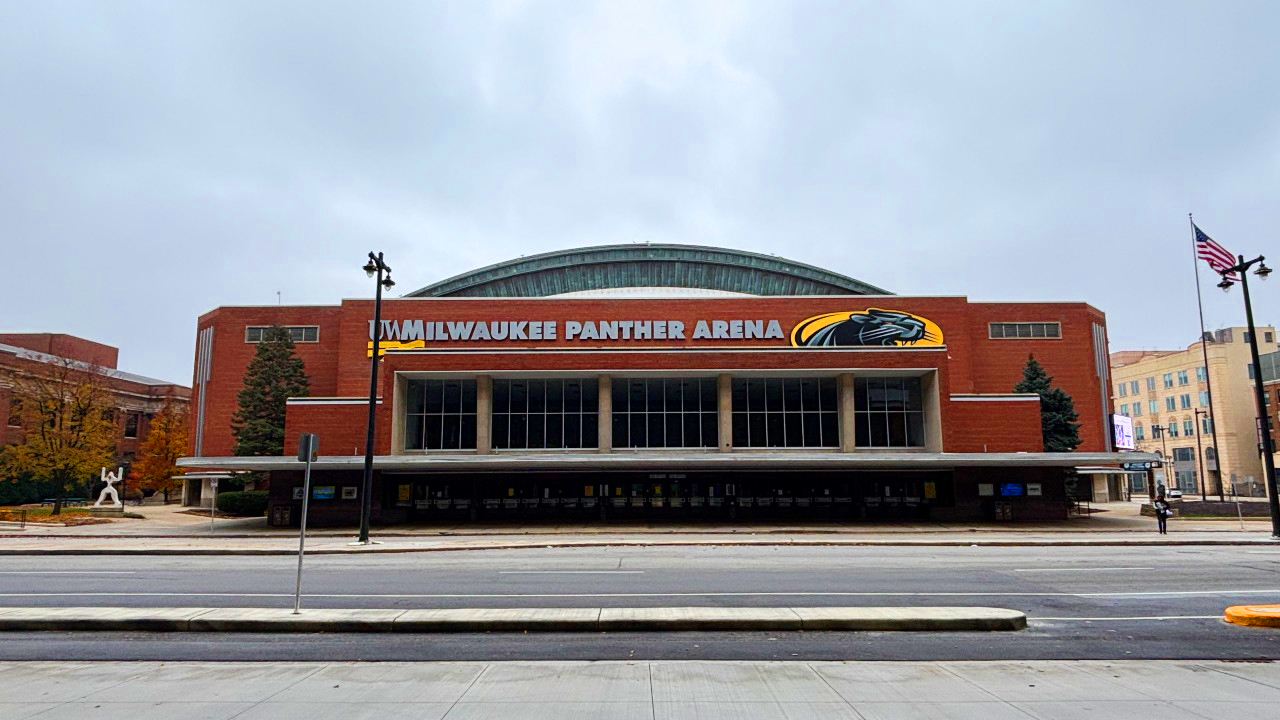
The study was first publicly discussed in May 2025, and, at the time, discussion centered around the UW-Milwaukee Panther Arena, located at 400 W. Kilbourn Ave. WCD president and CEO Marty Brooks informed the board that the WCD had entered into a contract with Hunden to study the highest and best use of the WCD’s real estate, which includes the Baird Center, Panther Arena and Miller High Life Theatre. The study cost $147,000.
At the time, WCD was entering into negotiations with the Milwaukee Admirals hockey team, whose lease at the Panther Arena ends after the 2026-‘27 season. WCD has been seeking to extend the Admirals’ lease until 2029, which is when the UW-Milwaukee Panthers lease and naming rights agreement ends. The WCD declined to provide an update on these lease negotiations.
“There are several factors we need to consider before entering into any discussion,” Brooks told the board. “…In assessing the length of a future agreement, we need to consider what is the best and highest usage of the facilities in the WCD’s real estate. If we aren’t growing, we as an organization are dying.”
In an interview with BizTimes in February, Brooks said that prior long-range planning efforts for the district had focused on the Baird Center expansion and, with that project completed and “getting rave reviews,” the district felt it was appropriate to “engage an expert to provide us with information (about its other facilities).” Further, Brooks said the district had not previously made a long-range plan for all of its properties.
Upon introducing the contract with Hunden to the board, board member Greg Marcus, president and CEO of The Marcus Corp. – the owner of three downtown Milwaukee hotels, including the Hilton Milwaukee – asked if the study could be expanded to include properties surrounding the WCD. Mark Flaherty of Jackson Street Holdings, another major hotel owner in downtown Milwaukee, echoed Marcus’s request.
A convention center hotel was not discussed at the May 2025 board meeting.
In response to the board’s request, Hunden’s study was expanded to evaluate six downtown sites for potential development:
- 310 W. Wisconsin Ave., an office building that’s struggled with low occupancy
- the city-owned parking lot at West Wisconsin and North Vel R. Phillips avenues
- the state office building at 801 N. 6th St.
- the state-owned parking lot at 623 W. State St.
- the UW-Milwaukee Panther Arena
- the Miller High Life Theatre.
Hunden ranked these sites based on their connectedness to the Baird Center, ability to accommodate the recommended project, potential to create vibrancy around the district, historic importance and presumed construction costs.
The Panther Arena and Miller High Life Theatre sites tied for the highest overall score. Ultimately, however, the report recommends redevelopment of the theater site rather than the arena. The arena is described as a “key district asset” due to its tenants and affordable entertainment offerings, though it needs an estimated $54.8 million in capital improvements over the next 20 years. Hunden said the High Life Theatre has comparatively weaker “community attachment,” though it only needs $18.5 million in improvements.
Moreover, Hunden said the High Life Theatre is vulnerable to competition from the newly opened Landmark Credit Union Live music venue in the nearby Deer District as both venues have a capacity of around 4,000.
However, Gary Witt, CEO of The Pabst Theater Group, called this comparison “professionally disqualifying.” Pabst Theater Group is the exclusive booker, marketer and operator of the High Life Theatre along with five other venues in the city.
Witt said the High Life Theatre is the state’s only traditional seated proscenium-style theater, suited for touring Broadway productions, comedy acts and keynote-style presentations, while Landmark Live is designed primarily for the contemporary music market.
“(Where) are we going to book Jerry Seinfeld? Are we going to have Ringo Starr? Are we going to have Steve Martin?” Witt said. “I could go on and on of all the shows that we do (at Miller High Life Theatre). … (Hunden is) a validated research company, and their main thrust of why to eliminate High Life is the fact that it’s going to be rendered useless by Landmark? It’s pretty easy to differentiate between the two (venues).”
In 2025, the Miller High Life Theatre was booked 102 days, according to figures provided by Pabst Theater Group. Of those dates, 41 were live performances booked by Pabst Theater Group and 61 were events booked by WCD. By comparison, Landmark Live is expected to host about 70 shows and events in its first full year of operation.
Witt said the booking split is due to the operating agreement between Pabst Theater Group and WCD, under which the district retains priority use of the venue for convention-related events.
“We agreed in our relationship with WCD to be able to allow them to still use it for convention- and conference-related purposes, and we would only use it for live performances,” Witt said. “…I feel 2026 is probably our first year of being able to (book more PTG shows) but we’re still battling with them over this.”
Witt and downtown Alderman Bob Bauman, a WCD board member, have also questioned the neutrality of the process.
The day before the May board meeting when the study was introduced, Witt received an email from Brooks asking to meet. According to Witt, Brooks said that the “goal of the study is to take down Panther Arena” and that the High Life Theatre was safe.
“The Hunden guys put together a study to satisfy Marty Brooks’ request for them to be a rubber stamp of what his bulls–t ideas were,” Witt said. “I can’t argue against a lie.”
Brooks said there was no predetermeined outcome for the study.
After the study was announced to the board, Bauman nominated both the arena and theater for local historic status, also saying he believed the study would conclude one of the buildings should be demolished for a hotel development. Throughout that process – which does not prohibit demolition or alteration to the buildings but does require city approval to do so – UWM and the Admirals came out in favor of saving the arena.
“Reading this over, it seems to me that your thumb was on the scale,” Bauman said, addressing Hunden Partners at a committee meeting after the report was unveiled. “You’re clearly pushing in favor of removal of the theater.”
Despite renderings in the report depicting a hotel on the High Life site and its top ranking in the scoring matrix, Brooks and Hunden have said the study does not recommend demolishing any specific building, and the board should consider any of the sites it ranked.
“There is no recommendation outlined in the study, that’s a misconception,” Brooks told BizTimes. “There is nothing in the study that recommends anything other than (Milwaukee needs) another convention center hotel. …My takeaway from the study was I am so glad we did this, because there is information in here that I believe is thought provoking.”
The UW-Milwaukee Panther Arena at 400 W. Kilbourn Ave. has a seating capacity of 12,700.Supply, demand and subsidy
Greg Hanis, hotel industry analyst and president of New Berlin-based Hospitality Marketers International Inc., said he has long believed Milwaukee needs another convention headquarters hotel to fully leverage the expanded convention center.
“There’s no question it would help the Baird Center’s marketability,” Hanis said. “If you put the property (at the High Life Theatre site), you will be the number one hotel in Milwaukee.”
The issue, however, is cost, he said.
Hanis estimates the hotel portion alone would exceed $200 million in development costs, with the entire project costing upwards of $500 million, and would need to command an average daily room rate of around $300 to justify that investment. According to a report on downtown Milwaukee’s hotel market from CoStar, the market’s ADR in 2025 was $167.
“When you look at the numbers, this project would never, never, never pencil out,” Hanis said. “The only way to make it work is with a substantial public subsidy.”
Currently, the WCD and Hunden have not outlined a framework for how the recommended hotel should be financed. Both have said it is too early in the process to have done that.
The City of Milwaukee’s longstanding tax increment financing policy has avoided the use of TIF for hotel development, which is the most common subsidy for hotel developments like this in other markets.
Other potential incentives could include hotel occupancy tax rebates, sales tax rebates or having the WCD finance the building’s meeting space, according to Doug Nysse, hospitality industry advisor and director of project and development services with Colliers.
Without a defined incentive framework, the project is “not viable whatsoever,” said Nysse.
“To motivate a developer, this deal would probably need one-quarter to one-third equity, one-third to one-half incentives that can effectively be treated as equity, and about one-third debt,” he said.
Even if a financing structure can be assembled, both analysts said the hotel’s long-term success would depend on whether the Baird Center can generate enough consistent convention business to fill it.
Hanis said a 650-room headquarters hotel would likely become the city’s premier property, potentially operating under a major upper-upscale or luxury brand, such as JW Marriott. A new building could offer larger room layouts, upgraded mechanical systems and more modern amenities than much of downtown’s existing hotel inventory, though he noted that recent renovations at the Hilton Milwaukee have narrowed the quality gap between it and any potential new competitor.
At the proposed size, the hotel would need a near-constant rotation of large events.
“You almost have to have 52 large conventions (a year),” Hanis said, “so that you would have a large convention coming in and out of that hotel at least once a week.”
Absent that steady group base, the hotel would be forced to compete directly with existing downtown properties for corporate travelers and tourists, according to Hanis. According to CoStar, downtown Milwaukee’s hotel occupancy for 2025 was 62%, compared to 70% in 2019. Business travel remains below pre-pandemic levels nationally, and Hanis said some travelers have recently gravitated toward smaller, lifestyle-oriented hotels such as The Trade and the Moxy, which is expected to begin construction this year in Deer District.
“If you don’t have those major conventions in there, that 650-room hotel on a non-convention week is going to compete with all the other hotels in town,” Hanis said. “It’s an interesting matrix.”
“In order for this hotel to be successful – and for the other existing hotels to be more successful – the Baird Center has to generate additional incremental room nights,” he said. “It can’t just reshuffle the deck.”
Reshuffling is exactly what Greg Marcus of The Marcus Corp. is concerned about.
“You tell me how our community supports another hotel when we’re running 60% occupancy,” Marcus said. “Adding more supply isn’t going to make it more healthy. Adding more demand will make it healthy.”
Marcus argues the expansion of the Baird Center was designed to improve operational efficiency – allowing conventions to load in and out simultaneously and smoothing booking gaps – rather than to dramatically increase overall size or immediately justify another large hotel.
“(The expansion) allowed you to more efficiently use your hotel stock,” Marcus said.
In November, Marcus told BizTimes that the Hilton Milwaukee could be expanded to 1,000 rooms at the city-owned site at Wisconsin and Vel R. Phillips avenues and would cost less than building a new hotel, but said that he doesn’t think now is the time for more hotel supply.
Developing that site, where the city has issued multiple requests for proposals, is also the preference of Bauman.
“I was told we were doing a highest and best use study of the two buildings (the Miller High Life Theatre and the UW-Milwaukee Panther Arena), not a hotel development pitch,” Marcus said. “I was pretty surprised by what we received (in the Hunden report). Not surprised at the idea that at some point we need more hotel stock, but just the, ‘Hey, everybody else has a hotel like this. You should too.’ Everybody else has a lot more air service than we have, and nobody else is this close to Chicago.”
Of the cities Hunden listed as competitors, Milwaukee has the lowest direct flights with 36, with Cleveland and Louisville the closest competitors with 39 and 41 direct flights, respectively. Some of the cities listed in the competitive set, like Charlotte and Nashville, have more than 100 direct flights.
Visit Milwaukee president and CEO Peggy Williams-Smith said air service comes down to a “chicken or the egg” scenario. She pointed to other markets like Columbus that have invested in their convention centers and their hotel package, and flight capacity increased subsequently.
Further, since the Baird Center expansion, she said, the number of leads requiring between 750 and 2,500 hotel rooms has grown significantly. In Milwaukee, a “citywide” convention is defined as one that uses at least 750 rooms.
According to Visit Milwaukee, the city has booked 19 citywide conventions between April and December this year with estimated attendance between 850 and 40,500 attendees, plus three tentative events. In 2027, there are 20 definite and tentative citywide conventions and 11 in 2028 so far.
This momentum could be built upon with the addition of a convention center hotel at some point.
“My position has been consistent in that I believe, for the market to grow and for us to be competitive, that we need another convention center hotel,” Brooks said.
However, in 2024, 42% of visitors to the Baird Center originated within 25 miles of the convention center, and another 33% originated within 25 to 100 miles. Many of these people are unlikely to be staying at hotels.
“How this can somewhat be successful is by figuring out how the city drives room nights to this hotel and every other one,” Nysse said. “That’s absolutely key.”
Nysse also said the Hunden study does not fully address seasonality, one of Milwaukee’s longstanding convention challenges. The city performs relatively well from spring through early fall, when convention activity overlaps with peak tourism season. Winter months, however, are more difficult to fill.
“I don’t know that this hotel will increase demand in the off months,” Nysse said. “And that’s going to be an issue.”
No decision yet
The WCD board has referred the study to a special committee for further review, which will present its findings to the full board in May.
The committee is chaired by Milwaukee County comptroller Liz Sumner and includes Northwestern Mutual executive Grady Crosby, Milwaukee Education Partnership executive director and Republican Party official Gerard Randall, Bauman, Wauwatosa mayor Dennis McBride and board chair Jim Kanter.
Sumner said the group is working to answer four primary questions: Does Milwaukee need to pursue a convention center hotel? Where should it be located? Is the Wisconsin Center District the right catalyst to get a hotel sited, financed and built? And, is there a different or better catalyst?
Even if political support and financing fell into place quickly, a project of this scale likely would not open until the early to mid-2030s.
“The conversations about additional hotel inventory aren’t about today’s occupancy,” Williams-Smith said. “They’re about long-term demand, citywide convention requirements and opportunities that we currently can’t pursue because of package limitations.”
Author
-
 View all posts
Elizabeth Morin is a writer based in Virginia Beach. She is passionate about local sports, politics and everything in between.
Have any Virginia Beach-related news published on our website? Email us at admin at thevirginiabeachobserver.com.