[ad_1]
Mariana Sanabria says some people are built to be first responders.
“When they see a need, they run towards it,” said Sanabria, Alverno College’s vice president of enrollment services. “I would describe myself as that kind of person.”
When she started at the private Catholic women’s college on Milwaukee’s south side in February 2025, she saw plenty of needs.
Alverno had spent years losing students and money, and in 2024 an outside consultant warned that the college could close within a few years if it did not fundamentally change the way it operated. The college responded by declaring financial exigency, cutting academic programs and jobs, renegotiating contracts and making other changes aimed at closing a structural budget gap that in 2024 surpassed $11 million.
Now, in its 139th school year beginning this week, Alverno has made measurable progress on the problems that put its future in question, but the college is still operating in a difficult higher education market, where declining numbers of traditional college-age students and changes to federal student financing are creating new challenges.
Undergraduate applications for this fall are up 40% from last year, and new incoming undergraduate enrollment is expected to be up 59%, Sanabria said. Overall enrollment, however, is expected to only be up by about 11% due to declining graduate student enrollment, which Alverno leaders attribute to federal policy changes in graduate funding.
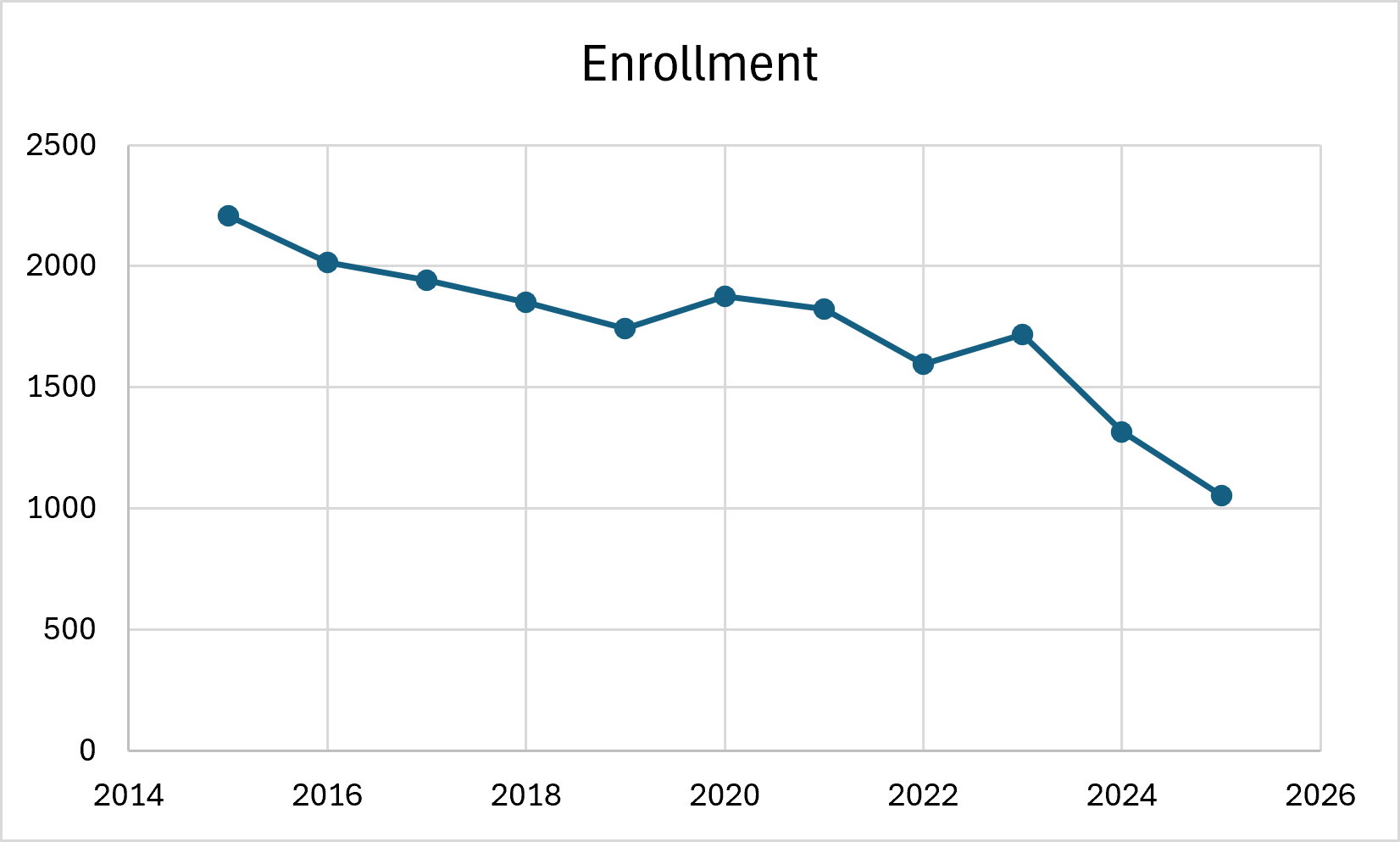
That comes after Alverno’s total enrollment fell from 2,209 students in 2015 to 1,053 in 2025, a decline of more than half.
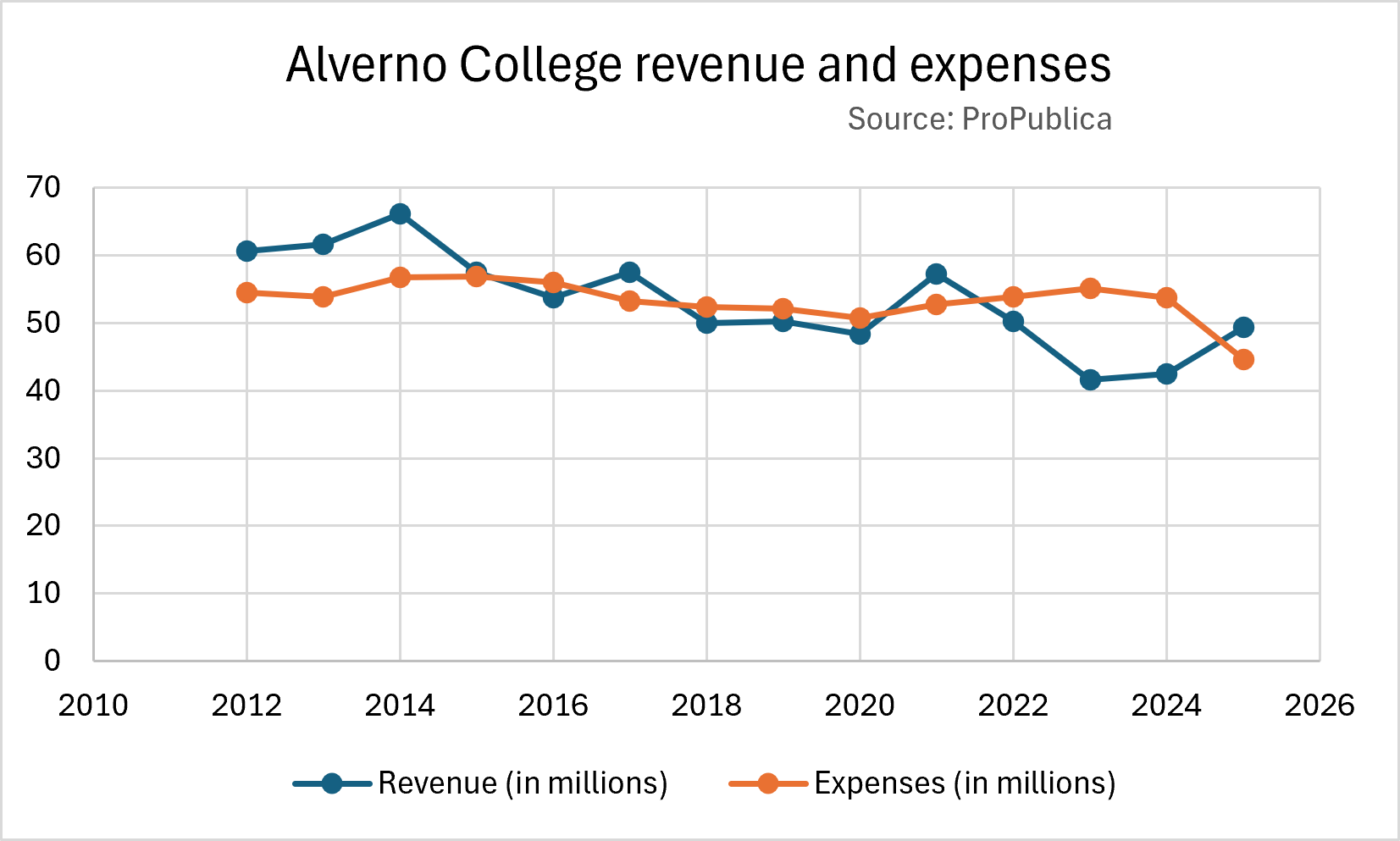
On the financial side, Alverno’s tax filings posted by ProPublica show that fiscal year 2025 marked the first time in several years that its total revenue – $49.4 million – surpassed its expenses of $44.6 million.
The school, however, is still operating with a structural deficit of $5.2 million in fiscal 2025— albeit down considerably from the $11.5 million structural deficit in fiscal 2024, according to Alverno president Christy Brown.
“The needle is pointing in the right direction,” Brown said in an interview with BizTimes. “It’s going to take more than one year to make changes to the organization, but at this moment (we are) on a positive trajectory.”
Confronting the deficit

Brown arrived at Alverno in 2023 with a background that she says was unusual for a college president. She had worked in higher education finance and administration at UW-Milwaukee and Milwaukee Area Technical College, practiced labor and employment law and most recently led Girl Scouts of Wisconsin Southeast, but did not come from the academic background many college presidents do.
“The reason that I came here was because I love higher ed,” Brown said. “I feel like higher ed changed my life.”
At that time, Alverno’s board had already hired a consultant to examine the college’s finances and operations, including its academic programs, admissions, advancement, athletics and marketing, which Brown received about a month after arriving. It included roughly 300 pages, plus a 1,500-page addendum, she said.
The college declared financial exigency in 2024, which is a formally declared state of financial distress that gives an institution the ability to make deeper changes to its staffing and academic portfolio.
At Alverno, the total number of undergraduate majors was reduced from 43 to 29. Graduate tracks were similarly consolidated from 25 down to 19. The college’s track and field program was also cut. To further stabilize the budget, the college laid off 25 full-time faculty members and 12 full-time staff members. Additionally, Alverno renegotiated its contract with several vendors, including an online program manager that resulted in about $2.6 million in additional revenue, according to Brown.
“I’m here because the skills that I bring are not traditional higher ed skills,” Brown said. “I’m a businessperson, and when I came in, they were in a time of financial distress. I think they were looking for somebody who could really meet the moment because it was a very crucial moment in the institution’s history. I was tapped to come help transform the organization, but it’s a focused transformation because not everything is broken.”
As a result, expenses fell to their lowest level since 2012 at $44.6 million in fiscal 2025. Between 2012 and 2024, expenses hovered between $50 million and $57 million, despite enrollment declines, tax records show.
Six months after declaring financial exigency, the Higher Learning Commission removed Alverno’s financial distress designation in December 2024.
The financial trajectory has also been helped by philanthropy. Brown said Alverno typically receives about $3 million in annual operating support from philanthropy, but landed a $10 million gift from the TOSA Foundation, among other gifts, that provided an additional boost in fiscal 2025. For the 2026 fiscal year, which closed this summer, Brown said Alverno received roughly $3.7 million in philanthropic support.
The college reported an $11.5 million structural deficit – which includes contribution revenue but not one-time gifts or grants – in fiscal 2024, followed by a $5.2 million deficit in fiscal 2025. Brown said the school is expecting to have performed at or slightly better than its budget for the 2026 fiscal year.
“It’s hard work, but it’s work that everybody here is willing to do and is committed to doing,” Brown said.
Rebuilding enrollment

Sanabria first worked in admissions at Alverno from 2014 to 2016, when the college was in a much different position.
“I was here at a time when Alverno was really exploding,” Sanabria said. “We were coming off a huge capital campaign and a huge investment into the college at that time, so there was a lot of excitement. There was a lot of innovation happening, and it was a really vibrant community.”
She spent the years after that working in higher education enrollment and admissions elsewhere before returning to Alverno in February 2025. By then, the college had lost more than half its students.
“Having known what it could be really drove me back to Alverno,” Sanabria said.
For years, Alverno’s admissions operation had become less visible, in part because financial constraints limited travel and recruiting activity, according to Sanabria.
Sanabria returned to an admissions operation that was also in transition. Retirements and departures had left the team rebuilding, and the college had to reestablish relationships with high school counselors and prospective students.
The strategy has been to get Alverno back into places where students are making college decisions.
New undergraduate enrollment for this fall is currently 59% higher than last year, Sanabria said. Applications are up 40% and deposits are up 66%.
Sanabria attributes much of that growth to a stronger admissions team, including counselors who are Alverno graduates and can explain the college’s distinctive approach from personal experience.
For years, however, the question hanging over those conversations was whether Alverno would still be around. Alverno’s financial challenges came to light in 2024, Cardinal Stritch University, another private Catholic college in Milwaukee’s north shore suburbs, had closed just a year prior, and UW-Milwaukee closed its satellite campus in Washington County in 2024 and its Waukesha County campus in 2025.
Sanabria said counselors and families had legitimate questions about the college’s future during the period of financial uncertainty.
“A lot of the work we did this year was just starting those conversations again and saying, ‘Yes, we’re here,’” she said.
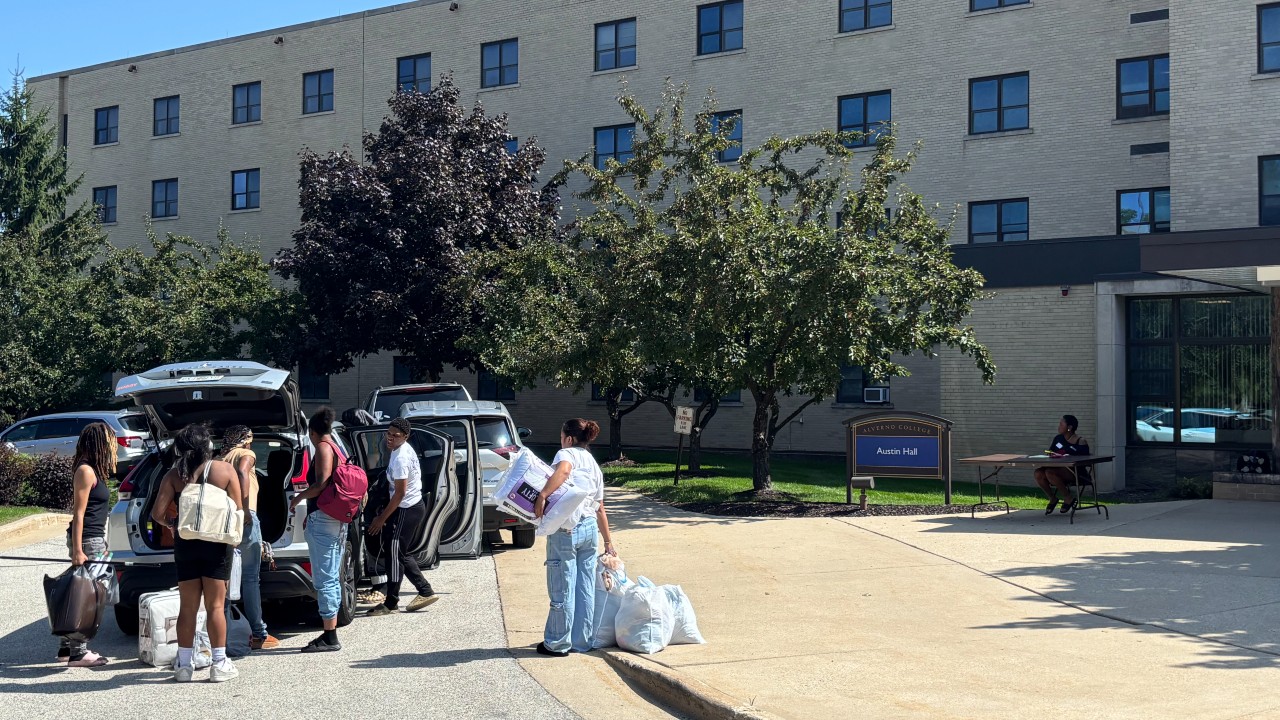 Credit: Hunter Turpin/BizTimes Media
Alverno has also tried to remove friction from the application process.
The college recently joined the Common Application, which is a single online website that lets students apply to participating schools instead of filling out a different application for each school. Alverno also became the first private school to partner with Milwaukee Public Schools on a direct-admission program. The first cohort of MPS students produced twice as many applications as the previous MPS application count, according to Sanabria.
“Since that announcement, I’ve had other calls from other schools and other districts who are like, ‘We want in,’” Sanabria said. “We’re paying attention to students that we’ve historically served well, but we have to catch up with the best way to serve them.”
That effort extends beyond traditional high school graduates. Sanabria said degree completion is an area of particular interest for Alverno, which is looking at ways to reach adults who started college but never finished. Wisconsin has roughly 780,000 adults with some college credits but no degree, according to a report released in July by ReUp Education.
Alverno is also working to expand its online and hybrid offerings, which could allow it to reach students who are working, caring for families or otherwise unable to attend a traditional in-person program, according to Sanabria.
The undergraduate gains are coming as Alverno faces a separate problem on the graduate side.
Changes to federal student lending that were passed as part of the One Big Beautiful Bill Act and took effect July 1 eliminated new Graduate PLUS borrowing for most graduate students and imposed new federal borrowing limits for graduate and professional programs. The changes have made it harder for some prospective graduate students to finance their education and led to a “contraction” in graduate enrollment, Sanabria said.
Making the case for Alverno
The enrollment push comes as the value of a college degree faces increasing scrutiny nationally and colleges face more pressure to show students what they will get in return for the cost of a degree.
That debate is particularly consequential for Alverno, which is a designated Hispanic Serving Institution and has a student body with high financial need. Roughly 70% of its students are Pell-eligible and more than 70% of students are first-generation college students.
Alverno has responded in part by narrowing its academic portfolio toward fields it believes has stronger demand and clearer connections to the regional workforce. Today, nursing, education, business, social work and psychology are among the college’s core fields.
According to federal data released in March, Alverno graduates had the third-highest earnings post-graduation in Metro Milwaukee, following Milwaukee School of Engineering and Marquette University.

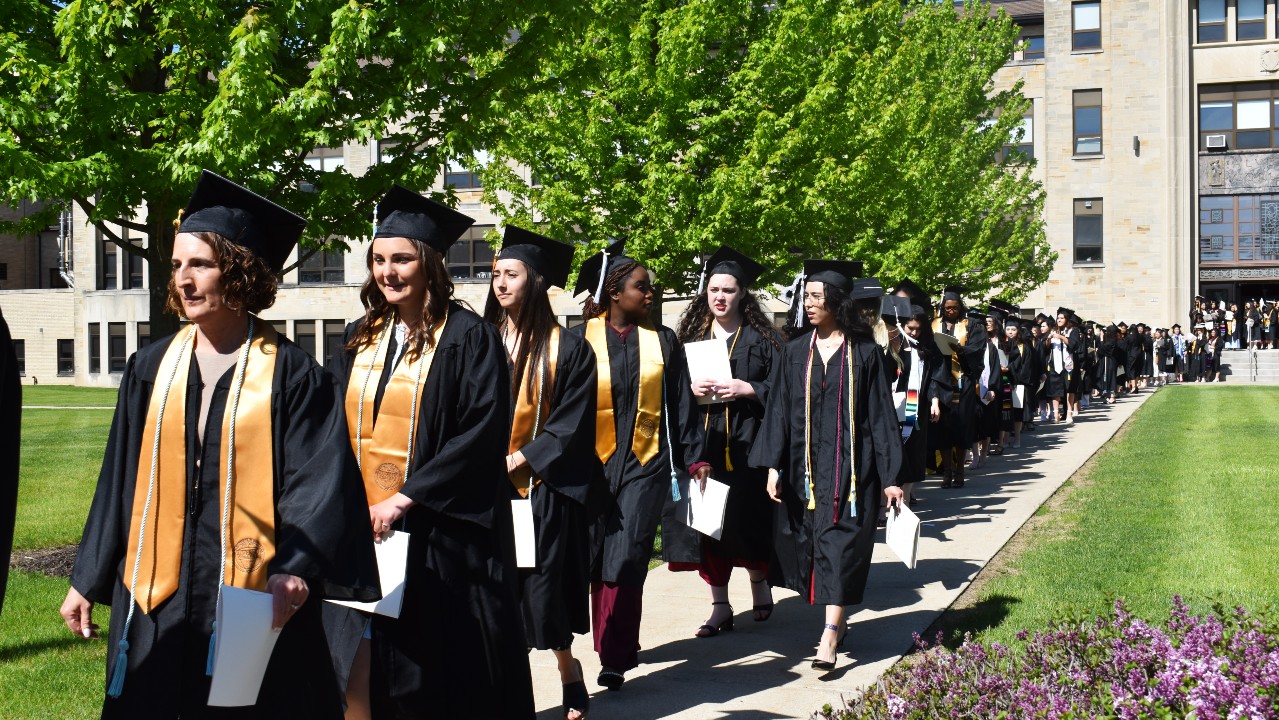
Brown and Sanabria said part of that post-graduation success is due to Alverno’s unique grading philosophy.
Since the 1970s, Alverno has eschewed traditional letter grades in favor of an ability-based approach in which students demonstrate competencies and receive detailed feedback. Brown argues that the system more closely resembles the workplace – and life – than a traditional grading system.
“(Students) benefit from getting feedback and from being able to demonstrate that they can communicate or problem solve,” Brown said. “Our abilities approach is helping bring people into the world who are critical thinkers. They are going to contribute in the spaces that they’re in.”
“If we continue to shift the way that we help students understand the ‘why’ of choosing Alverno to really focus on that outcome piece, I think that will be a good way to kind of respond to that national conversation,” Sanabria said.
Another 140 years
The financial restructuring bought the institution time, and enrollment growth is giving it momentum, but Brown said her larger goal is to build a vibrant institution that is stable enough to weather the ongoing headwinds in higher education.
Alverno will turn 140 years old in 2027, and “we want to have another 140 years,” Brown said.
“The goal is long-term sustainability by continuing to capitalize on the gains that we’re making, and then making sure that momentum carries us through the long term,” Brown said. “We think that the world, and Milwaukee specifically, needs Alverno College. …I think if we weren’t here, there would be a lot of students and families who would be in a different place, and a city that would be in a different place.”
[ad_2]