Milwaukee Film’sDowner Theatrecapital campaign continues with sessions to inform the community about its restoration plans and timeline. People in attendance at these Downer Theatre info sessions range from local film lovers, community partners, private donors and Milwaukee Film members.
The $8 million total fundraising goal covers purchasing costs, renovation phases, a contingency for inflation and a reserve for future repairs. Milwaukee Film’s campaign has raised just over 20% of its goal and just over $1.7 million.
There are four main goals for the capital campaign:
Elevate the filmgoing experience with high-quality projection, audio, seating and accessibility features.
Improve the economic and cultural livelihood of the Downer Avenue neighborhood.
Add the Downer Theatre to the National Register of Historic Places.
Reduce the operating costs for Milwaukee Film, while still expanding programming and bolstering its mission to “create world-class cinematic experiences” that initiate “positive change in Milwaukee.”
Milwaukee Film director Susan Kerns is hosting these info sessions, and she has also been doing live introductions to films where she brings up the Downer Theatre’s capital campaign. Most recently, these live introductions were done at the first few nearly sold-out screenings of “The Odyssey.”
Downer Theatre’s capital campaign is separate from operating costs; therefore, money from memberships, concessions and ticket sales goes only toward day-to-day business operations.
“We’re basically trying to make sure that people understand the long game with the Downer Theatre but also understand the importance of the day-to-day moviegoing. They are both the same kind of organizational philosophy,” said Kerns.
Alongside the capital campaign, Milwaukee Film is fundraising for a rigging project at the Oriental Theatre, which is considered part of general operating costs.
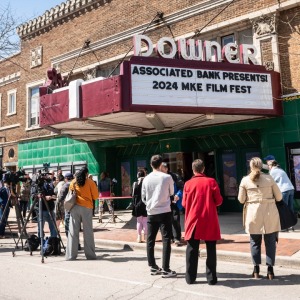
Credit: Milwaukee Film The Downer Theatre during the 2024 Milwaukee Film Festival.
After purchasing the Downer Theatre for $1.55 million in February, Milwaukee Film launched the capital campaign to raise money for improvements. In June, it received a $500,000 donation from the Richard and Ethel Herzfeld Foundation. That donation was the first major gift announced for the campaign, and it was accompanied by a challenge to match it. The intention is that this helps Milwaukee Film pay off the loan it had to use to purchase the Downer Theatre.
Previously, Milwaukee Film rented the small two-screen cinema on Milwaukee’s East Side at 2585 N. Downer Ave. since March 2024, after it had closed its doors in September 2023. It purchased the building from Seattle-based real estate investor Bridge33 Capital.
Bridge33 was very eager to sell the Downer Theatre building, according to Kerns. Therefore, with the option to purchase expiring in March, Milwaukee Film’s Board of Directors approved the Downer Theatre purchase with a low-interest loan from board member Matthew Helmerich via The Helmerich Trust.
The Downer Theatre capital campaign isn’t traditional in that it was announced very early on, whereas usually it would go public when more money had been raised.
“We felt like we had to launch it because we had to purchase by the deadline,” said Kerns. “We needed to go public with this and start talking to people since the purchasing timeline made some decisions for us.”
The purchase of the Downer Theatre was necessary for the continued success of the Milwaukee Film Festival. Inflation changed the landscape for setting up theaters in auxiliary spaces. It becomes cost prohibitive to try to put an additional screen in a space that isn’t a movie theater year-round.
According to Kerns, it was just about $100,000 for each screen that was set up in different spaces. The Milwaukee Film Festival needs more than just the three screens available at the Oriental Theatre to accommodate the films being exhibited during its two-week period.
If the purchase had not been made, then the Downer Theater would’ve been at risk of being gutted and turned into a plethora of revolving businesses, which historically happens when theaters are not operating as theaters continuously.
A local example given of this trend is the Modjeska Theatre located on Mitchell Street, which closed in 2010. The theater has had past failed renovation projects and currently sits abandoned.
“The Modjeska Theatre is still very opulent inside if somebody were able to come in and save it, but it’s just so far gone at this point that it would be very, very difficult. So, that’s basically what we were trying to avoid by making sure that we acted quickly (in purchasing the Downer Theatre),” Kerns said.
For dramatic effect, Kerns showed an edited photo of the front of the Downer Theatre as a dirty, dilapidated building full of neon signs. In this imagined dystopian future, the theater was a business that sold cell phones and vapes.
“A lot of times they will take all the seats, they will take the screens and they will take the sound systems. Then what happens is somebody will move in, and it might be like a fitness center for a couple of years and a daycare for a couple of years, and then this or that for a couple of years,” Kerns said at the Downer Theatre info session.
Credit: Milwaukee Film
After taking over operations of the theater, the nonprofit arts organization became the first local owner and operator of Downer Theatre since the 1980s.
According to Milwaukee Film, the historic Downer Theatre, which first opened in 1915, is Wisconsin’s oldest still-operating movie theater. The cinema was originally one screen before being duplexed in the 1990s by its then-owners, Landmark Theatres.
The Downer Avenue neighborhood is unique and special to Milwaukee because several long-standing local businesses operate there, including the Downer Theatre, Boswell Book Company and Nehring’s Sendik’s on Downer.
Cinema United, a national organization of theater owners that Milwaukee Film belongs to, has done studies on the business impact of movie theaters. It talks to people all over the country about the economic impact that cinemas have on neighborhoods.
According to a Cinema United national study, for every $1 spent at a movie theater, an additional $1.50 is spent in the neighborhood on nearby food/drink, shopping and parking. Milwaukee Film estimates that the Downer Theatre generated $952,500 for the neighborhood, based on revenue at the theater for 2025.
The Kubala Washatko Architects (TKWA) of Cedarburg, which handled the renovation of Milwaukee Film’s Oriental Theatre, will handle all the historical preservation and architectural plans for renovation for the Downer Theatre.
“TKWA knows what our expectations are in terms of our quality,” Kerns said. “The same team will take the same care and precision that they did with the Oriental in this space. We know nobody else is going to do this at the level that we want to do it. We have very, very high expectations of ourselves in terms of the projection, the sound and the seating.”
The goal is to preserve as much as possible while improving the experience. Downer Theatre’s plaster is still in very good condition and just needs some cleaning up. Targeted lighting will be put in different places to accentuate the already unique features of the Downer interiors.
Milwaukee Film is confident with how it currently screens films in the Downer Theatre, but they know there are places to make improvements to the cinematic experience.
“I hope that it looks very much the same as it does now, but just nicer. Like a glowed-up version of itself, with nicer seats that are a little bit more comfortable,” Kerns said. “Targeted lighting will draw attention to the beautiful ceiling here and some of the plaster details at the top. Things like that show off what a great space it is. Bring everyone back to what it looked like in the 1930s by just doing a little bit of cosmetic renovation.”
Besides putting in new theater seats, one planned improvement is in how the theater is masking its films. Masking refers to the borders around the projected image area that ensure the film is exhibited in the specific aspect ratio intended by the filmmakers. This allows the viewer to properly have their attention channeled into the film’s world.
“It’s like seeing a painting at an art museum without a frame. It just sort of blends into the wall,” Kerns said.
Currently, their masking system is a manual curtain with a pulley system. This is clunky and awkward for the viewer because a cinema worker will have to physically come to the front and adjust the curtains. The new system would be electronic and controlled remotely.
Accessibility is another concern for Milwaukee Film, as they plan to install a hearing loop, which means placing hearing coils beneath theater seats. This is the same system utilized at the Oriental Theatre, which allows people with hearing assistive devices to use an app to connect to the coils and have a seamless film-going experience.
The Downer Theatre needs updated and improved acoustic isolation to prevent sound bleed from one screening room to the other. This is due to the quality of the wall that was put up when the theater was split into two in the 1990s.
“This wall is incredibly thin. That wall is literally the width of my hand,” Kerns said. There is only a six-inch wall that separates the two spaces.
Inside the projection booth, Milwaukee Film wants to place 35MM projectors, which would allow the Downer Theatre to screen movies on film. Currently, the theater only screens digital films.
Outside in the front of the theater, Milwaukee Film wants to do some neon restoration of the marquee with no plan to ever replace it with LEDs. Other minor external updates include touching up the poster cases and tile replacement.
However, Milwaukee Film isn’t interested in messing with the theater’s historic image. “We want to stick with what we have because it’s so iconic,” Kerns said.
There is the possible addition of a blade sign that includes a theater naming rights option for someone who reaches the $4 million level. If this $300,000 blade sign is unneeded, then its funding moves into the reserve.
An amenities renovation would include the Downer Theatre bathrooms, which are functional, but far from luxurious. The bathroom lounges on each side would be removed to allocate extra actual bathroom usage and make sure there is space for an all-gender or family restroom.
Naming rights for donations received are subject to change as renovation progresses, and additional options might become available later. However, all donors at or above $10,000 will appear on a donor wall.
“People have also been asking about the restrooms, if they could have their name on the restrooms. The answer is absolutely. I just did not anticipate how popular that question would be,” Kerns said.
The concessions stand will also be moved back by removing a few rows of seats inside the theater. This is being done to create more space in the theater lobby.
“If we have just like three more feet of space in there, it’s just going to be so much easier to move around. You can talk to your friends a little bit easier after the movie is over. We do a lot with community partners, so being able to have a table for them to talk to people about their work, all those things allow this space to be the vibrant community hub that we know it is,” said Kerns.
While all these changes to the Downer Theatre are happening in phases, the bulk of the renovation is planned to take place after the 2028 Milwaukee Film Festival concludes. The Downer Theatre would shut down for most of the rest of the year, and then Milwaukee Film would have a grand reopening with all changes in place. This ensures that there wouldn’t be a major shutdown two years in a row.
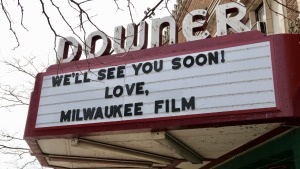
Credit: Milwaukee Film The Downer Theatre’s marquee sign.
“As somebody who is really invested in film, I love that I get to go to the oldest theater in Wisconsin,” Kerns said. “I know that this is not the most opulent theater we have in Milwaukee. That’s only because we have such an amazing theater (the Oriental Theatre) down the street. In most cities, this would be just like the cream of the crop and Milwaukee is so lucky that we don’t even know that.”
The Downer Theatre will continue to show films for the near future, and an important tenet of the theater is strategically programming films to target nearby young audiences. Attendees at the Downer Theatre info session brought up how younger viewers are craving authentic experiences, and that the University of Wisconsin-Milwaukee is just down the street.
Upcoming, from September 24-27, 2026, Milwaukee Film will have its Dialogues Documentary Festival sponsored by Potawatomi Casino Hotel, which will take place in both the Downer and Oriental Theatres.
$8 Million Fundraising Breakdown:
Phase One (2024-2026): Initial Expenses ($1,904,236)
Initial expenses (pre-ownership) and purchasing the Downer Theatre
Phase Two (2028): Small Space Renovation ($2,015,855)
Vestibule, Lobby, Concessions, Restrooms, Projection Booth and Office Space
Phase Three (2028-29): Theatre Houses Renovation ($2,945,597)
New Seating, Hearing Loops, Acoustic Isolation, Masking System, Speakers and Visual Upgrades
Phase Four (2029): External Building Costs ($478,000-$778,000)
Marquee, Blade Sign, Poster Cases, Paint and Tile Replacement
Elizabeth Morin is a writer based in Virginia Beach. She is passionate about local sports, politics and everything in between.
Have any Virginia Beach-related news published on our website? Email us at admin at thevirginiabeachobserver.com.