In downtown Milwaukee, the new Milwaukee Public Museum is forcing its builders to rethink standard practices.
The building’s canted façade, irregular floor heights and rounded geometries have eliminated many off-the-shelf construction solutions, leaving the project team to “pave their own way” through several major design and engineering decisions.
The $255 million project at North Sixth Street and West McKinley Avenue will replace the current Milwaukee Public Museum building at 800 W. Wells St., which opened in 1963 and has struggled for years with aging infrastructure and mounting maintenance demands that have made long-term updates increasingly difficult. Scheduled to close in January 2027, the existing museum would likely have to be shut down around then, regardless of whether a replacement was under construction, said MPM president and CEO Ellen Censky.
When complete in late 2027, the new five-story, 200,000-square-foot facility will be known as the Nature & Culture Museum of Wisconsin. Designed by New York-based Ennead Architectsin collaboration with Milwaukee-based Kahler Slater and built by Minneapolis-based Mortenson, the project is among the most complex builds currently underway in the region.
From the beginning, leaders said the scale and ambition of the design required a tight level of coordination across disciplines. Formal design work began in 2021, with construction launching in 2024, but project leaders emphasized that aligning architects, builders and museum leadership early was critical to keeping the vision both ambitious and achievable.
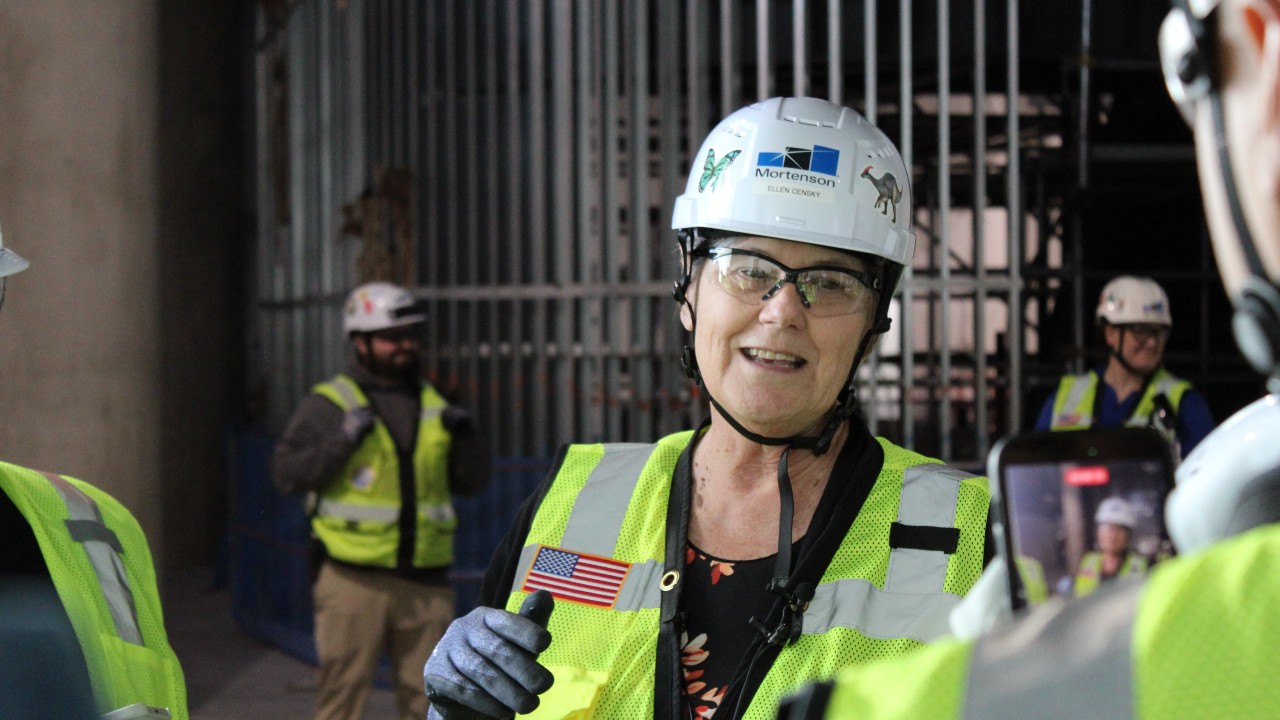
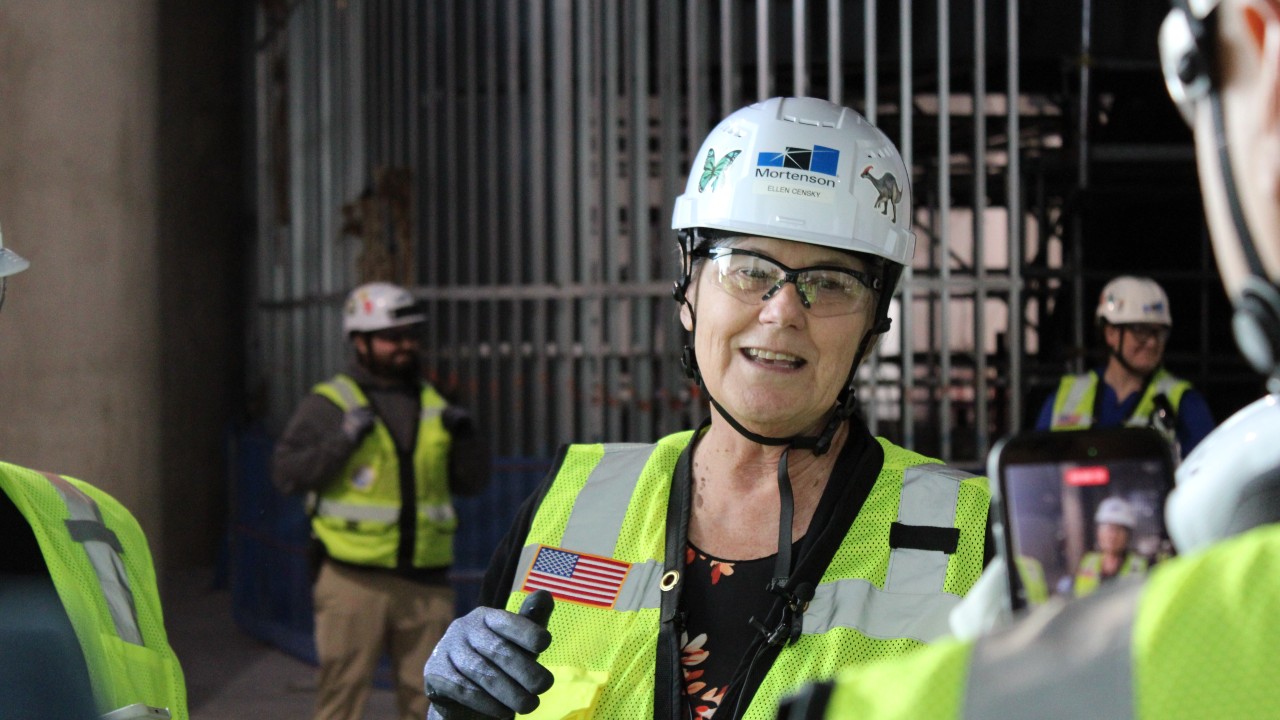
Credit: Hunter Turpin/BizTimes Media Ellen Censky led a media tour of the new museum in mid-May.
“The reason we made the commitment to bringing the team together all at once was because we knew we were going to have a lot of hard conversations and we needed to be honest in those conversations,” Censky said. “Construction management, they’re the ones who cost it all out, and you know architects are gonna design these amazing buildings that cost an amazing amount of money, and we needed at every step in that process to cost it out and make sure that what we came out with we could afford.”
Inspired by nature
A major source of design inspiration came from outside the drafting room entirely. Early in the design process, the team traveled across Wisconsin on a tour to learn about the state, help the project team bond and kick off community engagement statewide.
“One of the things that we learned from the trip was how important the movement of water was for the development of Wisconsin, for the development of its diverse landscapes, for the people who settled in those diverse landscapes how they made their livings and how those livings evolved into culture. Water is both in the shape and the form of the building,” said Jarrett Pelletier, principal at Ennead Architects.
The building’s organic, rounded shape and textured exterior mimic the ancient geological formations and “sea stacks” found at Mill Bluff State Park in west-central Wisconsin. Those formations were created by glacial forces more than 10,000 years ago. Further, the interior commons is inspired by the meeting of Milwaukee’s three rivers.
“We have people who love the building (design) and people who say it looks like takeout food containers,” Censky said. “I’ve heard it all, but when I explain where the inspiration came from and show pictures of the actual bluffs, people have a new view on it, the geology of Wisconsin and the impact of water. This building could only sit in this state and have meaning.”
But translating those conceptual ideas into a buildable structure has required continuous problem solving.
One of the museum’s defining design ambitions is to “turn the museum inside out,” revealing what is hidden in storage in the current museum. Roughly one-third of the new building is dedicated to collection storage, housing portions of the museum’s more than 4 million objects. Those storage areas require lower ceiling heights and safe, controlled environments. Exhibit floors, by contrast, demand tall spaces designed for immersion, which was another one of the museum’s core design requirements, according to Censky.
The architectural response was to stack and stagger those different uses, rather than isolate them. Two floors of public exhibit space are paired with three floors of collection storage, with intentional “seams” between them, where glass openings allow visitors to see directly into the collections environment.
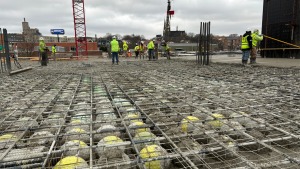
That design decision, however, created a cascading set of engineering challenges. Traditional column grids could not accommodate the mismatched floor heights and load patterns created by the staggered design, explained Kurt Theune, vice president and general manager at Mortenson. To solve this, the team turned to a system known as “BubbleDeck,” which is a reinforced slab technology that uses hollow spheres embedded within concrete to reduce weight while maintaining strength.
Credit: Mortenson The BubbleDeck system.
The system allowed engineers to eliminate a significant volume of concrete, which Theune estimated at roughly a million pounds.
On the exterior, the museum’s distinctive canted façade, where panels tilt inward rather than stacking vertically, exposed the limits of traditional precast construction.
Early design concepts imagined the shape of the building to be “inverted cones,” Pelletier said.
“We discovered that, as a cone, each one of those panels would be a different shape and size, and that drove up the cost substantially,” Pelletier said. “What we learned was if we could make it a tilted cylinder, which is what the shape of the building is now, then each of those panels throughout the whole of the building could be identical in terms of its shape, so the precaster could make the structure much more efficiently.”
However, since the panels tilt inward, they couldn’t rest atop one another the way conventional precast panels do. The weight had to go somewhere else.
“To figure it out, Mortenson reached out across the country to say, ‘who’s done this before and how have you done it?’ And they could not find anybody who had done it,” Censky said. “So, they spent six months figuring out how are we going to hang these panels.”
“We are all now experts in figuring it out,” Theune said. “This is the type of project that all of the craftsmen and tradespeople that worked on it will drive past for years and say, ‘I built that.’”
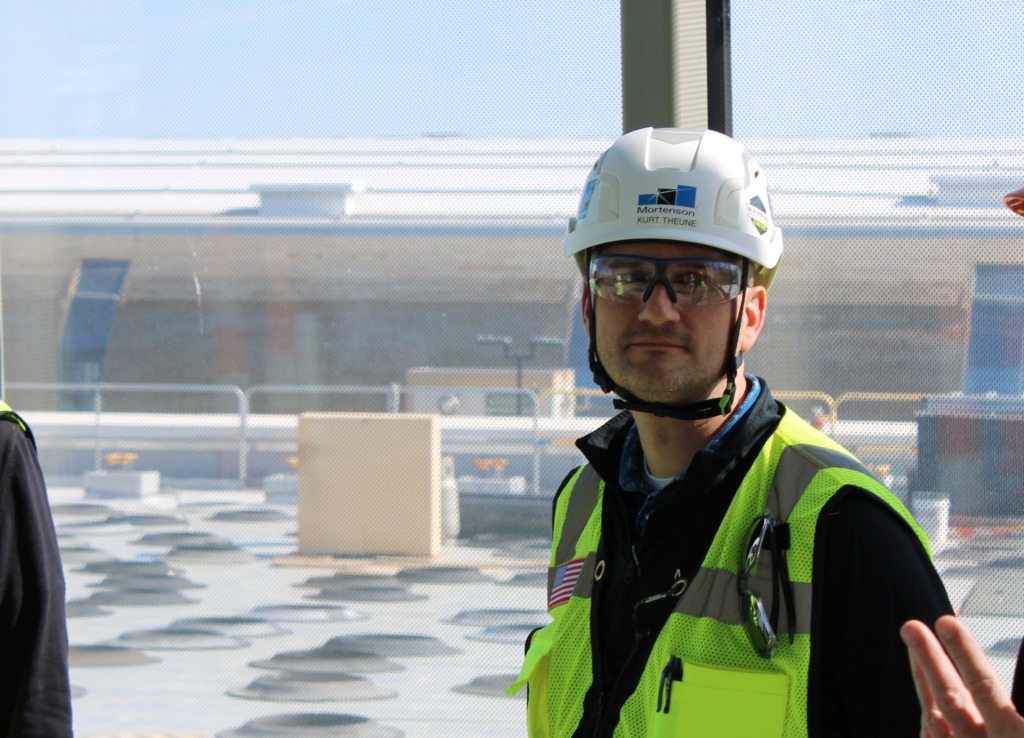
Credit: Hunter Turpin/BizTimes Media Kurt Theune, vice president and general manager at Mortenson, on a May construction tour.
Elizabeth Morin is a writer based in Virginia Beach. She is passionate about local sports, politics and everything in between.
Have any Virginia Beach-related news published on our website? Email us at admin at thevirginiabeachobserver.com.