Cancer researchers have spent decades identifying the pieces of a puzzle they hope will eventually unlock better treatments and cures. According to Medical College of Wisconsin Cancer Center director Dr. Gustavo Leone, scientists now know where most of those pieces are.
“Think about a puzzle that has 1,000 pieces,” Leone said. “I think we have probably 920 something odd pieces of the puzzle— not placed, but identified. As you build it up and you start putting the pieces together that we have like genomics, RNA proteins, lipids…”
Add a $27 million donation to the mix, and Leone says researchers can assemble the puzzle faster.
“The timing is critical right now,” Leone said. “This will accelerate everything we’re doing.”
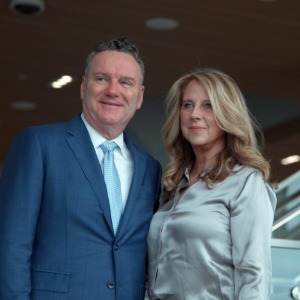
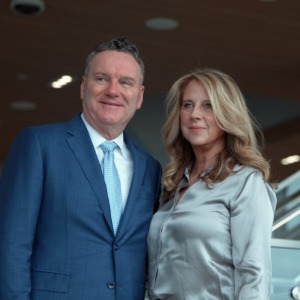
Credit: Medical College of Wisconsin Tim Michels and Barbara Michels
The funding will support the recruitment of researchers, expansion of precision oncology programs and investments in technology ranging from tumor sequencing to bioinformatics and artificial intelligence, according to MCW.
For Tim Michels, the decision to increase the family’s commitment to MCW was driven in part by its new cancer center, which opened in August and is now known as the Michels Center for Cancer Discovery, and the scientists working inside it.
“It’s a beautiful building, but without people, this building is just glass, steel, brick and mortar,” Michels said. “The people are what really inspired us.”
Leone said a significant portion of the funding will be directed toward the recruitment of new faculty. The cancer center expects to recruit approximately 15 additional faculty researchers, plus other trainees and staff, according to Leone.
The opening of the new facility has already helped raise MCW’s profile among researchers, Leone said.
“I think we have an opportunity now, because of the new building,” he said. “People get attracted to shiny buildings to work in modern facilities with state-of-the-art technologies.”
Additional researchers can expand the number of projects underway at the cancer center while bringing expertise in emerging areas of cancer science, he said.
Beyond recruiting talent, MCW plans to use the funding to expand technologies that researchers say are transforming cancer research.
Among the priorities is precision oncology, an approach that seeks to understand cancer at the molecular level and tailor treatments to the biology of individual tumors.
The approach allows researchers to look beyond a cancer’s location in the body and examine its unique genetic and molecular characteristics. That can be particularly valuable in rare cancer research, where identifying shared molecular features across different tumors may help researchers develop more targeted treatments.
According to the National Institutes of Health, a rare cancer is defined as one affecting fewer than 15 people per 100,000 annually. Yet, collectively, rare cancers account for approximately 25% of all new U.S. adult and pediatric cancer diagnoses. For many rare cancer types, research to identify causes or develop prevention and early detection strategies remains difficult and chronically underfunded, according to MCW.
“We’re no longer just thinking about breast or brain or prostate or other cancers,” Leone said. “We’re really looking at the molecular fingerprint, and that allows us to do better diagnosis of that disease and then to develop therapies.”
The funding will also support bioinformatics, artificial intelligence software, computing systems and cloud-based data storage.
Leone said the investment comes at a pivotal moment in cancer research, as advances throughout the medical field are generating unprecedented amounts of data.
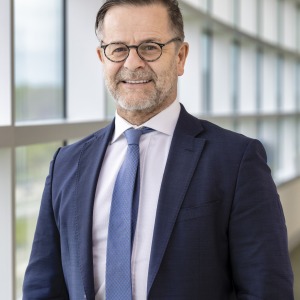
Dr. Gustavo Leone
“How we bring that data together, and the understanding that comes out of that research then can impact patients,” Leone said. “This (donation) has the best timing, because it will accelerate everything we’re doing. What would have taken 20 years will take us 10 to 12 years. When you’re talking about years, it matters to people. It matters to patients.”
The focus on accelerating research is personal for the Michels family. Their daughter, Sophie, was diagnosed with choroid plexus carcinoma, a rare pediatric brain cancer, in 2012.
Michels said that experience led him and his wife to learn as much as they could about cancer and remain engaged with the research their philanthropy supports.
“That’s why I think this is a very powerful relationship, that not just writing a check and walking away, but also be emotionally invested,” Michels said.
Elizabeth Morin is a writer based in Virginia Beach. She is passionate about local sports, politics and everything in between.
Have any Virginia Beach-related news published on our website? Email us at admin at thevirginiabeachobserver.com.