Even as he wraps up a 16-year stint heading up one of the Midwest’s top academic medical centers, Dr. John Raymond Sr. mostly prefers to keep his sights set on what’s ahead for the Medical College of Wisconsin, rather than looking back on his accomplishments.
Raymond will step down as MCW’s president and CEO on June 30, moving into a faculty role as he helps guide the leadership transition to his recently named successor, Dr. Shekar Kurpad, a professor of neurosurgery and senior associate dean for neuroscience at MCW.
During his tenure, Raymond led key initiatives that strengthened MCW’s community impact, from expanding access and regional reach to investing in partnerships and facilities aimed at improving health outcomes. Those initiatives include ThriveOn King, a public health collaboration and major community development that opened in 2024 on Milwaukee’s north side; the launch of MCW’s School of Pharmacy in 2017; regional campuses that opened in Wausau in 2016 and Green Bay in 2015; and the development of the Milwaukee Regional Medical Center’s new, soon-to-open forensic science facility in partnership with local and state government.
BizTimes Milwaukee associate editor Maredithe Meyer recently spoke with Raymond about his next chapter, cost pressures and workforce shortages in health care, and MCW’s approach to impact.
BizTimes: What are your priorities in the final months as president and CEO?
Raymond: “First and foremost, to ensure a successful transition and to create the best possible opportunity for Dr. Kurpad to leave his own mark on the institution. I’m already meeting, several times a week with him to first of all, ensure that he knows what’s in flight, just in terms of open issues, but second of all, to ensure that any decisions that we make in the next couple of months resonate with him and are consistent with his vision for the future. We are really focused on introducing Dr. Kurpad to our key partners, donors, elected officials and ensuring that they know what a high-quality leader we’re going to have here. So, the transition is going to be successful, I have no doubt.
“Periodic refreshment of perspective and ideas and skill sets is healthy for an organization. I want to make sure that the entire community understands: this is great, this is going to be wonderful for MCW, and is going to be, I think, an enhancement of all the opportunities that we have. …
“… (Shekar Kurpad) is an incredible leader, he’s a fantastic clinician, he’s a wonderful example of service leadership, and I think everyone in the community should feel great that he was chosen as our next leader.”
If you were to look back on the transition a few months from now and consider it a successful one, what would it look like in hindsight?
“What I’d love to hear is that people switch immediately to talking about Dr. Kurpad’s future vision for MCW, which I know he’ll put together in partnership with our health systems and our education partners, but most importantly, our faculty, staff and learners; that we didn’t drop any balls with the handoff, which I’m sure we won’t; and that our future continues to be very bright.”
What will your day-to-day work look like as a faculty member, and what draws you back to faculty work at this stage of your career?
“Well, first of all, I do have the privilege of being a tenured faculty member, and I will have the opportunity over the next year to really choose where I can dedicate my time and effort and the experience that I have to share in ways that are wanted and matter to the institution. But I have been so heavily invested in leading MCW for so long, I really haven’t reflected on exactly what that will look like. I love to teach, but it’s hard to go back and be a classroom teacher. I think that most of my efforts would be in the clinical teaching environment. I do plan to spend more time taking care of patients at the Zablocki VA Medical Center. I’ve been a VA physician for 44 years. I really care deeply about the sacrifices and dedication of our veterans, and I want to continue to give back in that way as a volunteer. I can’t really go back to doing hardcore basic science. I closed my lab in 2014 so that I could be fully invested in being the best president I could be. But I certainly can continue to help early-career faculty choose their projects wisely, help with career advice and whatnot.
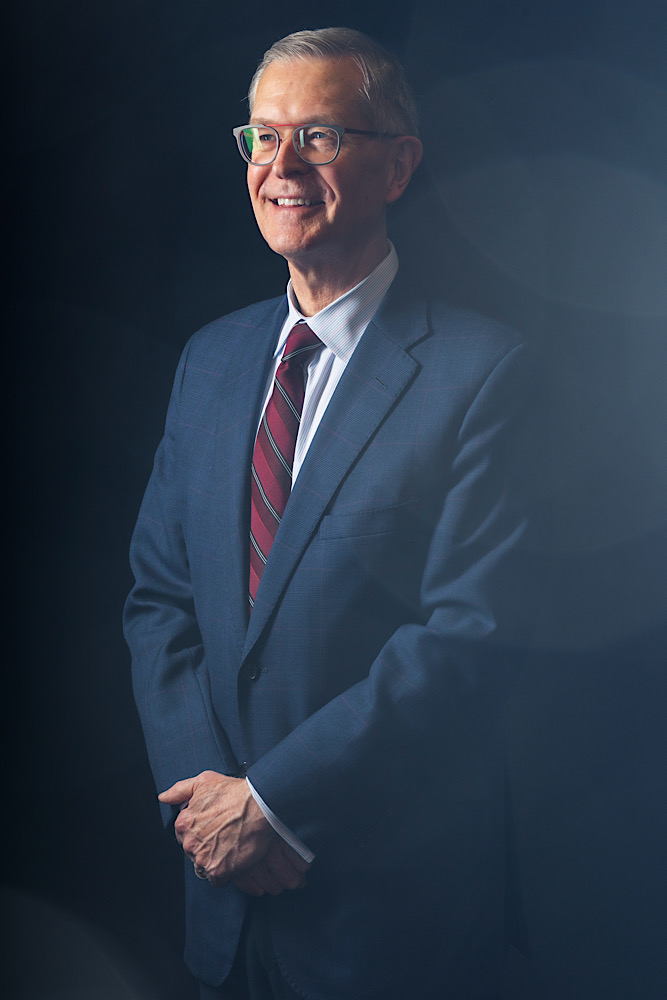
Credit: Kenny Yoo Dr. John Raymond Sr.
“And then finally, I deeply care about our communities. And I care about people of color, I care about the minority communities that we have here in and around Milwaukee, and I care about the communities in the rural Northwoods. I’m hoping that we can continue to engage with them in ways that are respectful and humble and that address their needs. So, for example, in the Northwoods, there are many counties that don’t have OBGYN or mental health providers, and finding ways to project the talent we have here at MCW into those areas would be very rewarding. I would say the same thing for trauma care in the Northwoods. There are many instances of farming-related accidents where there are delays in care. And then here in Milwaukee, we have populations that formerly were middle class and, again, predominantly people of color, that for many, many different reasons are not fully participating in the vitality of our economy. That’s a lost opportunity for Milwaukee to be competitive on the world stage, and for the people that have made Milwaukee home to have living wage jobs and to have future aspirations, hopes and dreams that all of us can share and so I want to continue to work through ThriveOn King and other similar initiatives to make sure that MCW stays grounded in the people that need us the most.”
Tell me more about your work as a VA physician.
“I’m a nephrologist, a kidney doctor. When I do the work, it’s mainly doing consults for people that have some degree of kidney failure, whether that’s early stages in clinical settings or in the emergency room or intensive care units. And also, the VA has a very busy chronic dialysis unit, a strong transplant program, a hypertension program, so those would be the types of things that I have done and am looking forward to doing. Again, what the beauty of that is we get to give back to the people that have given so much to our country. It’s a wonderful place for me to interact with fellow faculty members and our learners.”
Rising health care costs continue to affect patients across Wisconsin. Where do you see academic medical centers like MCW fitting into solutions?
“Yes, I think we have the opportunity to continue to be thought leaders in the area, and obviously, we want the highest quality of health care, but we also don’t want it to be cripplingly expensive. And I think the ultimate solution really has to do with our country focusing more on prevention and wellness, on the social determinants of health, than we previously have. I mean, right now, the payment system, in many ways, is upside down. All of us as providers get rewarded for doing more things to sick people in the end stages of their disease than we do for preventing those diseases from occurring. So, I think the payment model needs to change.
“Academic medical centers provide the best quality of care, especially to the most complex individuals, and we’ve done a really wonderful job of improving access over the last 20 years. But what’s missing is a true investment in prevention wellness and what I call the social determinants of health, or the determinants of health that ultimately are more important than the quality of health care we can give. It’s safe and stable homes. It’s high-quality education. It’s access to nutritious food. It’s living-wage jobs. It’s having the family unit have a sense of hope for the future and the prospects of advancing wealth from one generation to another. Ultimately, those factors contribute more to the overall quality of an individual life and to the prospects of healthy populations than anything else that we can do and there’s been a growing awareness over the last decade that medical schools and academic health centers actually don’t really know how well to uplift populations in that regard, and that’s why I’m so bullish on the collaboration that we have at ThriveOn with the Greater Milwaukee Foundation, they committed to having an equitable Milwaukee for all, which means the people that need us the most. They have considerable expertise in how to economically empower disenfranchised populations, and the overlap area for us is in that area of social determinants of health. It’ll be a very bright future if we can continue to create those types of catalytic partnerships.”
Anything to share on the impact of the ThriveOn project so far?
The ThriveOn King project at 2153 N. Doctor M.L.K. Jr. Drive in Milwaukee.
“There’s a huge sense of pride that the old Gimbels and Schuster’s store, an iconic part of downtown Milwaukee, has been revitalized. We’re celebrating the history of Bronzeville and predominantly African American leaders in a way that is respectful and humble and uplifting. People want to have their events at ThriveOn. And I would also say that the initial partnership was four ways: Royal Capital Group, the Greater Milwaukee Foundation, MCW, and the three neighborhoods that are at the intersection of ThriveOn King, Harambee, Halyard Park and Brewer’s Hill. But we have been able to inspire other people, especially not-for-profits to co-locate there and to invest in the community. The Dohmen Company Foundation healthy food initiative and their (production) facility are a block away. You have the Dr. Howard Fuller Collegiate Academy, a high-quality charter school, predominantly serving African Americans, that is bringing hope to the area. Malaika Early Learning Center, JobWorks MKE, the Versiti on King blood donation center, which also connects African Americans to job opportunities in health care and raises the awareness of the need for both blood and organ donation in the African American community. That’s just some examples. We are hoping to provide, at least initially on a limited basis, some clinical care in and around the ThriveOn facility.
“When we started this initiative, we listened. We listened to the community after the Sherman Park civil unrest for several years to hear what it is that they wanted from MCW, and the main things that they wanted that we could actually help to provide were living wage job opportunities – and that’s where JobWorks MKE and Versiti come in. They wanted high-quality early childhood education for their kids. They wanted MCW to plant a flag in the ground, in a highly visible way, in central city Milwaukee and to make a generational commitment. We signed a 22-and-a-half-year lease with Royal Capital, so what that means is MCW is going to be there through the ups and downs of the economy and the changes in leadership. They wanted healthy food options. We have the Kinship Cafe, which is a really beautiful story that actually helps provide entry-level jobs into the food service industry and provides high-quality food. And that’s actually changed MCW’s medical school curriculum. We now actually have classes in healthy food and healthy cooking available to our students and to the community as an example. So I think if you roll all those things up, I think you can say, wow, initially, there are so many things to be hopeful for, and so many early successes. Our job now is to continue to catalyze those partnerships in a respectful way.”
Wisconsin, like much of the country, faces ongoing health care workforce shortages. MCW has worked to address this issue by expanding training pathways over the years. Where do those efforts stand now and what’s the next phase of building that pipeline?
“We have done a very good job of addressing the physician shortage, both in terms of primary care and specialty care, through our regional campuses, through creating two psychiatry residencies in the Northwoods, through partnering with a number of health systems to expand family medicine residencies. I would hope that we would continue that investment in both underserved rural and urban settings, but again, that’ll be up to the next president.
“We also have started to expand into other health care offerings. Health care is really team oriented. The physician, in most cases, may lead the team, but we have a huge shortages of nurses, advanced practice providers – like advanced practice nurse practitioners and physician assistants – respiratory therapists, even people that provide support services within the hospital, like food service and people that clean and sterilize rooms and equipment. And I think if MCW can broaden our reach and our impact through program expansion, especially in coordination with our key health system partners, that will be filling a really important gap and the needs of our state and in our country. From my perspective, we’ve only just begun that journey, and I hope that our institution will continue to be bold and innovative and to lean into those opportunities to provide a broader swath of health care jobs.”
What are the biggest opportunities for MCW over the next few years or decade?
“We have a chance to better align our four missions. Our research enterprise has largely operated somewhat in isolation from the needs of our health system partners and from the opportunities to do rapid translation of ideas into products and treatments and cures. So there’s an opportunity to better harmonize. And you may not know this, but MCW has one of the 80 largest research enterprises in our country. We rank number 79 out of 20,000 research institutions in the U.S. Our research enterprise is on par with some of the members of the AAU, and it’s the largest in the state other than UW. And so that’s something that we can, I think, do a better job of aligning with the clinical and educational opportunities that we have here. Second of all, continuing to harmonize the great partnerships that we have with our four major partners here primarily in Milwaukee, Froedtert ThedaCare, Children’s Wisconsin, the Versiti Blood Research Institute, and the Zablocki VA Medical Center, but also use our education mission and research opportunities to foster new partnerships in other parts of the state. As MCW grows into its name as the Medical College of Wisconsin, we need those new partnerships, and that is not to say that those would be in competition with our primary partnerships here. What we found through our regional campuses and the graduate medical education programs we’ve started in the Northwoods is every new partnership that we have enhances our ability to provide high-quality care to patients, and to provide a world-class education to our learners. And so, I hope that we can continue to look for new opportunities as well.”
What would you say you are most proud of from your time leading MCW?
“I’ll just take a step back from the specific achievements that our institution has been able to accomplish, and say that I’m just so grateful and so impressed that MCW has 2,000 faculty that are committed to our community, they’re not afraid to be innovative and that they approach their jobs with a service mindset. Maybe sometimes our humility gets in the way of broader recognition that we all really have earned, but again, I think serving with people that just want to have an impact has been really wonderful for me to see that you can approach a competitive field like health care or education with that service mindset, and still be able to grow in amazing ways, which MCW has and to see this culture of partnership evolve over the years, those would be the things that I would say I can be vicariously proud of because, obviously, that wasn’t all on me, it was on the great people that we recruited here. In terms of specific accomplishments, I think leaning into our community engagement mission in meaningful ways – that would be the regional campuses, the residency programs that we’ve started, the ThriveOn initiative. That’s the big package; we’re building partnerships that will have an impact for generations to come on our community.”
Credit: Medical College of Wisconsin The Medical College of Wisconsin, located at the Milwaukee Regional Medical Center in Wauwatosa.
Elizabeth Morin is a writer based in Virginia Beach. She is passionate about local sports, politics and everything in between.
Have any Virginia Beach-related news published on our website? Email us at admin at thevirginiabeachobserver.com.