[ad_1]
Removing a portion of I-794 between downtown Milwaukee and the Historic Third Ward could help generate up to $490 million in new development by 2050, but would cost significantly more than repairing the existing freeway structure and would result in increased traffic and accidents, according to a new study published by the Wisconsin Department of Transportation.
The findings are part of an ongoing review of whether to repair the freeway as is, improve it with a modified design or remove it entirely. Two options are being considered for modification.
Supporters of removing the freeway say it creates a barrier between downtown and the Third Ward and replacing it with a surface street would open up land that could be developed.
But the removal option has a caveat. According to the WisDOT study removal of the freeway would likely result in an increase in traffic crashes. That option also costs significantly more than repairing the existing structure, known as the replace in kind option.
The selected alternative for I-794 will be announced in early 2027, said David Pittman, WisDOT’s project Manager. For now, Pittman said, “all options are still on the table” and that community feedback and involvement is important to deciding what’s next.
Here’s what you need to know about each option for I-794 and its potential impact, according to the WisDOT study:
Replace in kind option
Cost: $425 million to $575 million
Development potential: $150 million to $210 million

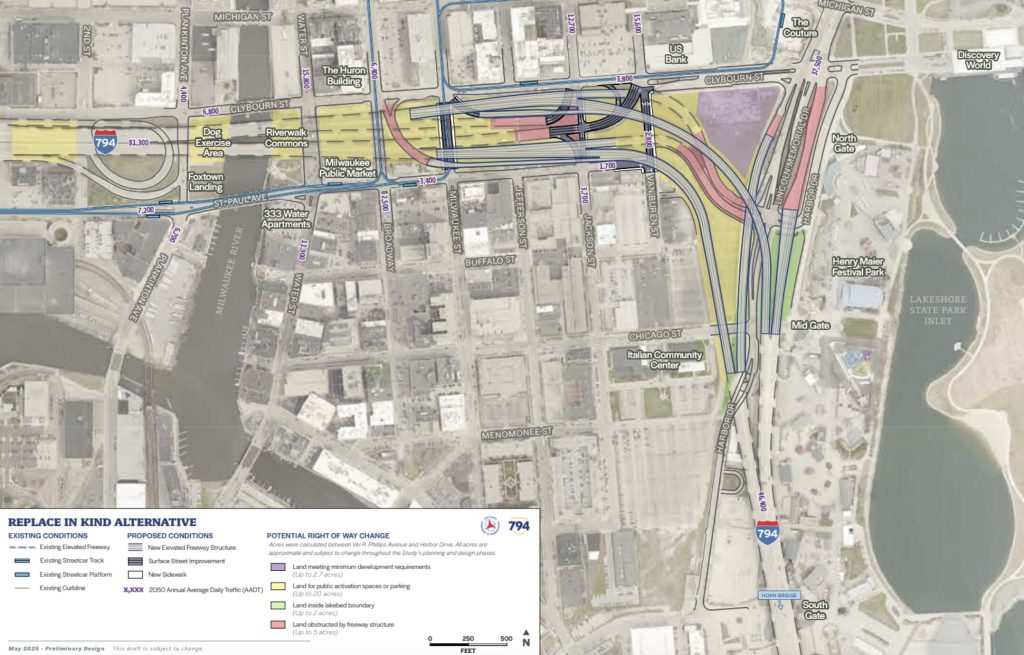
The replace in kind option would rebuild the 28 deficient bridges along the freeway corridor in roughly the same alignment as the existing elevated freeway, preserving all current access points. While some outdated design elements, such as shoulder widths, stopping-sight distances and superelevation, would be partially modernized, the overall facility would remain largely unchanged.
Improvements to surface streets, bicycle facilities and pedestrian accommodation would also be minimal.
If selected, the project is estimated to cost $425 million to $575 million and would take two to four years to complete.
The nearby real estate development potential of this option is estimated at between $150 million to $210 million. That specifically relates to the possible development of the vacant 2.7-acre site southwest of Clybourn Street and Lincoln Memorial Drive. That site was opened up for development when the I-794 Lake Interchange was rebuilt and reconfigured in 2017. The WisDOT study says the site could support high-density development valued between $150 million and $210 million by 2050. The site could accommodate 500 residential units or 250 hotel rooms, and 425,000 square feet of office space, totaling roughly 550,000 square feet of new development after an estimated five to eight years of market exposure.
Traffic patterns for the replace in kind option would see minimal change, the study said.
Freeway removal option
Cost: $850 million to $1.25 billion
Development potential: $270 million to $490 million

The freeway removal option would replace the elevated structure of I-794 between downtown and the Third Ward with a traditional street grid, improving surface-street connectivity and creating a more complete street environment for pedestrians and cyclists.
The WisDOT study notes that the removal of the freeway would open up 16 acres of developable land located on nine blocks east of the Milwaukee River and one block west of the river for development, plus six acres of activatable space.
The development potential for the land is estimated at $270 million to $490 million by 2050, according to the study. The land could support development of 470 to 850 residential units, 330 to 600 hotel rooms and 300,000 to 500,000 square feet of office or commercial space. By 2050, the study notes that only 60% of the development would be complete and full build-out would require an additional 10 years.
If selected, the project is estimated to cost $850 million to $1.25 billion and would take four to six years to complete.
The study shows this alternative would lead to an overall increase in vehicular crashes, particularly along the I-43 and I-94 corridors and downtown.
Travel times would also be affected by the freeway removal, with morning rush-hour commutes to downtown from north and south likely to double. Afternoon rush-hour commutes would become less reliable, especially in summer when the Clybourn Street movable bridge opens for boat traffic, the study says.
Freeway improvement options
Cost: $675 million to $1 billion
Development potential: $280 million
The two freeway improvement options would reconstruct the elevated freeway without adding capacity, while bringing the corridor up to modern design standards. This option includes improved safety features, consolidated access ramps, better surface-street connectivity and new complete-street accommodation for people walking and biking.
It would create five blocks of developable land, plus nearly 12 acres of activatable space. The development potential is valued up to $280 million, by 2050, for up to 1 million square feet of development which could include 490 residential units, 340 hotel rooms, 315,000 square feet of office space, according to the study.
Both the freeway improvement and freeway removal options are projected to increase crashes in the downtown area because they introduce additional intersections and surface streets. However, the freeway removal option would have a higher increase due to greater traffic volumes shifting onto downtown roads, the study says.
According to the WisDOT study, improved connections between East Town and the Historic Third Ward would strengthen the market outlook for nearby sites. Still, because I-794 would remain a physical barrier, redevelopment opportunities would function more as an extension of East Town rather than a fully unified district.
If selected, the project has estimated costs of $725 million to $1 billion if right-hand ramps are prioritized or $675 million to $900 million if left-hand ramps are prioritized.
It would take two to four years to complete.
[ad_2]